“World domination” by a coordinated cabal is not supported; the realistic danger needs no cabal. Ambient, profit-driven mass surveillance, plus a handful of opaque choke-point firms...
with discretionary control over visibility, plus governments that covet both, is already enough to threaten civil liberties — without any directed conspiracy to protect donors or venture capitalists.

Summary: The data-aggregation half of the hypothesis is largely true but commercially driven, fragmented and rivalrous — not a coordinated plot.
The "stop or rewrite adverse transmissions in flight" half is mostly foreclosed by near-universal encryption, with the real fight now at the endpoint (on-device scanning) and pushed mainly by governments, not a unified industry.
Civil rights are materially threatened by what's already documented — surveillance, profiling, opaque suppression — so regulators should act on those proven harms without tethering them to the weaker total-control narrative.
Total Visibility, Total Control?
Evaluating the hypothesis that “Big Tech” is moving to see all data and to stop, filter or alter any transmission that runs counter to its interests
Scope: data aggregation · privacy defaults · content control and shadow banning · real-time manipulation · civil-rights risk · regulatory options
Prepared: June 2026, by Claude
How this report treats the question
The request bundles two very different kinds of claim. One layer is concrete and well documented: surveillance-driven business models, privacy-hostile defaults, the data-broker trade, content moderation and shadow banning, and the technical machinery for inspecting and altering network traffic. The other layer is an interpretive master-narrative: a single, coordinated “Big Tech” pursuing “world domination” by reading and rewriting everyone’s communications to protect a wealthy class.
To be useful rather than merely agreeable, this report keeps four things apart that the strong version of the hypothesis collapses together: capability (what is technically possible), practice (what is actually being done), intent (what actors are trying to achieve), and coordination (whether they act as one). Treating a proven capability as proof of a coordinated plan is exactly the move that turns legitimate alarm into an unfalsifiable conspiracy theory — and it also makes the real dangers harder to see and to fight.
The short version: the data-aggregation drive is real, vast and structurally incentivised; the capacity for opaque — even undetectable — control over what people see is real and under-appreciated; the fear of mass, real-time rewriting of messages and articles “on the fly” is largely blocked today by near-universal encryption; and the single move that would unlock the dystopian scenarios — scanning or altering content on the device before it is encrypted — is precisely what is being fought over right now, with governments, not a unified industry, doing most of the pushing.
This is an analytical research report, not legal advice. Sources, with URLs, are listed at the end.
Executive summary
Assessed against the available evidence, the hypothesis is partly accurate and partly mis-architected. The accurate part is serious; the mis-architected part matters because it points defenders at the wrong threat. The main findings:
· The drive to aggregate data is real and structural. An advertising- and prediction-driven economy creates a standing incentive to collect more data and remove privacy frictions. Concrete, documented practices follow from it: privacy-hostile defaults and “dark patterns” (a 2024 FTC/ICPEN sweep found roughly three-quarters of sites and apps used at least one), a sprawling data-broker market trading precise location and sensitive traits, and ad-auction “bid-stream” leakage. The cleanest single example of a privacy product that quietly did the opposite: Avast, fined US$16.5m for selling users’ browsing data after promising to block tracking.
· But it is profit-driven and fragmented, not a unified plan. The aggregation is assembled by a competitive, rivalrous, semi-criminal market and by firms that frequently fight each other and the state. Some of “them” are moving the other way (Apple’s end-to-end-encrypted iCloud option; browser privacy features). “Big Tech” is not one mind.
· Platform-level control of what we see is the most substantiated concern. Ranking, recommendation, demotion of “borderline” content, shadow banning and deplatforming already determine what billions encounter. A peer-reviewed study shows shadow banning can be tuned to shift collective opinion toward a target while appearing neutral to outside observers — a demonstrated capability for undetectable opinion-shaping.
· Network-level real-time manipulation is technically real but largely foreclosed. ISPs have injected code (Comcast) and tracking (Verizon), and state systems have rewritten traffic in flight (China’s Great Cannon; the NSA’s QUANTUM). All of these work only on unencrypted traffic — and roughly 97% of web pages and 99%+ of Chrome browsing time are now encrypted. Mass on-the-fly rewriting of your encrypted email or articles is not currently feasible without compromising the endpoints or breaking encryption.
· Message scanning is the live battleground — and governments are the main pushers. Unencrypted mail and chat are already scanned; the fight over the EU’s “Chat Control” is whether to mandate scanning of even end-to-end-encrypted messages via on-device (“client-side”) scanning. Apple proposed device scanning in 2021, abandoned it under privacy backlash in 2022, and in 2026 is being sued for not scanning. The decisive lesson: the dangerous capability is the on-device scanner/backdoor, and the force demanding it is mostly the state, with a split industry.
· “World domination” by a coordinated cabal is not supported; the realistic danger needs no cabal. Ambient, profit-driven mass surveillance, plus a handful of opaque choke-point firms with discretionary control over visibility, plus governments that covet both, is already enough to threaten civil liberties — without any directed conspiracy to protect donors or venture capitalists.
· Civil rights are genuinely affected today, and could be far more so. Privacy, free expression, assembly, due process, non-discrimination and the secrecy of correspondence are all implicated by documented practices — and the mere awareness of being watched and curated produces chilling effects independent of any manipulation.
· Regulators are not powerless, but the deepest obstacle is that they are conflicted. Real tools exist and are being used (DMA fines on Apple and Meta in 2025; a €2.9bn Google ad-tech antitrust penalty; first-ever bans on selling sensitive location data). The hardest problem is that governments want the same surveillance powers they should be constraining. The commercial machine is tameable; the worst-case control scenarios are held off mainly by protecting encryption and device integrity — a defence that is currently winning more than losing, but is reversible.
1. Introduction: how to read the hypothesis
The proposition under examination is that, to achieve a goal of world domination, “Big Tech” is doing two things on a short timeline. First, weakening or disabling privacy protections across software, hardware and networks so that user data lies in the open for aggregation, indexing and AI-driven analysis. Second, building the means to identify, stop, shadow-ban, filter, manipulate or amend any data transmission that runs counter to its interests — or those of wealthy entities such as venture capitalists, donors and chief executives. The request asks how far this might go, especially toward real-time manipulation; for a catalogue of the practical and theoretical options; for an assessment of the threat to civil rights; and for what regulators could do, if anything.
That is a serious set of questions, and the worst way to answer them is to wave them away. Many of the underlying mechanisms are real, documented and consequential. The second-worst way, though, is to accept the framing wholesale, because the framing makes a specific structural claim — a single coordinated actor with a unified goal — that the evidence does not support, and that, by misdescribing the threat, makes it harder to counter.
1.1 The four-level test used throughout
Each claim in this report is sorted along four levels that the strong hypothesis tends to merge:
1. Capability — is it technically possible at all? (Often yes.)
2. Practice — is it actually being done, by whom, and at what scale? (Sometimes, partly.)
3. Intent — what are the actors trying to achieve? (Usually profit, engagement and market power; sometimes an owner’s political preference; for states, surveillance.)
4. Coordination — do they act as one? (Parallel incentives and heavy lobbying, yes; a directed cartel orchestrating censorship for a donor class, no evidence.)
A proven capability is not proof of practice; practice is not proof of a shared intent; and shared incentives are not proof of coordination. The strong hypothesis mostly fails at the intent and coordination levels, not the capability level — which is why it is both frightening and wrong in a particular, important way.
1.2 “Big Tech” is not a single actor
The phrase flattens at least three very different kinds of company with conflicting interests. Advertising-and-data platforms (Alphabet, Meta) profit directly from behavioural data; a device-and-services company (Apple) increasingly markets privacy as a differentiator and has shipped more encryption, not less; and network operators (ISPs, mobile carriers) sit on the wire and have their own incentives to inspect and monetise traffic. These groups routinely fight one another — over app-store rules, default search, tracking, and the very question of encryption — and they fight governments too. Any model that treats them as one mind with one plan has already gone wrong. The remainder of this report therefore speaks of incentives and choke-points, not of a hive.
2. Prong one — seeing everything: weakening privacy to aggregate data
2.1 The engine: surveillance-driven accumulation
The intellectual backbone of this prong is Shoshana Zuboff’s account of “surveillance capitalism”: a market logic in which human experience is claimed as free raw material, converted into behavioural data, and used to predict and ultimately to nudge behaviour. Zuboff describes a distributed apparatus she calls “Big Other” and argues that, as competition for predictive certainty intensifies, firms move from merely observing behaviour to intervening in it to shape outcomes that suit them. Crucially for the hypothesis, she frames this as profit-driven accumulation — “what happened when democracy stood down” — rather than a political project of conquest, even as she warns it corrodes democracy. The kernel of truth the hypothesis correctly identifies is this: the business model itself generates a standing, structural appetite for more data and fewer privacy frictions.
2.2 The most literal version of the claim: defaults and dark patterns
If “disabling privacy protections” has a literal everyday form, it is the engineering of defaults and interfaces so that the data-exposing choice is easy and the protective one is buried. Regulators now treat this as a category of harm. A 2024 review by the FTC and international consumer networks found that nearly 76% of examined sites and apps used at least one “dark pattern,” and about 67% used several (FTC/ICPEN). The EU’s Digital Services Act prohibits designing interfaces that deceive or manipulate; California’s privacy regulator issued a 2024 advisory against dark patterns; and several U.S. state laws now declare that “consent” obtained through dark patterns is not consent at all.
The single strongest data point for the specific claim that companies disable privacy protection in order to harvest data is Avast. The security firm told users its products would block online tracking, then, through a subsidiary, sold their granular, re-identifiable browsing histories. In 2024 the FTC ordered it to stop and to pay US$16.5m. A tool sold as a privacy shield was, in fact, a collection funnel — the hypothesis’s thesis in miniature. It is also, notably, an enforcement success rather than an unstoppable trend.
2.3 The aggregation layer: data brokers and ad-auction leakage
Above the individual app sits a market whose entire purpose is aggregation. Data brokers compile finances, app usage and location into profiles and sell them. Across 2024 the FTC brought an unusual run of enforcement actions: bans on selling precise location data (X-Mode/Outlogic and InMarket), and actions against Gravy Analytics/Venntel and Mobilewalla — with Gravy claiming to curate more than 17 billion location signals a day from around a billion devices. The harms were concrete: geofencing used to build lists of people who visited reproductive-health clinics or places of worship, to profile attendees of protests after George Floyd’s death by race, and to track union organisers.
A particularly important mechanism is real-time bidding (RTB). When an ad slot is auctioned, the “bid request” can broadcast a user’s precise location and characteristics to many bidders — and the FTC alleged Mobilewalla retained this data even from auctions it lost, contrary to exchange rules. The FTC’s then-chair warned that the ease with which RTB can be exploited to surveil people “should raise serious alarm.” This is the closest thing to a structural pipe through which fine-grained data about almost everyone leaks continuously. But note its shape: it is a chaotic, competitive marketplace with few technical controls, not a single directed surveillance system.
2.4 The device, operating-system and network layers
The appetite reaches down into devices and the wire. Operating systems ship telemetry that streams usage data by default; mobile platforms assign persistent advertising identifiers that let disparate location points be stitched into one person’s movements; commercial Bluetooth and Wi-Fi networks enable physical tracking; and at least one carrier (AT&T) ran a “pay-for-privacy” scheme. Digital-rights groups have long noted that, with modern processing, it has become cheap for network operators to inspect and modify essentially every byte that crosses their routers — the “middlebox” industry (EFF). That last point matters for prong two as well: the infrastructure that could, in principle, alter traffic already exists for commercial reasons.
2.5 The AI accelerant
Artificial intelligence sharpens both the value of data and the appetite for it. Training large models creates pressure to ingest user content, surfacing recent controversies over default opt-ins for AI training and over scanning for “unknown” (not previously catalogued) material rather than only known items. AI also makes aggregated data far more usable: indexing, linking and inference across enormous, messy datasets is exactly what these systems are good at. This is the newest force expanding the data-hunger the hypothesis describes — and the most plausible reason the timeline feels “short.”
2.6 Verdict on prong one
Substantially supported, with one structural correction. The aggregation is real, vast and incentivised, and many specific privacy-eroding practices are documented and ongoing. But the driver is commercial accumulation, not political conquest; the “they” is a plural, rivalrous market plus individual firms rather than a single brain; and there is a genuine countervailing trend — privacy-by-design features, more encryption, and active regulation — pushing the other way. “They are disabling privacy to aggregate everything” is therefore about half right: the aggregation is undeniable; the agency behind it is fragmented, competitive, and in part self-correcting.
3. Prong two — controlling the flow: identify, stop, shadow-ban, filter, alter
This prong has the most genuinely alarming evidence and the most over-stated fears, sitting side by side. The decisive question is which layer of the stack a given form of control lives at, because the layers differ enormously in feasibility.
3.1 The platform layer: where control actually lives
The most powerful, least exotic control is the everyday operation of the platforms themselves. Ranking and recommendation systems decide what billions of people see; “integrity” signals demote content judged borderline; and a family of quieter measures — ghost bans, search and suggestion bans, down-tiering — reduce a user’s reach without telling them. Researchers note that the existence of such visibility reduction is no longer seriously in dispute: Reddit openly confirms shadow bans, Meta announced borderline-content reduction as early as 2018, and surveys find sizeable minorities reporting suppression. Affected users are frequently met with what scholars call “black box gaslighting” — official denials that contradict their experience.
The most important single finding for this prong is a peer-reviewed result (published in PLOS One, with related work from Yale): shadow banning can be optimised to move a network’s collective opinion toward a chosen target distribution, and — critically — the resulting policy can look neutral from the outside, because one can shift sentiment by turning down the volume on both sides unevenly. In other words, undetectable opinion-shaping through visibility control is a demonstrated capability, not merely a fear. The honest caveat: this was shown in simulation on real network structures; it establishes what is possible, not that mainstream platforms are covertly doing it to a political end.
3.2 Favouring powerful interests
The hypothesis’s claim that the system protects the interests of CEOs, donors and investors has documented analogues — but as individual, self-interested behaviour, not a coordinated programme. The clearest is Meta’s internal “cross-check” (XCheck) system, which shielded high-profile accounts from the rules applied to ordinary users. The second is owner-driven steering: a proprietor can tilt a platform toward personal interests — for example, throttling links to rival services. These cases show that platforms can and sometimes do bend the playing field toward favoured parties. They do not show a cross-industry cartel suppressing speech to defend a wealthy class; they show concentrated, discretionary power being used the way concentrated power usually is.
3.3 The network layer: stopping and altering traffic in flight
Can transmissions be stopped or rewritten while in transit? Technically, yes — and it has been done. Commercially, ISPs have injected their own JavaScript into pages (Comcast, for data-cap and upgrade notices and, on its hotspots, ads) and inserted persistent tracking headers (Verizon’s “supercookies”); academic work has catalogued network operators performing this kind of content injection. At state scale, China’s Great Firewall kills connections by injecting forged TCP “reset” packets when it sees a banned request, and the separate Great Cannon acts as an in-path machine-in-the-middle that can arbitrarily replace unencrypted content — it was used to hijack ordinary users’ traffic and weaponise them into a denial-of-service attack on GitHub and the anti-censorship site GreatFire. Researchers note its design is comparable to the NSA’s QUANTUM “man-on-the-side” injection system. So the capability to identify, stop and alter a transmission in flight is unambiguously real.
The decisive limit: every one of these techniques works only on unencrypted traffic. The Great Cannon, Comcast’s injector and Verizon’s headers all fail against HTTPS. That single fact reshapes the whole “real-time manipulation” question, as the next sections show.
3.4 The message layer: scanning mail and chats
Email and chat that are not end-to-end encrypted can be — and are — scanned on the provider’s servers. Under a temporary EU exception (nicknamed “Chat Control 1.0”), unencrypted U.S. services such as Gmail, Facebook/Instagram Messenger, Skype, Snapchat, iCloud Mail and Xbox have voluntarily scanned messages for known child-abuse imagery. The fierce, multi-year fight has been over “Chat Control 2.0”: whether to make scanning mandatory and to extend it to end-to-end-encrypted messages via “client-side scanning” — checking content on the device before it is encrypted. After repeated deadlock, the most coercive element (forced scanning of encrypted messages) was dropped from the Council’s late-2025 position; the European Parliament rejected extending the interim regime, which lapsed in April 2026; yet major U.S. firms announced they would keep scanning their unencrypted services regardless. Independent reporting has documented lobbying for scanning technology by interested parties (notably the nonprofit Thorn), and the European Commission’s own implementation report conceded no proven link between message scanning and convictions or children rescued, with a large majority of flags not actionable.
The Apple episode is the most clarifying case in the entire debate. In 2021 Apple proposed on-device scanning (“NeuralHash”) to detect known abuse imagery before upload; after an intense backlash from security researchers and rights groups it abandoned the plan in 2022 and instead expanded encryption (end-to-end-encrypted iCloud backups). In 2026 a U.S. state sued Apple for not scanning — and privacy advocates lined up to defend it. The security community’s core argument is the one that matters most for this report’s central worry: you cannot build a client-side scanner that only ever scans for one category. Once the pipe exists, it can be repointed — by the company, by a government order, or by an attacker — at political speech or anything else. The dangerous capability is the on-device scanner; the actor pushing hardest to install it is the state.
3.5 The hard limit: near-universal encryption
The reason mass, real-time rewriting of communications is not happening at the network layer is that the network can no longer read most of what it carries. By 2025–26, roughly 97% of web pages load over HTTPS, more than 99% of Chrome browsing time is spent on encrypted pages, and Android HTTPS use has passed 99%; TLS 1.3 is the dominant protocol, “Encrypted Client Hello” now hides even the destination hostname from network observers, and Chrome is moving to an HTTPS-first default in late 2026. End-to-end-encrypted messaging (WhatsApp, Signal, iMessage) is mainstream, and Apple offers end-to-end-encrypted iCloud. The net effect is that an in-flight observer typically sees that you contacted a service and how much data flowed — metadata — but not the content, and cannot silently edit it. The attack surface for content manipulation has migrated away from the wire and toward two places: the endpoints (your device and the platform’s servers) and legal compulsion (mandated access or weakened encryption). That migration is the single most important technical fact in this analysis.
3.6 Verdict on prong two
· Platform-level control: real, powerful, partly documented, and — uniquely — shown capable of undetectable opinion-shaping. This is the most substantiated part of the entire hypothesis and the most under-appreciated.
· Network-level real-time manipulation: technically real, but increasingly foreclosed by encryption. Mass covert rewriting of encrypted messages and articles is not currently feasible without compromising endpoints or breaking encryption.
· Message scanning: real and ongoing for unencrypted services; the encrypted frontier is contested and, so far, mostly resisted — and the pressure comes chiefly from governments, with the industry split.
4. How far will they go? An assessment
4.1 Capability is high; intent and coordination are where the strong hypothesis fails
Run the question through the four-level test. Capability is high and rising across every layer. Practice is real but uneven — extensive at the data and platform layers, constrained at the network layer, contested at the endpoint. Intent, however, is mostly mundane: firms intend to maximise engagement, ad yield and market power; some owners intend, at times, to tilt discourse toward their preferences; states intend to surveil and to control. A unified intent to “dominate the world” by reading and rewriting everyone’s correspondence is not in evidence. And coordination — the load-bearing assumption of the master-narrative — is the weakest link: there is parallelism of incentive, ad-tech collusion of the ordinary antitrust kind, and intense lobbying, but no evidence of a directed cross-industry cartel orchestrating censorship to protect venture capitalists or donors.
4.2 A more accurate model: a surveillance oligopoly in uneasy symbiosis with the state
The picture the evidence supports is not a single conquering intelligence but a concentrated, dangerous, and fragmented system: a handful of firms with oligopolistic control over key information chokepoints, sitting in an uneasy and shifting relationship with governments that want the same powers. The danger does not require a conspiracy. Three ingredients suffice: ambient, profit-driven mass surveillance becoming normal; a small number of opaque chokepoint firms holding discretionary, unaccountable control over what is seen; and states eager to lean on both. The very public 2025–26 clash between the EU — fining Apple, Meta and Google and probing Amazon and Microsoft — and a U.S. administration threatening tariffs and even visa restrictions over what it calls censorship of Americans is itself strong evidence against the single-cabal picture: even the states do not agree, and the platforms are caught between them.
4.3 Real-time manipulation: a feasibility ladder
The sharpest worry — changing or stopping messages, articles and emails on the fly, and seeking out dissidents — is best answered layer by layer, because the answer flips from “yes, routinely” to “no, currently blocked” depending on where you stand in the stack.
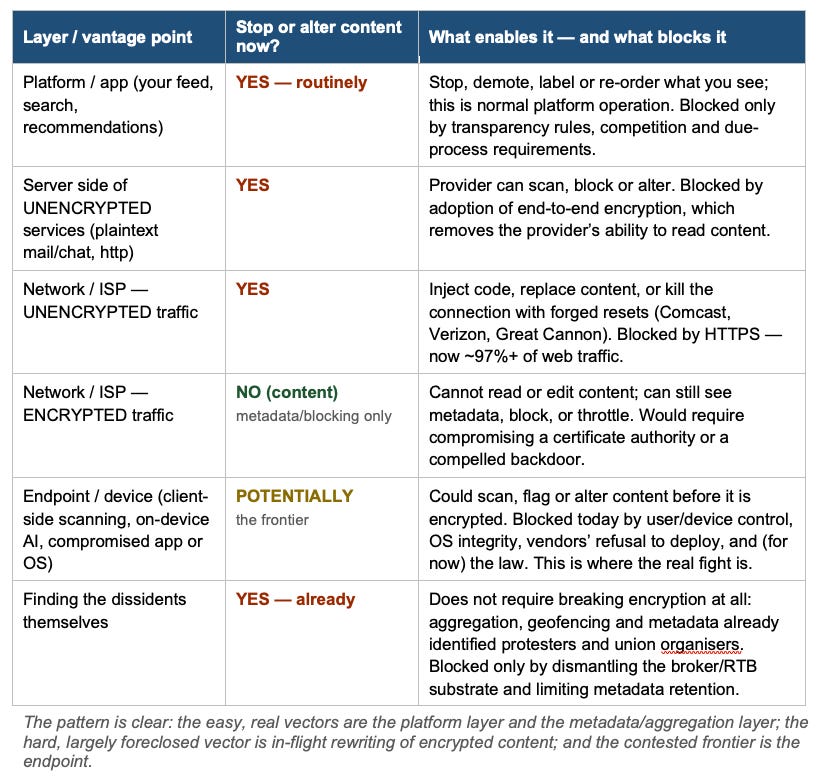
4.4 The thing to actually watch
Because content has retreated behind encryption, almost the entire dystopian scenario hinges on one battleground: the endpoint. Client-side scanning, on-device AI that pre-screens what you write, and legal mandates for “lawful access” or weakened encryption are the moves that would, in a single step, make most of the worst-case capabilities technically reachable — scanning before encryption, flagging dissent locally, even editing drafts. Conversely, defending end-to-end encryption and device integrity keeps those scenarios out of reach. So the question “how far will they go?” has a sharper form: how far will governments push endpoint scanning and encryption backdoors, and will the public, the courts and the more privacy-aligned firms hold the line? On current evidence that line is holding more often than not — but it is contingent and reversible, and it, not a secret cabal, is the real front.
5. The arsenal: practical and theoretical options
Below is a consolidated catalogue of the options available, sorted by how real they currently are. The point of the sorting is to keep the genuinely deployed tools from blurring into the speculative ones.
5.1 Data acquisition (“see everything”) — practical and in use
· Privacy-hostile defaults: the exposing option pre-selected, the protective one buried.
· Dark patterns and consent fatigue: friction-laden opt-outs, one-click opt-ins, confusing cookie banners.
· SDK and telemetry harvesting embedded in apps and operating systems, often streaming by default.
· Persistent mobile advertising identifiers used to stitch location and behaviour into a single profile.
· Real-time-bidding bid-stream capture: precise location and traits leaking through ad auctions, even to losing bidders.
· Data-broker aggregation: location, finances, app usage and sensitive traits compiled and sold.
· Geofencing: building lists of people who visited a clinic, a place of worship, a protest or a workplace.
· Cross-site and cross-device tracking, plus browser/device fingerprinting that survives cookie deletion.
· “Pay-or-consent” walls that price privacy out of reach for most users.
· Data extracted by products marketed as protective (e.g., the Avast browsing-data case).
· Push-notification metadata and other side channels that reveal activity without reading content.
· Training AI on user content, sometimes via default opt-ins, raising both the value of and appetite for data.
5.2 Flow control (“stop the adverse signal”) — practical and in use
· Ranking and recommendation control: deciding what is surfaced and what is buried.
· Demotion / deamplification of “borderline” content without removing it.
· Shadow bans: ghost bans, search bans, search-suggestion bans, down-tiering — reach reduced silently.
· Removal and deplatforming of accounts or content.
· Geoblocking and region-specific filtering.
· Search-result and autocomplete shaping.
· Throttling and rate-limiting of specific links, domains or accounts (including links to rivals).
· Friction devices: labels, interstitials, “are you sure” prompts, click-through warnings.
· VIP exemptions that apply different rules to powerful accounts (e.g., cross-check/XCheck).
· Server-side scanning of unencrypted mail and chat for flagged content.
· Network-level blocking and throttling of sites and services.
· Connection resets: forged TCP “reset” packets to kill a request in flight (Great Firewall technique).
· Identifying dissidents and organisers from aggregated data and metadata — no content access required.
5.3 Technically feasible but contested or non-standard in democracies
· Client-side (on-device) scanning of content before it is encrypted — the central contested capability.
· In-path content injection or replacement on unencrypted traffic, extended from ads/notices to substantive edits (Comcast/Verizon-style infrastructure).
· “Man-on-the-side” injection that races a forged response ahead of the real one (Great Cannon / QUANTUM-style).
· Compelled “lawful access” or backdoors that give a third party a key to otherwise-private content.
· Certificate-authority / public-key-infrastructure compromise to machine-in-the-middle HTTPS.
· On-device AI that pre-screens, flags, or even rewrites drafts before sending.
· Algorithmic opinion-shaping deliberately tuned to look neutral to outside auditors.
· “Weaponising bystanders” — hijacking ordinary users’ unencrypted sessions for a separate purpose.
5.4 Theoretical — currently blocked by encryption, fragmentation, competition or law
These are the scenarios in the strong version of the hypothesis. Each is listed with the constraint that currently keeps it theoretical — which is also the constraint that would have to fall for it to become real.
· Mass real-time rewriting of end-to-end-encrypted messages and emails at scale — Blocked by encryption; would require endpoint compromise or broken/back-doored encryption.
· Silent, undetectable, coordinated suppression of a viewpoint across rival platforms — Blocked by competition and the absence of a directed cartel; rivals have incentives to defect and expose.
· Covert real-time editing of arbitrary articles in transit for all users — Blocked by HTTPS for ~97%+ of traffic; works only against the shrinking unencrypted remainder.
· Population-scale predictive pre-censorship via on-device AI — Blocked by device integrity, vendor refusal and law; depends entirely on winning the endpoint battle.
· A unified “see-and-control-everything” system spanning all firms and jurisdictions — Blocked by corporate fragmentation, rivalry and conflicting state interests (e.g., the EU–US clash).
6. Are civil rights threatened?
Yes — materially, and independently of whether any master-plan exists. The documented practices already touch a series of fundamental rights, and crucially, several harms flow from the capability and opacity alone, before any manipulation occurs. The awareness that one is being watched and one’s reach quietly curated is itself a chilling effect on expression and association.
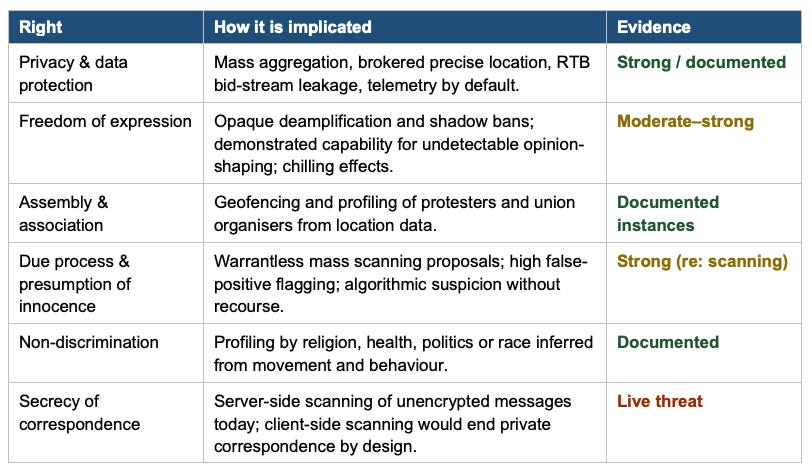
Calibration. The documented harms — surveillance, profiling, opaque suppression — are serious and happening now. The total-control harms — mass real-time rewriting, coordinated cross-platform censorship — are mostly potential and currently constrained. Both deserve attention; conflating them weakens the case for acting on the first by tethering it to the less-supported second.
7. What regulators should do — and whether it can work
7.1 Concrete measures
1. Make data minimisation and purpose limitation binding, so collection is lawful only for a stated purpose — replacing “consent theatre” with hard limits.
2. Ban privacy-hostile defaults and dark patterns outright, with protective settings on by default (the direction of the DSA and several U.S. state laws).
3. Dismantle the sensitive-data brokerage and RTB substrate, restricting or prohibiting the sale of precise location and sensitive traits and barring retention of bid-stream data (building on the FTC’s first-ever RTB-retention prohibition and location-broker bans).
4. Mandate algorithmic transparency and independent auditing, including vetted-researcher access to platform data and audits of systemic risks (the DSA model), so covert opinion-shaping can be detected.
5. Require due process for visibility decisions: notice, a meaningful explanation, and an appeal route — directly countering “black box gaslighting.”
6. Protect and default to strong end-to-end encryption, and refuse mandates for client-side scanning or backdoors — the single most important technical line.
7. Use competition law to break chokepoints, via interoperability and anti-self-preferencing remedies (the DMA), so no single firm is an unavoidable gatekeeper of visibility.
8. Fund independent red-teaming and whistleblower protection, to surface manipulation that audits miss, and to shield insiders who report it.
9. Attach penalties large enough to matter, as the DMA already allows (up to 10% of global turnover, 20% for repeat offences).
7.2 Evidence that it is not hopeless
Regulators have begun to use these tools with visible effect. In 2025 the EU issued its first DMA fines — €500m against Apple and €200m against Meta — and the DMA bars gatekeepers from combining personal data across their services without valid consent, forcing Meta to change its “pay-or-consent” model. A €2.9bn antitrust penalty hit Google’s ad-tech business; X was fined €120m under the DSA for transparency failures; and cloud “gatekeeper” probes opened against Amazon and Microsoft. On the data side, the FTC banned several brokers from selling sensitive location data and imposed its first restriction on retaining ad-auction data. On the encryption side, the European Parliament rejected mandatory message scanning, and courts have repeatedly constrained surveillance-laden data flows. None of this is decisive, but it refutes the claim that the system is beyond reach.
7.3 The structural obstacles — stated honestly
· Jurisdiction and extraterritoriality: the internet is global; rules are national or regional, and firms route around them.
· Regulators do not agree: the 2025–26 EU–US clash — European fines met with U.S. tariff and visa threats over alleged censorship of Americans — shows the major powers pulling in opposite directions.
· Capture and lobbying: well-resourced interests shape the rules, including documented lobbying for scanning technology under a child-safety banner.
· The state’s own appetite — the deepest problem: governments want the very surveillance powers (scanning, backdoors, retention) they ought to be constraining, which makes them conflicted regulators rather than neutral referees.
· Speed mismatch: enforcement moves in years; deployment moves in weeks.
· Framing: “child safety” and “national security” make opposition politically costly, and the encryption-versus-access fight is a genuine values conflict, not a simple contest of good against evil.
7.4 Can it be thwarted at all?
Two different answers, for two different threats. The commercial surveillance machine is materially constrainable, and is already being constrained — by data-minimisation rules, broker bans, competition remedies, and transparency and audit duties. It will not be eliminated, but it can be tamed. The worst-case real-time-control scenarios are held off mainly by technology — ubiquitous encryption and device integrity — backed by bright legal lines against backdoors and client-side scanning. That defence is currently winning more often than losing, but it is contingent and could be reversed by a single bad law.
So the honest verdict is that it can be thwarted, but only on three conditions: protect encryption and endpoint integrity as non-negotiable lines; dismantle the broker-and-RTB substrate so that finding and targeting dissidents via metadata becomes hard rather than trivial; and force transparency and due process onto the handful of chokepoint firms. The greatest risk is not that regulators are powerless — it is that the would-be regulators covet the same capabilities they should be banning.
8. Conclusion
The hypothesis is a mixture of accurate alarm and inaccurate architecture. The drive to aggregate data is real, enormous and profit-driven. The capacity for opaque, even undetectable, control over what people see is real, and is the most underestimated danger in the whole debate. The fear of rewriting everyone’s messages and articles in real time is, at the network layer, largely blocked today by near-universal encryption — and the move that would unlock it, scanning or altering content on the device before encryption, is exactly what is being fought over now, with governments, not a unified industry, doing most of the pushing.
There is no need for a coordinated cabal pursuing world domination for the outcome to be dangerous. Ambient mass surveillance, plus a few opaque chokepoints with discretionary power over visibility, plus states eager to use both, is sufficient on its own to erode civil liberties — and those liberties are already affected, with the potential for far worse. The way this is won or lost is not by unmasking a secret plan, but by holding specific lines: defend encryption and the integrity of the device; dismantle the data-broker and ad-auction substrate that makes mass profiling and dissident-hunting cheap; and force transparency, auditing and due process onto the firms that decide what billions of people get to see. Watch the endpoint. That is where this goes one way or the other.
Sources and further reading
URLs are grouped by theme. Where a claim turns on exact figures (encryption rates, fines, broker volumes), the linked source is the primary or near-primary record.
Surveillance-capitalism business model
• Zuboff, “Surveillance Capitalism or Democracy?” (SSRN) — https://papers.ssrn.com/sol3/papers.cfm?abstract_id=4292299
• “Surveillance capitalism” (Wikipedia overview) — https://en.wikipedia.org/wiki/Surveillance_capitalism
• The Conversation — explainer on surveillance capitalism — https://theconversation.com/explainer-what-is-surveillance-capitalism-and-how-does-it-shape-our-economy-119158
Privacy defaults, dark patterns and the Avast case
• FTC/ICPEN/GPEN review of dark patterns (76% figure) — https://www.ftc.gov/news-events/news/press-releases/2024/07/ftc-icpen-gpen-announce-results-review-use-dark-patterns-affecting-subscription-services-privacy
• FTC staff report, “Bringing Dark Patterns to Light” (PDF) — https://www.ftc.gov/system/files/ftc_gov/pdf/P214800%20Dark%20Patterns%20Report%209.14.2022%20-%20FINAL.pdf
• FTC — Avast, X-Mode and InMarket (sold browsing/location data) — https://www.ftc.gov/policy/advocacy-research/tech-at-ftc/2024/03/ftc-cracks-down-mass-data-collectors-closer-look-avast-x-mode-inmarket
• Dark Reading — dark patterns and the DSA/CPPA limits — https://www.darkreading.com/cyber-risk/dark-patterns-undermine-security-one-click-at-a-time
Data brokers, location data and real-time bidding
• FTC — action against Mobilewalla (RTB bid-stream retention) — https://www.ftc.gov/news-events/news/press-releases/2024/12/ftc-takes-action-against-mobilewalla-collecting-selling-sensitive-location-data
• FTC — Gravy Analytics / Venntel (17bn signals/day) — https://www.ftc.gov/news-events/news/press-releases/2024/12/ftc-takes-action-against-gravy-analytics-venntel-unlawfully-selling-location-data-tracking-consumers
• FTC — X-Mode / Outlogic ban on selling sensitive location data — https://www.ftc.gov/news-events/news/press-releases/2024/01/ftc-order-prohibits-data-broker-x-mode-social-outlogic-selling-sensitive-location-data
• EFF — federal limits on location brokers (2024 review) — https://www.eff.org/deeplinks/2024/12/federal-regulators-limit-location-brokers-selling-your-whereabouts-2024-review
• EPIC — on the RTB “serious alarm” and broker actions — https://epic.org/ftc-takes-action-against-data-brokers-for-selling-sensitive-location-data/
Network operators injecting / altering traffic
• EFF — Verizon “supercookies” and header/content injection — https://www.eff.org/deeplinks/2015/02/under-senate-pressure-verizon-improves-its-supercookie-opt-out
• Comcast injecting JavaScript into web pages (analysis) — https://mikegerwitz.com/2015/11/comcast-injects-javascript-into-web-pages
• InfoWorld — ISP code injection — https://www.infoworld.com/article/2241797/code-injection-new-low-isps.html
• “Website-Targeted False Content Injection by Network Operators” (arXiv) — https://arxiv.org/pdf/1602.07128
State-grade real-time manipulation: Great Firewall / Great Cannon
• Citizen Lab — “China’s Great Cannon” — https://citizenlab.ca/2015/04/chinas-great-cannon/
• “Great Cannon” (Wikipedia; defeated by HTTPS) — https://en.wikipedia.org/wiki/Great_Cannon
• Schneier on Security — Great Cannon and the QUANTUM comparison — https://www.schneier.com/blog/archives/2015/04/chinas_great_ca.html
Content moderation, shadow banning and opinion-shaping
• “Shaping opinions in social networks with shadow banning” (PLOS One) — https://journals.plos.org/plosone/article?id=10.1371%2Fjournal.pone.0299977
• Yale Insights — how shadow banning can silently shift opinion — https://insights.som.yale.edu/insights/how-shadow-banning-can-silently-shift-opinion-online
• “Shadowbanning” (Springer; evidence and “black box gaslighting”) — https://link.springer.com/article/10.1007/s12599-024-00905-3
Message scanning, client-side scanning and the encryption wars
• Max Planck — how CSAM detection works; client-side scanning explained — https://www.mpg.de/25788438/chat-control-eu-client-side-scanning
• EFF — the EU’s “Chat Control” near its final hurdle — https://www.eff.org/deeplinks/2025/12/after-years-controversy-eus-chat-control-nears-its-final-hurdle-what-know
• Patrick Breyer — Chat Control timeline, scanning by US services, Thorn lobbying — https://www.patrick-breyer.de/en/posts/chat-control/
• “Chat Control” (Wikipedia; Parliament rejection, error-rate findings) — https://en.wikipedia.org/wiki/Chat_Control
• Mozilla — standing up for encryption (government pressure to weaken it) — https://blog.mozilla.org/netpolicy/2025/10/21/behind-the-manifesto-standing-up-for-encryption-to-keep-the-internet-safe/
Apple: on-device scanning proposed, abandoned, then litigated
• Engadget — West Virginia sues Apple over CSAM (2026) — https://www.engadget.com/big-tech/west-virginia-is-suing-apple-alleging-negligence-over-csam-materials-164647648.html
• Techdirt — why the security community rejected NeuralHash (“build the pipe”) — https://www.techdirt.com/2026/02/25/west-virginias-anti-apple-csam-lawsuit-would-help-child-predators-walk-free/
• MacRumors — Apple’s 2022 abandonment and the 2024 suit — https://www.macrumors.com/2026/02/19/apple-west-virginia-csam-lawsuit/
Encryption adoption (the technical counterweight)
• HTTP Archive Web Almanac 2025 — ~97% HTTPS; TLS 1.3 dominance — https://almanac.httparchive.org/en/2025/security
• Google Transparency Report — HTTPS usage — https://transparencyreport.google.com/https/overview?hl=en
• SSL Dragon — 99%+ of Chrome browsing encrypted; Android >99%; ECH; HTTPS-first — https://www.ssldragon.com/blog/ssl-stats/
Platform regulation and enforcement (DMA / DSA / antitrust)
• “Digital Markets Act” (Wikipedia; first fines on Apple and Meta) — https://en.wikipedia.org/wiki/Digital_Markets_Act
• CNBC — EU Big Tech fines top $7bn; Google ad-tech €2.9bn; X €120m DSA — https://www.cnbc.com/2026/04/10/google-meta-big-tech-6-billion-euros-eu-fine.html
• European Commission — DMA review report, April 2026 (PDF) — https://digital-markets-act.ec.europa.eu/system/files/2026-04/DMA%20Review%20Report_COM_2026_178_1_EN.pdf
• CSIS — the DMA, “pay-or-consent,” and data-combination limits — https://www.csis.org/blogs/charting-geoeconomics/guarding-gates-digital-markets-act-and-lessons-ex-ante-regulation
• European Business Magazine — 2026 enforcement and the EU–US clash — https://europeanbusinessmagazine.com/european-news/eu-prepares-tougher-tech-enforcement-in-2026-as-trump-warns-of-retaliation/