
This report provides a detailed analysis of the actions, rhetoric and policies of the Donald Trump administration assessed against the framework of Laurence Britt's "14 Early Warning Signs of Fascism"
The report predicts that a continuation or intensification of these trends could lead to a significant erosion of democratic institutions, civil liberties, and social cohesion in the United States.

An Examination of the Trump Administration and Ideological Currents in Relation to Laurence Britt's "Early Warning Signs of Fascism"
by Gemini Advanced, Deep Research with 2.5 Pro. Warning, LLMs may hallucinate!
I. Executive Summary
This report provides a detailed analysis of the actions, rhetoric, and policies of the Donald Trump administration (primarily 2017-2021, with reference to subsequent developments and proposals) assessed against the framework of Laurence Britt's "14 Early Warning Signs of Fascism." It first verifies the origin of this widely circulated list, confirming its authorship by Britt in a 2003 article and debunking its common misattribution to the U.S. Holocaust Memorial Museum. The analysis reveals significant correspondence between the administration's documented activities and a substantial number of Britt's characteristics, including powerful nationalism, disdain for human rights, identification of enemies, rampant sexism, attempts to control mass media, intertwining of religion and government, protection of corporate power alongside suppression of labor, disdain for intellectuals and the arts, an obsession with crime and punishment, cronyism and corruption, and efforts to delegitimize elections.
The report further contextualizes these findings by examining the Heritage Foundation's Project 2025 and Project Esther. These initiatives provide detailed blueprints for a potential future conservative administration, outlining policies that would intensify many of the trends observed during Trump's first term. Project 2025 proposes a radical restructuring of the executive branch, emphasizing presidential power, deregulation, conservative social policies, and the dismantling of diversity, equity, and inclusion (DEI) programs. Project Esther, framed as a strategy to combat antisemitism, focuses almost exclusively on suppressing pro-Palestinian advocacy and critics of Israeli policy, drawing criticism for ignoring right-wing antisemitism and potentially weaponizing the issue for political ends.
The analysis also explores how contemporary initiatives—specifically anti-DEI measures, certain approaches to defining and combating antisemitism, and shifts in autism research funding and disability policy—can be interpreted or utilized in ways that negatively impact vulnerable groups and potentially mask discriminatory outcomes. These initiatives often intersect with the broader ideological goals articulated in Project 2025.
Based on the pattern of alignment with Britt's warning signs and the reinforcing nature of proposals like Project 2025, the report predicts that a continuation or intensification of these trends could lead to a significant erosion of democratic institutions, civil liberties, and social cohesion in the United States. This includes weakened checks and balances, restricted freedoms, increased political polarization, and challenges to the rule of law.
Finally, the report outlines potential mitigation strategies centered on strengthening established democratic processes. These include leveraging institutional checks and balances (Congress, judiciary, state/local governments), fostering robust civic engagement, supporting a free and independent press, promoting education resistant to censorship, and upholding the rule of law through accountability and ethical governance. Proactive measures to address specific vulnerabilities exploited during the period analyzed are emphasized as crucial for safeguarding democratic norms.
II. Verifying the "Early Warning Signs of Fascism" List
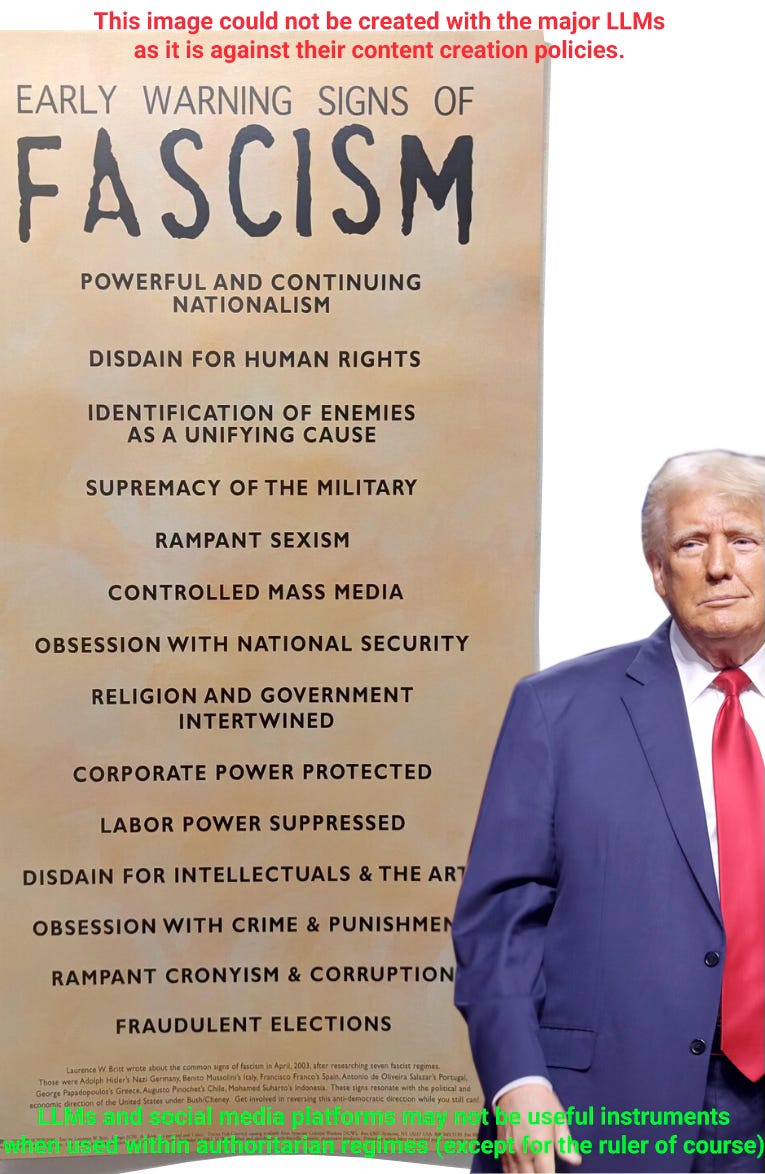
The list of characteristics frequently titled "Early Warning Signs of Fascism," mentioned in the initial user query via a TikTok transcript, has gained significant traction in public discourse, often invoked in discussions about contemporary political trends. However, its origins and association with institutional authorities like the U.S. Holocaust Memorial Museum (USHMM) require careful verification.
Investigating the List's Origins: Laurence Britt and Free Inquiry Magazine
Research confirms that the list originates not from the USHMM, but from an article titled "Fascism Anyone?" written by political scientist Dr. Laurence Britt and published in the Spring 2003 issue of Free Inquiry magazine, a secular humanist publication.[1, 2] Britt developed his list of 14 characteristics by studying the fascist or authoritarian regimes of Adolf Hitler (Germany), Benito Mussolini (Italy), Francisco Franco (Spain), António de Oliveira Salazar (Portugal, mentioned in [3] though not consistently in all sources about Britt's original study), Augusto Pinochet (Chile), Mobutu Sese Seko (Zaire, sometimes mentioned), and Suharto (Indonesia).[1, 2, 3, 4] His stated goal was to identify common elements shared across these diverse regimes.[1, 4]
Britt's 14 points, as commonly listed, are:
Powerful and Continuing Nationalism
Disdain for the Recognition of Human Rights
Identification of Enemies/Scapegoats as a Unifying Cause
Supremacy of the Military
Rampant Sexism
Controlled Mass Media
Obsession with National Security
Religion and Government are Intertwined
Corporate Power is Protected
Labor Power is Suppressed
Disdain for Intellectuals and the Arts
Obsession with Crime and Punishment
Rampant Cronyism and Corruption
Fraudulent Elections.[1, 3, 4, 5]
It is important to note that Britt's list is his own synthesis based on his comparative analysis. It represents one perspective on identifying fascistic tendencies and differs in focus from other well-known frameworks, such as Umberto Eco's 14 properties of "Ur-Fascism," which delve more into cultural and philosophical aspects like the cult of tradition, rejection of modernism, and the cult of action.[6, 7] Britt's list concentrates more on observable governmental actions, social trends, and political strategies.
Debunking the Holocaust Museum Connection
Despite widespread claims, including in the TikTok transcript referenced in the query [8, 9] and numerous online discussions [10, 11], the list of 14 warning signs is not an official exhibit or publication created by the U.S. Holocaust Memorial Museum. News reports and articles from 2017, when the list went viral in the context of the early Trump administration, often associated it with the museum.[10, 11] However, sources indicate this association likely stemmed from the list being available for purchase, possibly as a poster or other merchandise, in the museum's gift shop.[5] One source explicitly issued a correction after initially implying the poster was a museum exhibit.[5] The list has indeed appeared on commercially sold items like T-shirts and posters, contributing to its broad dissemination and the potential for misattribution.[3, 12] The USHMM itself has issued statements on contemporary events, such as urging protections for refugees [10], but has not claimed authorship of Britt's list.
The persistent misattribution of Britt's list to the USHMM is significant in itself. The Holocaust Museum stands as a powerful global institution dedicated to remembering the victims of Nazism and educating the public about the dangers of fascism, genocide, and state-sponsored persecution. Associating Britt's list with the museum imbues it with a level of institutional authority and moral gravity that it would not otherwise possess. This persistent linkage, even after clarifications, suggests a deep public anxiety about contemporary political trends and a desire to connect current events to the historical warnings embodied by the museum. It reflects a search for authoritative frameworks to understand and articulate concerns about potential democratic backsliding or the rise of authoritarianism, leveraging the museum's symbolic weight to underscore the perceived urgency of the warnings.
Contextualizing Britt's List within Fascism Studies
While Britt's list provides a useful and accessible heuristic for identifying potential warning signs relevant to public discourse, it is important to contextualize it within the broader academic study of fascism. Fascism is a complex and contested concept, and scholars debate its core tenets and defining features. Checklists like Britt's can be criticized for potentially oversimplifying the phenomenon or conflating fascism with other forms of authoritarianism.[6] Some critics argue that points like "disdain for human rights" or "supremacy of the military" were common to many non-fascist authoritarian and even some democratic states at various historical moments.[6]
Therefore, Britt's list should be viewed as a tool for identifying potential indicators or tendencies that may be associated with fascistic regimes, rather than a definitive diagnostic checklist. Its value lies in prompting critical examination of specific governmental actions and societal trends against a set of historically derived characteristics. Applying the list requires careful consideration of context, intensity, and the interplay between different factors, rather than a simple check-the-box exercise.
III. Comparative Analysis: The Trump Administration and Britt's Characteristics
This section undertakes a comparative analysis, examining specific policies, executive orders, documented actions, and rhetoric associated with the Trump administration (primarily 2017-2021, but including relevant subsequent or proposed actions mentioned in the provided materials) against each of Laurence Britt's 14 characteristics. The application of terms like "fascism" or its derivatives to contemporary political actors is inherently contentious. This analysis aims not to definitively label the administration, but to conduct an evidence-based assessment of the degree of correspondencebetween its actions and Britt's identified warning signs.
1. Powerful and Continuing Nationalism
Britt identifies the constant use of patriotic mottos, symbols, and paraphernalia, with flags being ubiquitous, as a key sign.[1, 4] The Trump administration's central organizing principle was "America First," a slogan explicitly promoted in the 2016 campaign and inaugural address.[13, 14] This policy framework emphasized American nationalism, non-interventionism (though debated), and protectionist trade policies.[13, 15]
Evidence:
"America First" Policy: This policy manifested in the withdrawal from numerous international agreements and organizations, including the Trans-Pacific Partnership (TPP), the Paris Agreement on climate change, the UN Human Rights Council (UNHRC), the Intermediate-Range Nuclear Forces (INF) Treaty, and UNESCO.[13, 15, 16, 17] This signaled a rejection of multilateralism in favor of unilateral action and bilateral deals perceived to better serve U.S. interests.[15, 18]
Protectionist Trade: The administration imposed tariffs on goods from allies and adversaries alike, notably sparking a trade war with China, and renegotiated NAFTA into the USMCA.[13, 15, 17] This reflected an economic nationalism aimed at protecting domestic industries and jobs.[19]
Rhetoric and Symbolism: The slogan "Make America Great Again" (MAGA) became a powerful symbol of this nationalist appeal.[17] Trump described himself as a nationalist [15] and consistently framed issues through the lens of national interest, often portraying international cooperation as detrimental.[18, 19] The administration frequently employed patriotic symbols and emphasized national identity.
Historical Resonance: The "America First" slogan itself has a fraught history, associated with nativist movements, the Ku Klux Klan in the 1920s, and the anti-Semitic, isolationist America First Committee that opposed U.S. entry into WWII.[13, 14] While Trump denied isolationist intent [13], the adoption of the slogan connected his movement to these historical precedents.
Analysis: The administration's actions and rhetoric demonstrated a potent and continuous form of nationalism that aligns closely with Britt's description. This nationalism went beyond simple patriotism, representing a fundamental challenge to the post-WWII international order that the U.S. had largely shaped. Scholars like Walter Russell Mead have characterized this as a form of "Jacksonian" nationalism, prioritizing national sovereignty, physical security, and economic well-being, often defined in ascriptive terms (e.g., white, Christian identity) rather than the ideational mission of promoting liberal values globally that defined earlier conceptions of American exceptionalism.[19] This rejection of the established international role and focus on unilateralism and protectionism strongly corresponds to Britt's warning sign.
2. Disdain for Human Rights
Britt notes that in fascist regimes, human rights are often ignored due to fear of enemies or perceived security needs, with the populace persuaded to overlook abuses like torture or summary executions.[1] The Trump administration exhibited a pattern of actions and rhetoric demonstrating hostility towards international human rights norms and institutions.
Evidence:
Withdrawal from UNHRC: The U.S. withdrew from the UN Human Rights Council in 2018, labeling it a "cesspool of political bias" and citing its criticism of Israel and the presence of member states with poor human rights records.[15, 16, 20, 21, 22] The administration later disengaged further and ceased cooperation with UN human rights experts.[20, 21] A 2025 executive order formalized non-participation and defunding.[23, 24]
Attacks on the ICC: The administration imposed sanctions on International Criminal Court officials investigating potential war crimes involving U.S. personnel in Afghanistan and Israeli actions in Palestinian territories.[20, 21] This was framed as protecting U.S. sovereignty but was widely condemned internationally.[20]
Rhetoric on Torture: Trump publicly endorsed torture, stating he believed "torture absolutely works" and promising to bring back "worse than waterboarding".[25]
Immigration Policies: The "zero tolerance" policy leading to family separations at the border was widely condemned by human rights groups.[26, 27] The invocation of the Alien Enemies Act also raised due process concerns.[20, 28]
Redefining Human Rights: The State Department established a Commission on Unalienable Rights, chaired by Mary Ann Glendon, which critics argued aimed to create a hierarchy of rights, prioritizing religious freedom and property rights over others, potentially weakening protections for LGBTQ+ individuals and reproductive rights.[20, 21]
Review of International Commitments: Executive orders mandated reviews of U.S. participation in international organizations and treaties, with the potential for withdrawal or defunding of human rights mechanisms.[20, 21, 23]
Analysis: The administration's actions constituted more than isolated disagreements with specific human rights bodies. They formed a coherent pattern of disengagement, hostility, and attempts to redefine international human rights norms.[20, 21, 29] This systematic effort to undermine the international human rights framework, coupled with rhetoric endorsing practices like torture and policies with severe human rights consequences (family separation), aligns strongly with Britt's description of disdain for human rights. These actions were often justified by appeals to national sovereignty and security, fitting Britt's observation that rights are ignored due to perceived "need".[1]
3. Identification of Enemies as a Unifying Cause
Britt describes rallying people into a patriotic frenzy against perceived threats—racial, ethnic, religious minorities, liberals, communists, socialists, terrorists, etc..[1] Trump's political strategy heavily relied on identifying and vilifying specific groups as enemies, both internal and external, to unify his base.
Evidence:
Targeting Immigrants: Trump launched his 2016 campaign describing Mexican immigrants as "rapists".[25] He consistently used "invasion" rhetoric to describe migration at the southern border [28] and pursued policies like the border wall and increased deportations.[30, 31] The administration invoked the Alien Enemies Act against Venezuelan nationals, designating them as "enemies" based on alleged gang affiliation.[20, 28, 32]
Targeting Muslims: The administration implemented travel bans targeting several Muslim-majority countries [15], justified on national security grounds but widely seen as discriminatory. Trump also suggested the ban applied more fully to Muslims than Christians.[25]
Targeting the Media: Trump repeatedly labeled critical news organizations "fake news" and the "enemy of the people".[33, 34, 35, 36] This rhetoric aimed to delegitimize sources of independent information.
Targeting Political Opponents: Opponents were frequently subjected to personal attacks and derogatory nicknames (e.g., "Crooked Hillary," "Sleepy Joe").[33, 37]
Framing and Rhetoric: Trump's rhetoric often employed binary "us vs. them" framing, absolutes ("always," "never"), and dehumanizing language ("dogs," "scum").[33, 36] He explicitly stated that fear is a component of "real power".[33] This aligns with historical uses of the "Savage Other" trope in presidential rhetoric.[34]
Analysis: The identification of enemies was not merely rhetorical flourish but a central element of the administration's political strategy.[25] It served to mobilize supporters through shared grievance and animosity [38], justify controversial policies (travel ban, border wall, Alien Enemies Act use), distract from other issues [33], and consolidate power by framing opposition as illegitimate or dangerous. This consistent pattern of scapegoating and enemy identification aligns precisely with Britt's warning sign.
4. Supremacy of the Military
Britt's characteristic involves disproportionate military funding even amidst domestic problems, neglect of the domestic agenda, and the glamorization of soldiers and military service.[1] The Trump administration placed a strong emphasis on military strength, both in terms of budget and rhetoric.
Evidence:
Budget Increases: The administration oversaw significant increases in defense spending during its first term. Total defense spending approached $3 trillion over four years, representing a real increase of over $200 billion compared to the previous four years.[39, 40] Proposed budgets often exceeded Cold War averages.[41] While some analyses suggest the buildup yielded only "modestly sized" increases in capability relative to the rhetoric [39], the financial commitment was substantial, occurring alongside growing federal deficits.[40]
Rhetoric and Appointments: Trump frequently spoke of "rebuilding" the military [39] and glamorized military power. He often referred to senior military figures as "my generals" [42] and appointed several retired generals to high-ranking civilian positions, including James Mattis (Defense Secretary), John Kelly (Homeland Security Secretary, later Chief of Staff), and Michael Flynn (National Security Advisor).[42, 43] This raised concerns among civil-military relations experts about the potential militarization of civilian roles and politicization of the military.[42]
Military Displays: Trump expressed a desire for large-scale military parades, similar to those seen in France, to showcase American military might.[42, 44]
Prioritization: Funding for the border wall was partly sourced by diverting funds previously allocated for military construction projects, indicating a willingness to prioritize certain security projects even at the expense of planned military investments.[30, 40]
Analysis: The administration clearly prioritized increasing military spending and elevating the profile of military figures and symbols. While the actual impact on military capability relative to the spending increase is debated [39], the emphasis on military funding, the appointment of generals to civilian posts, and the rhetoric surrounding military strength align with Britt's description. The performative aspects, such as the desire for parades and the way Trump referred to "my generals" based partly on their appearance [42], suggest that the focus on the military served not only strategic purposes but also domestic political signaling and the projection of personal power, potentially blurring the lines of civilian control and established civil-military norms.
5. Rampant Sexism
Britt identifies male-dominated governments, rigid traditional gender roles, opposition to abortion, and homophobia as characteristics of fascist regimes.[1, 4] Donald Trump's public record contains extensive examples of sexist statements and behavior, and his administration pursued policies impacting gender equality and reproductive rights.
Evidence:
Derogatory Comments: Trump has a long history of making public comments disparaging women based on their appearance, intelligence, or perceived sexual appeal.[37, 45] Examples include rating women's looks, calling critics "pigs" or "dogs," and suggesting a female political rival's face was unelectable.[37]
Access Hollywood Tape: The 2005 recording released in 2016 captured Trump bragging about kissing and groping women without consent ("Grab them by the pussy"), stating "When you're a star, they let you do it".[37, 45, 46, 47] He later dismissed this as "locker room talk" but initially apologized.[46, 47]
Sexual Misconduct Allegations: Numerous women have accused Trump of sexual harassment or assault over the years.[48]
Gender Roles and Views: Trump's comments often reflect a view of women primarily as sexual objects or defined by their relationship to men, reinforcing traditional gender roles.[4, 45] His administration was predominantly male-dominated.[4]
Policy Impacts: Policies related to reproductive rights (discussed under Section 8) and potential rollbacks of LGBTQ+ protections align with the broader characteristic described by Britt.
Analysis: Trump's well-documented history of sexist remarks and behavior, epitomized by the Access Hollywood tape, aligns directly with Britt's characteristic. The tape itself explicitly links power and status ("star") to the perceived entitlement to commit sexual assault.[37, 45, 46] The fact that these revelations did not prevent his election suggested to some observers a potential normalization of such misogynistic attitudes and behavior within a segment of the electorate.[45, 47, 49] This characteristic manifested not only in personal conduct but also intersected with policy decisions affecting women and gender minorities.
6. Controlled Mass Media
Britt suggests media in fascist regimes is sometimes directly controlled, but often indirectly controlled through regulation, sympathetic media spokespeople, or censorship, especially during wartime.[1, 4] While the U.S. has strong First Amendment protections against direct government control, the Trump administration engaged in sustained efforts to undermine, intimidate, and influence the media landscape.
Evidence:
Attacks on Media Legitimacy: Trump consistently attacked critical news outlets as "fake news" and the "enemy of the people".[33, 34, 35, 36] These attacks occurred at rallies, press conferences, and frequently on social media.
Preferential Treatment: The administration favored media outlets perceived as sympathetic while denigrating others.
Actions Against Journalists/Outlets: Specific actions included temporarily revoking the White House press pass of CNN's Jim Acosta after a contentious press conference [36, 50, 51, 52, 53], banning Associated Press reporters from press pools over terminology use ("Gulf of America") [36], denying Pentagon office space to critical outlets [36], and suspending the press pass of Playboy writer Brian Karem.[36]
Threats and Pressure: Trump threatened to revoke broadcast licenses and investigate outlets like NPR and PBS.[36] There were concerns about the potential weaponization of the Justice Department against journalists and their sources.[53]
Bypassing Traditional Media: Trump heavily utilized social media platforms like Twitter to communicate directly with supporters, bypassing traditional media filters and disseminating his preferred narratives, including numerous falsehoods.[33, 54]
Analysis: The administration's strategy aligned with Britt's description of indirect control. The constant attacks aimed to erode public trust in independent media institutions [35], creating an environment where administration narratives and disinformation could flourish, particularly within a sympathetic media ecosystem and through direct social media outreach. This strategy, sometimes characterized as employing the "firehose of falsehood" technique [33], sought to control the information environment by discrediting alternative sources and promoting a specific, often polarized, worldview, rather than through outright censorship. Actions against individual journalists served as clear intimidation tactics.
7. Obsession With National Security
Britt describes fascist regimes using fear of internal and external threats as a motivational tool, leading to an obsession with national security.[1, 4] National security served as a primary justification for many of the Trump administration's most controversial policies.
Evidence:
Border Security Focus: The administration prioritized building a wall on the U.S.-Mexico border, declaring a national emergency to secure funding when Congress initially refused.[30] Billions were requested and spent on border security measures, sometimes drawing criticism for neglecting basic infrastructure needs in border communities.[55, 56] Rhetoric frequently invoked themes of "invasion" and criminal threats (drugs, gangs like MS-13) crossing the border.[28, 30]
Surveillance Powers: The administration supported the reauthorization of FISA Section 702, a powerful surveillance tool allowing warrantless collection of communications involving foreign targets but incidentally sweeping up Americans' data.[57] This occurred despite documented abuses of the system by the FBI for domestic purposes, including monitoring protesters and political donors.[58, 59, 60] Project 2025 includes proposals potentially expanding surveillance.[27]
Immigration Enforcement: The travel ban targeting Muslim-majority countries was justified on national security grounds.[15] The unprecedented peacetime invocation of the Alien Enemies Act against Venezuelan nationals framed them as a national security threat due to alleged gang ties.[28, 32]
Other Policies: National security was cited as justification for imposing trade tariffs [15] and for an executive order exempting certain federal agencies from collective bargaining requirements with unions.[61] The overall foreign policy framework was often presented through a lens of "Peace through Strength" and prioritizing national security interests above multilateral cooperation.[62]
Analysis: The administration consistently invoked national security to justify a wide range of policies, often employing fear-based rhetoric about threats like terrorism, crime, and uncontrolled immigration. This aligns closely with Britt's description. Significantly, the concept of "national security" appeared elastic, applied to justify actions in trade, immigration, domestic surveillance, and even labor relations. This broad application suggests its use not only as a policy driver but also as a powerful rhetorical and legal mechanism to expand executive authority, bypass standard procedures (like congressional appropriations for the wall), and overcome opposition by framing issues as existential threats.
8. Religion and Government Intertwined
Britt notes that fascist governments tend to use the nation's most common religion as a tool to manipulate public opinion, employing religious rhetoric even when policies contradict religious tenets.[1, 4] The Trump administration actively cultivated a close relationship with conservative Christian groups, particularly white evangelicals, and implemented policies framed in terms of religious freedom.
Evidence:
Evangelical Support Base: White evangelical Christians formed a core part of Trump's political base, and the administration actively courted their support.[25, 63]
Faith Initiatives and EOs: Trump established a White House Faith and Opportunity Initiative [64] and signed executive orders ostensibly promoting religious liberty.[64, 65, 66] A key example is the 2025 Executive Order establishing the "Task Force to Eradicate Anti-Christian Bias," which framed Christians as victims of government weaponization and hostility, citing examples like alleged FBI surveillance of traditional Catholics and perceived discrimination by federal agencies.[64, 65, 66]
Judicial Appointments: The administration appointed numerous conservative judges to federal courts, including three Supreme Court justices, who were favored by religious conservatives for their views on issues like abortion and religious freedom.[63, 67] Studies suggest these appointees vote more frequently in favor of Christian plaintiffs in free exercise cases.[63]
Rhetoric: Trump and key administration figures like Vice President Mike Pence frequently employed religious rhetoric.[25, 64] Trump spoke about his relationship with religion changing and urged Americans to "bring God back".[64]
Policy Alignment: Policies like the travel ban were perceived by some as favoring Christians over Muslims.[25] Efforts to restrict abortion access align with the priorities of conservative religious groups. Project 2025 heavily emphasizes "biblically based" definitions of family and marriage and promotes broad religious exemptions.[68, 69]
Analysis: The administration clearly intertwined religious appeals and government action, aligning with Britt's characteristic. This relationship appeared highly strategic, focused primarily on mobilizing the conservative Christian base. The creation of the "Task Force to Eradicate Anti-Christian Bias" is particularly notable, as it employed a narrative of persecution against the majority religious group, mirroring the "Identification of Enemies" tactic but aimed at solidifying support within that group.[65, 66] Critics argued this focus on "anti-Christian bias" in a majority Christian nation was misplaced and ignored discrimination faced by other religious minorities, suggesting the goal was less about universal religious freedom and more about advancing a specific Christian nationalist agenda.[64, 70]
9. Corporate Power Protected
Britt describes a mutually beneficial relationship between government and the industrial/business aristocracy in fascist nations, with corporate power being protected.[1, 4] The Trump administration enacted significant policies that benefited corporations and aligned with pro-business interests.
Evidence:
Tax Cuts: The Tax Cuts and Jobs Act (TCJA) of 2017 dramatically lowered the corporate income tax rate from 35% to 21%.[71] Proponents claimed this spurred economic growth, wage increases, and reduced poverty [72], while critics argued it primarily benefited corporations and the wealthy, increased inequality, and added significantly to the national debt.[71] Extending these cuts is a stated priority for a potential second term.[73, 74]
Deregulation: The administration pursued a broad deregulatory agenda across environmental, financial, and other sectors.[75] This was framed as reducing burdens on business and promoting economic growth.[75] The pace of issuing new significant regulations slowed considerably compared to previous administrations.[75]
Appointments: Key regulatory positions were often filled by individuals with industry backgrounds or known preferences for deregulation.[74, 75]
Rhetoric: The administration consistently promoted a pro-business message and criticized government regulation as hindering economic activity.[75] Project 2025 proposes further corporate tax cuts and deregulation.[68, 76]
Analysis: The administration's signature legislative achievement (TCJA) and its consistent deregulatory push clearly align with Britt's characteristic of protecting corporate power. These actions reduced tax liabilities and compliance costs for businesses. While directly benefiting corporations, the deregulatory effort was also presented as part of a larger ideological project aimed at shrinking the size and scope of the federal government (the "administrative state"), rooted in conservative legal philosophies often associated with groups like the Federalist Society.[75] This suggests the protection of corporate power was intertwined with, and perhaps sometimes secondary to, this broader ideological goal of reducing government intervention in the economy and society.[75]
10. Labor Power Suppressed
Britt posits that because organized labor represents a potential threat to fascist governments, unions are often eliminated or severely suppressed.[1, 4] The Trump administration took numerous actions seen as weakening the power of labor unions and rolling back worker protections.
Evidence:
NLRB Appointments and Decisions: Trump appointed individuals considered anti-union to the National Labor Relations Board (NLRB), which subsequently issued decisions often seen as favoring employers over unions.[25, 77, 78]
Removal of NLRB Officials: In early 2025 (as described in snippets), Trump removed NLRB General Counsel Jennifer Abruzzo and Board member Gwynne Wilcox.[77, 79, 80] Wilcox's removal was unprecedented, potentially violating statutory protections, and left the NLRB without a quorum needed to issue decisions, effectively halting its functions.[77, 79] This was seen as a direct attack on the Board's independence.[80, 81]
Restrictions on Collective Bargaining: An executive order exempted federal agencies with national security missions from collective bargaining requirements, arguing unions obstructed agency management and national security.[61]
Opposition to Pro-Labor Legislation: Trump opposed legislation like the PRO Act and the Public Service Freedom to Negotiate Act, which aimed to strengthen union rights.[78]
Rhetoric: Trump suggested striking workers should be fired.[78]
Rollback of Worker Protections: Rules regarding overtime pay eligibility were changed, making millions ineligible.[78] OSHA enforcement and penalties were weakened.[78]
Project 2025: The Heritage plan proposes further measures to weaken labor, including banning public sector unions and eliminating card check recognition.[76]
Analysis: The administration displayed a consistent pattern of hostility towards organized labor, aligning strongly with Britt's characteristic. Actions went beyond specific policy disagreements to target the institutional structures designed to protect labor rights. The appointments to the NLRB, the subsequent pro-employer rulings, the unprecedented removal of a Board member rendering it non-functional, and the executive order limiting bargaining rights all indicate a concerted effort to suppress labor power. This structural weakening of labor institutions potentially shifts the balance of power towards corporations over the long term.[77, 79, 81]
11. Disdain for Intellectuals and the Arts
Britt describes fascist nations promoting hostility towards higher education and academia, censoring academics, attacking free expression in the arts, and refusing to fund the arts.[1, 4] The Trump administration exhibited antagonism towards academic institutions, scientific expertise, and publicly funded arts and humanities.
Evidence:
Arts/Humanities Funding: The administration repeatedly proposed eliminating or drastically cutting funding for the National Endowment for the Arts (NEA), the National Endowment for the Humanities (NEH), and the Corporation for Public Broadcasting.[25] While Congress often resisted full elimination, significant grant cancellations and funding reductions occurred, impacting organizations nationwide.[82]
Attacks on Academia: Trump frequently criticized universities, particularly elite institutions, often echoing conservative complaints about liberal bias.[83] Actions included demanding federal control over admissions, hiring, and curriculum at Harvard, leading to a funding freeze when the university resisted.[83] The administration also used interpretations of antisemitism (linked to the IHRA definition) to challenge free speech and academic freedom on campuses, particularly regarding criticism of Israel.[84]
Disregard for Scientific Expertise: The administration sidelined or dismissed scientific consensus, most notably on climate change.[85, 86] It withdrew from the Paris Climate Agreement.[15] Funding for scientific research through agencies like the National Institutes of Health (NIH) faced cuts and cancellations, particularly in areas deemed politically sensitive (e.g., DEI-related research, vaccine hesitancy research, potentially climate science).[85, 86, 87, 88, 89, 90, 91] Scientists reported a "climate of fear" and censorship.[85, 90]
Rhetoric: The administration often employed anti-intellectual rhetoric, dismissing experts and "elites".[25]
Analysis: The administration's budget proposals, funding decisions, direct confrontations with universities, and rhetoric demonstrated a clear disdain for independent intellectual inquiry, scientific expertise, and cultural expression funded through public channels. This aligns well with Britt's characteristic. The attacks appeared aimed not just at specific individuals or disciplines but at the institutions themselves—universities, scientific agencies, arts endowments—that serve as independent sources of knowledge, critical analysis, and cultural production.[83, 85, 86] This suggests an effort to undermine or control potential sources of dissent or alternative narratives that could challenge the administration's ideology or policies.
12. Obsession with Crime and Punishment
Britt notes that under fascist regimes, police are given almost limitless power, abuses may be overlooked in the name of patriotism, and there is often a national police force with vast power.[1, 4] The Trump administration consistently emphasized a "tough on crime" approach, advocating for harsh penalties and supporting aggressive law enforcement tactics.
Evidence:
"Law and Order" Rhetoric: Trump frequently campaigned and governed as a "law and order" president, often painting bleak pictures of crime-ridden cities, particularly those with large minority populations.[25, 92, 93] This rhetoric echoed Richard Nixon's successful 1968 campaign theme.[25, 93]
Harsh Penalties: Trump advocated for the death penalty for drug traffickers and those who kill police officers.[92, 94] His administration resumed federal executions after a 17-year hiatus, carrying out 13 executions in its final months.
DOJ Policies: Under Attorneys General Jeff Sessions and William Barr, the Department of Justice reversed Obama-era reforms aimed at reducing punitiveness. Policies encouraged federal prosecutors to pursue the most serious charges and maximum sentences.[92, 94] The DOJ also targeted jurisdictions with progressive prosecutorial policies.[94]
Support for Aggressive Policing: Trump encouraged aggressive police tactics and condoned the use of force against protesters.[92] He sought to roll back Obama-era restrictions on military equipment transfers to local police and opposed consent decrees aimed at reforming police departments with patterns of misconduct. Project 2025 proposes further empowering police and potentially using the military for domestic law enforcement.[76]
Targeting Specific Crimes/Groups: The administration focused heavily on gang violence (MS-13) [30] and drug trafficking as justifications for harsh enforcement.
Analysis: The administration's rhetoric and policies consistently reflected an obsession with crime and punishment, aligning with Britt's description. This approach marked a significant reversal of the modest bipartisan criminal justice reform efforts that had gained traction in the years prior.[94] The "law and order" stance served as a powerful political mobilization tool, appealing to fears about crime and disorder, while critics argued it exacerbated racial disparities in the justice system and failed to address root causes of crime.[92, 93]
13. Rampant Cronyism and Corruption
Britt describes fascist regimes as almost always governed by groups of friends and associates who appoint each other, use government power to protect friends from accountability, and potentially steal national resources.[1, 4] The Trump presidency was marked by numerous instances of potential conflicts of interest, use of public office for private gain, and favoring of political allies and family members.
Evidence:
Business Conflicts/Emoluments: Trump refused to divest from his businesses, breaking decades of presidential precedent.[26, 95, 96] This created ongoing conflicts of interest and led to lawsuits alleging violations of the Constitution's Foreign and Domestic Emoluments Clauses, which prohibit presidents from receiving payments or gifts from foreign governments or U.S. states.[26, 97, 98] Evidence showed foreign governments (e.g., Saudi Arabia, China) and U.S. government entities (Secret Service, state officials) making substantial payments to Trump properties.[26, 97, 98] Trump also used his platform to promote his properties, like Mar-a-Lago, where membership fees doubled after his election.[95]
Family Appointments and Benefits: Trump appointed his daughter Ivanka Trump and son-in-law Jared Kushner to senior White House advisory roles.[26, 96] This raised ethical concerns, particularly regarding Kushner's extensive business dealings and potential benefits derived from his government position, such as securing loans after White House meetings or a bailout for a family property linked to Qatar.[95, 96] Ivanka Trump's company also secured foreign trademarks while she served in the White House.[96]
Pardons: Trump issued pardons to numerous political allies, former campaign aides, and individuals connected to him or his family, including Elliott Broidy (convicted lobbyist), Albert Pirro (convicted tax evader), and Charles Kushner (Jared's father, convicted of tax evasion, witness tampering, and illegal campaign contributions).[26, 97]
Patronage and Political Use of Office: The administration saw numerous instances of senior officials using their positions for partisan political activity, resulting in findings of Hatch Act violations.[26] Project 2025's proposal to reclassify tens of thousands of civil servants as political appointees (Schedule F) would dramatically expand the potential for patronage.[68, 69]
Analysis: The sheer volume and nature of conflicts involving the President's businesses, the appointment and potential enrichment of family members, and the pattern of pardons for allies strongly align with Britt's characteristic of rampant cronyism and corruption. The unprecedented refusal to divest and the open integration of family business interests with government service represented a significant departure from modern ethical norms for the presidency, effectively normalizing the blurring of lines between public office and private gain.[26, 95, 96]
14. Fraudulent Elections
Britt's final point describes elections in fascist nations as sometimes being complete shams or manipulated through smear campaigns, control of voting laws/districts, media manipulation, or judicial interference.[1, 4] Following his loss in the 2020 presidential election, Donald Trump and his allies engaged in an unprecedented campaign to overturn the results and delegitimize the electoral process based on unsubstantiated claims of widespread fraud.
Evidence:
Pre-emptive Claims of Fraud: Months before the 2020 election, Trump began claiming the election would be "rigged" or "stolen," particularly focusing on mail-in voting, asserting this was the only way he could lose.[54, 99, 100]
Post-Election False Claims: After losing the election, Trump immediately and repeatedly claimed victory and alleged widespread fraud ("the Big Lie") through social media, press conferences, and rallies.[54, 99, 101] These claims included traditional allegations of ballot stuffing as well as bizarre conspiracy theories.[54]
Pressure Campaigns: Trump and his allies pressured state election officials (notably in Georgia) to "find" votes, state legislatures to appoint alternate electors, and Vice President Mike Pence to refuse to certify the legitimate electoral votes on January 6, 2021.[100] He also pressured the Department of Justice to declare the election corrupt.[100]
Litigation: The Trump campaign and its allies filed dozens of lawsuits challenging election results in multiple states; these were overwhelmingly rejected by courts at all levels, including by Trump-appointed judges, due to lack of evidence.[102]
January 6th Capitol Attack: Trump encouraged his supporters to march on the Capitol on January 6th to protest the certification of the election results, based on his false claims of fraud, leading to the violent insurrection.[100]
Continued Delegitimization: Trump and many allies continued to promote the "Big Lie" long after leaving office, undermining public confidence in elections.[54, 99, 101] This rhetoric fueled efforts by Republican state legislatures to pass laws restricting voting access.[99]
Analysis: The sustained, multi-pronged effort to overturn the 2020 election based on demonstrably false claims of fraud aligns directly with Britt's characteristic of fraudulent or manipulated elections. This campaign involved spreading disinformation, pressuring officials at multiple levels of government, pursuing baseless litigation, and ultimately inciting supporters to disrupt the peaceful transfer of power. This represented a fundamental assault on democratic processes and norms.[54, 100, 101] The "fraudulent elections" narrative served not only as an attempt to retain power but also as a tool to mobilize the base through grievance, justify changes to voting laws, and potentially lay the groundwork for future challenges to democratic outcomes.[54, 99]
Summary Table
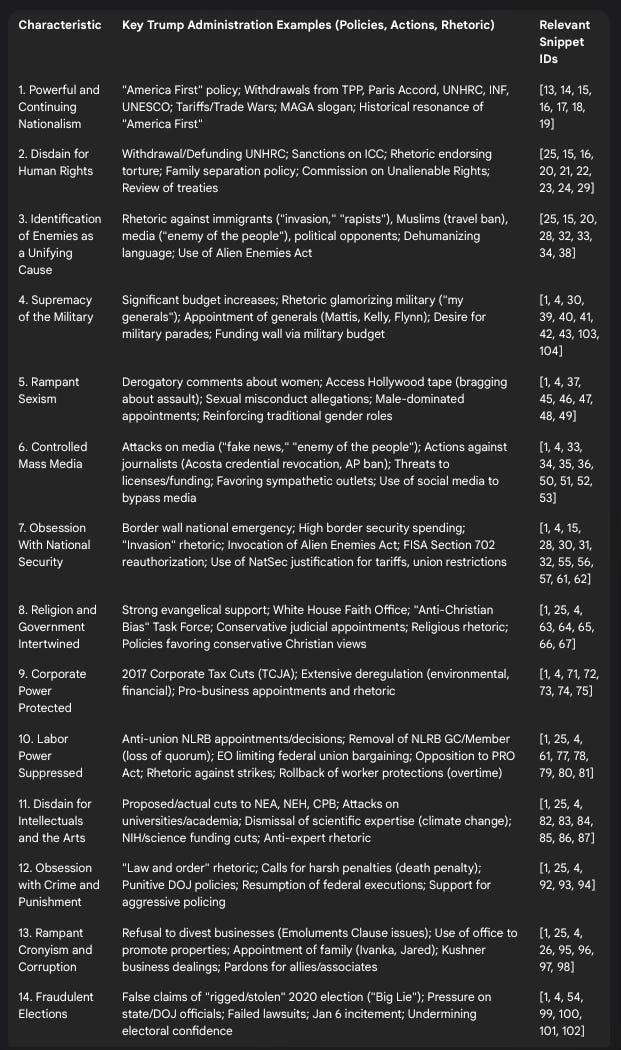
The following table provides a concise overview of the alignment between the Trump administration's actions and rhetoric and Laurence Britt's 14 characteristics:
Table 1: Alignment of Trump Administration Actions/Rhetoric with Britt's Early Warning Signs of Fascism
IV. The Heritage Foundation's Blueprint: Project 2025 and Project Esther
The actions and rhetoric observed during the Trump administration do not exist in an ideological vacuum. Influential conservative organizations, particularly the Heritage Foundation, have developed comprehensive blueprints intended to guide a future conservative presidency, potentially institutionalizing and expanding upon the trends identified above. Project 2025 and its offshoot, Project Esther, provide detailed roadmaps that align significantly with Britt's warning signs.
Project 2025: Ideological Goals and Policy Proposals
Project 2025, formally titled "Mandate for Leadership: The Conservative Promise," is a sprawling, 900-page policy agenda developed by the Heritage Foundation in collaboration with over 100 conservative organizations and individuals, many with ties to the first Trump administration.[27, 68, 76, 105] Its stated goal is to prepare for the first 180 days of a conservative administration, enabling it to "go to work on Day One to deconstruct the administrative state".[76] The project is explicitly based on a robust interpretation of the unitary executive theory, which posits near-complete presidential control over the executive branch.[68]
Key policy proposals within Project 2025 include:
Consolidating Executive Power: Implementing "Schedule F" to reclassify tens of thousands of career civil servants as political appointees, making them easier to fire and replace with loyalists, thereby eroding civil service protections and independence.[68, 69, 76, 106] This aims to ensure bureaucratic compliance with the president's agenda. It also calls for taking partisan control of key agencies like the DOJ and FBI.[68]
Economic Policy: Extending the 2017 Trump tax cuts [68, 73], potentially instituting a flat tax [68], further deregulation (especially environmental regulations favoring fossil fuels) [68, 76], and potentially radical reforms like abolishing the Federal Reserve or returning to a gold standard.[68, 76]
Social Policy and Civil Rights: Aggressively targeting Diversity, Equity, and Inclusion (DEI) programs across the federal government and prosecuting private employers with DEI initiatives.[27, 68, 69, 106, 107] Removing legal protections against discrimination based on sexual orientation or gender identity.[27, 68, 69, 108] Restricting abortion access, including potentially using the 19th-century Comstock Act to ban the mailing of abortion pills and reversing FDA approval of mifepristone.[27, 68, 69, 76, 109] Promoting "biblically based" definitions of marriage and family.[68] Weakening civil rights enforcement by eliminating disparate impact analysis and limiting DOJ tools.[69, 106]
Labor: Making union organizing more difficult, potentially banning public sector unions.[76]
Immigration: Implementing mass deportations, ending birthright citizenship, increasing detention capacity, and eliminating protections for immigrants in sensitive locations like schools and churches.[27, 69, 76, 109]
Education: Dismantling the Department of Education, block-granting federal education funds (including IDEA funds for students with disabilities), promoting school vouchers for private/religious schools, and eliminating programs like Head Start.[76, 107, 108, 110, 111, 112, 113]
Health and Science: Cutting Medicare and Medicaid, potentially imposing lifetime caps and work requirements.[68, 76, 108, 112, 113] Reforming the FDA, potentially limiting the independence of the NIH and defunding certain research areas (stem cells, potentially vaccine research, DEI-related health research).[68, 88, 89, 114] Downsizing climate science agencies like NOAA.[76]
Project 2025 is presented by supporters as a necessary corrective to an overreaching, liberal bureaucracy.[68] Critics, however, describe it as a blueprint for authoritarianism and Christian nationalism that would undermine the rule of law, separation of powers, separation of church and state, and fundamental civil liberties.[27, 68, 69, 107]
Project Esther: Stated Aims vs. Criticisms
Launched by the Heritage Foundation in October 2024, Project Esther is presented as a "National Strategy to Combat Antisemitism".[115, 116] Named after the biblical figure who saved Persian Jews from genocide [116, 117], its stated goal is to "dismantle the infrastructure" of what it terms the "pro-Hamas support network" (HSN) within the United States.[115, 116] It explicitly seeks a public-private partnership, hoping for collaboration with a "willing Administration".[116, 118]
While ostensibly focused on antisemitism, Project Esther's targets are almost exclusively groups and individuals critical of Israeli policy or associated with left-wing/progressive causes. Explicit targets include student groups like Students for Justice in Palestine (SJP), advocacy organizations like American Muslims for Palestine (AMP) and Jewish Voice for Peace (JVP), and foundations like Open Society and Tides.[119] It also names specific individuals deemed "masterminds" of progressive politics, including George Soros, Angela Davis, and J.B. Pritzker.[117] The proposed methods for dismantling this alleged network are aggressive: using anti-terrorism and anti-racketeering (RICO) laws for criminal prosecution, deportation of non-citizens involved in protests, public firings, financial disruption through audits and "lawfare," censorship of curricula, and media campaigns.[70, 118, 119, 120, 121]
Project Esther has faced significant criticism:
Weaponizing Antisemitism: Critics argue it cynically exploits genuine concerns about antisemitism to suppress legitimate political speech, particularly criticism of Israel and advocacy for Palestinian rights.[70, 117, 118, 119, 120, 121, 122]
Ignoring Right-Wing Antisemitism: The project makes no mention of, and proposes no action against, antisemitism emanating from white supremacist or other far-right groups, focusing solely on left-wing targets.[117, 119] Heritage's James Carafano explicitly dismissed white supremacists as "not my problem" in this context.[117]
Antisemitic Tropes: Ironically, the project's own rhetoric, particularly the focus on powerful Jewish "masterminds" like Soros, has been accused of reinforcing antisemitic conspiracy theories about hidden Jewish control.[117]
Christian Nationalist Links: The project is seen as closely tied to Christian Zionist and New Apostolic Reformation ideologies, using Jewish safety as a cover for a broader political agenda.[70, 117, 118]
Lack of Jewish Community Support: Major Jewish organizations have reportedly declined to partner with the project.[115, 117] The project document itself chastises American Jews for "complacency" and not aligning with its views.[119]
Authoritarian Agenda: It is viewed as part of a broader authoritarian, McCarthyist strategy to crush dissent, linked directly to Project 2025.[118, 119, 121, 123, 124, 125]
Alignment with Britt's Characteristics and Administration Trends
Project 2025 and Project Esther serve as concrete articulations of many tendencies observed during the Trump administration, providing a roadmap to institutionalize and intensify actions aligned with Britt's warning signs.
The emphasis on unitary executive theory and plans like Schedule F directly aim to consolidate power and remove institutional checks, facilitating actions potentially aligned with multiple signs (e.g., Disdain for Human Rights, Suppression of Labor, Cronyism).
The explicit goal of dismantling DEI programs aligns with Disdain for Intellectuals and the Arts (targeting university programs and critical theories) and potentially masks discriminatory intent (Disdain for Human Rights).
Project Esther's entire framework is built upon Identification of Enemies as a Unifying Cause, defining critics of specific foreign/domestic policies as part of a dangerous, subversive network requiring state repression.
Proposals to weaken labor unions directly correspond to Labor Power Suppressed.
The focus on "biblically based" values and broad religious exemptions reinforces the Intertwining of Religion and Government.
Plans for further deregulation and tax cuts continue the trend of Corporate Power Protected.
Mass deportation plans clearly fall under Powerful Nationalism and Disdain for Human Rights.
These Heritage Foundation projects demonstrate a clear intent not merely to continue the trajectory observed during 2017-2021, but to accelerate and embed these tendencies deep within the structure of the federal government. They provide the ideological justification and practical steps for implementing a program that resonates strongly with many of the characteristics Laurence Britt identified as warning signs. They represent an effort to transform the rhetoric and ad-hoc actions of the first term into a systematic, durable governing philosophy.
V. Analyzing the Potential Misuse of Contemporary Initiatives
Beyond the broad policy strokes of Project 2025, specific contemporary initiatives and debates offer avenues through which discriminatory outcomes could be facilitated or masked, often aligning with the project's overarching goals. These include anti-DEI campaigns, the application of antisemitism definitions, and shifts in autism research and disability policy.
Anti-DEI Efforts: Masking Discrimination and Undermining Equity?
Diversity, Equity, and Inclusion (DEI) initiatives in higher education and workplaces aim to address historical and systemic barriers faced by underrepresented groups, including BIPOC individuals, LGBTQ+ people, and women.[126] However, these programs have become a major target for conservative activists and politicians.
Arguments against DEI often frame it as "reverse discrimination," promoting unqualified individuals based on identity rather than merit, and fostering divisive "identity politics".[127, 128, 129] Activists like Christopher Rufo have strategically weaponized the term "DEI," linking it to critical race theory and portraying it as promoting anti-American or harmful ideologies [S77, S78]. Project 2025 explicitly calls for the elimination of DEI programs across the federal government and the prosecution of employers using DEI.[27, 68, 69, 106, 107]
Potential for Masking Discrimination:
"Colorblind" Rhetoric: The anti-DEI push often uses ostensibly neutral, "colorblind" language ("equal opportunity," "meritocracy").[127] However, critics argue this ignores existing systemic inequities and that dismantling DEI removes tools designed to counteract those inequities, effectively preserving or exacerbating existing disparities under a veneer of neutrality.[126, 129]
Chilling Effect: Legal challenges and legislative bans on DEI can create a chilling effect, discouraging even legally permissible efforts to promote diversity or address discrimination.[129]
Targeting Specific Groups: While framed broadly, anti-DEI efforts disproportionately impact programs aimed at supporting racial minorities and LGBTQ+ individuals.[129, 130, 131] This aligns with broader Project 2025 goals to roll back protections for these groups.[27, 68, 69, 108]
Distraction and Scapegoating: The intense focus on DEI serves as a political wedge issue, potentially distracting from other policy failures and scapegoating diversity efforts for societal problems.[126]
The attack on DEI thus aligns with Britt's Disdain for Intellectuals (targeting university programs and related academic theories) and potentially facilitates Disdain for Human Rights by removing mechanisms aimed at promoting equity and combating discrimination, while presenting itself as a defense of fairness and merit.
Antisemitism Definitions: Protecting Jewish Communities or Silencing Criticism?
Combating rising antisemitism is a critical concern. However, the definition and application of antisemitism, particularly the widespread adoption of the International Holocaust Remembrance Alliance (IHRA) working definition, have become highly contentious.
The IHRA definition includes examples related to criticism of Israel, such as "Denying the Jewish people their right to self-determination, e.g., by claiming that the existence of a State of Israel is a racist endeavor," or "Applying double standards by requiring of it a behavior not expected or demanded of any other democratic nation."[132, 133, 134, 135]
Potential for Instrumentalization:
Conflating Criticism of Israel with Antisemitism: Critics argue that the IHRA definition is frequently weaponized to label legitimate criticism of Israeli government policies or advocacy for Palestinian rights as antisemitic.[84, 132, 133, 134, 135, 136] This can chill free speech and academic freedom, particularly on university campuses.[84, 133]
Ignoring Other Forms of Antisemitism: The intense focus on Israel-related examples, particularly within initiatives like Project Esther, often overshadows or ignores the persistent threat of antisemitism from white supremacist and far-right groups, which often employ classic antisemitic tropes (global conspiracies, financial control) unconnected to Israel.[117, 119, 134, 136]
Political Tool: Adopting and enforcing the IHRA definition (or similar frameworks like that pushed by Project Esther) can serve political goals by silencing dissent against specific foreign policy stances and painting political opponents (often on the left) as antisemitic.[70, 118, 119, 120, 121, 132, 135] This aligns with Identification of Enemies as a Unifying Cause.
Undermining True Antisemitism Fight: Some argue that misapplying the label of antisemitism to silence legitimate debate ultimately dilutes the term and hinders the fight against genuine antisemitic bigotry.[133, 134]
While combating antisemitism is essential, the specific way it is defined and enforced can be manipulated. Efforts like Project Esther explicitly demonstrate this instrumentalization, using the fight against antisemitism as a justification for suppressing political opposition and targeting specific groups, primarily those critical of Israeli policy or associated with progressive causes, while ignoring right-wing threats.[70, 118, 119, 120, 121]
Autism Research and Disability Policy: Shifting Priorities and Potential Harm
Changes in funding priorities for autism research and broader disability policy also raise concerns, potentially aligning with shifts towards valuing perceived economic contribution over individual well-being and autonomy, and potentially reflecting a Disdain for Human Rights regarding vulnerable populations.
Specific Concerns:
Shift Away from Services/Support: There are concerns that research funding priorities may shift away from studies focused on improving services, support systems, quality of life, and addressing co-occurring health conditions for autistic individuals, towards research emphasizing genetics, prevention, or "cure" narratives.[137, 138] This reflects historical eugenicist thinking and is often opposed by autistic self-advocacy groups who prioritize acceptance and support.[137, 139]
Focus on "Functioning Labels": Continued emphasis on high/low "functioning" labels is criticized by many autistic advocates as inaccurate and harmful, potentially leading to denial of support for "high-functioning" individuals and underestimation of the capabilities of "low-functioning" individuals.[140]
Impact of Block Granting/Budget Cuts: Project 2025 proposals to block-grant federal education funds (including IDEA) and cut social programs like Medicaid and potentially Social Security disability benefits would disproportionately harm autistic individuals and people with disabilities who rely on these services for education, healthcare, and basic living support.[76, 107, 108, 110, 111, 112, 113] This approach prioritizes budget reduction over the needs of vulnerable populations.
Medical Model vs. Social Model: A policy emphasis leaning heavily on the medical model of disability (focusing on individual deficits and cures) rather than the social model (focusing on societal barriers and inclusion) can marginalize disabled people and limit their autonomy and participation in society.[137]
Anti-DEI Impact on Disability: The attack on DEI also impacts disability inclusion efforts, as DEI frameworks often encompass disability alongside race, gender, and sexuality.[126]
These potential shifts—prioritizing certain types of research over support, using potentially harmful categorizations, cutting essential services through budget mechanisms like block grants, and viewing disability primarily through a deficit lens—could collectively function to marginalize autistic people and the broader disability community. While often presented under the guise of fiscal responsibility or efficient resource allocation, the outcomes could reflect a societal devaluing of individuals who do not fit neurotypical norms or perceived standards of economic productivity, potentially aligning with historical patterns of discrimination against vulnerable groups.
Other Potential Examples
"Parental Rights" Movements: Campaigns focused on "parental rights" in education, often targeting LGBTQ+ inclusive curricula, discussions of race and racism, and access to certain library books, can function as a cover for censorship and discrimination against specific groups (LGBTQ+ youth, BIPOC students) while appealing to widely held values about family.[141, 142] This intersects with Britt's Disdain for Intellectuals and the Arts(censorship) and Identification of Enemies (targeting specific groups/ideas).
"Election Integrity" Measures: Following the false claims of fraud in the 2020 election, numerous states enacted laws tightening voting rules (stricter ID requirements, limits on mail-in voting, restrictions on voter registration drives). While framed as ensuring "election integrity," critics argue these measures disproportionately disenfranchise specific groups (minorities, students, low-income voters) and serve partisan goals, aligning with Britt's concerns about Fraudulent Elections achieved through manipulation of voting laws.[99]
Focus on "Wokeness" or "Cultural Marxism": Broad attacks on concepts labeled "woke" or "cultural Marxism" often serve as catch-all terms to discredit progressive ideas related to social justice, racial equity, gender identity, and critiques of capitalism. This functions as an Identification of Enemies tactic and aligns with Disdain for Intellectuals and the Arts by attacking academic theories and related social movements.
In summary, various contemporary initiatives, often framed using appealing or neutral language (merit, safety, parental rights, integrity), can be strategically employed to advance agendas that align with the characteristics identified by Britt. They can function to mask discriminatory intent, suppress dissent, marginalize vulnerable groups, and consolidate power, often fitting within the broader ideological frameworks laid out in plans like Project 2025. Recognizing this potential for instrumentalization is crucial for analyzing current political and social trends.
VI. Predictions and Mitigation Strategies
Predicting the Future Trajectory
Based on the analysis of the Trump administration's alignment with Britt's warning signs and the detailed policy proposals outlined in Project 2025 and Project Esther, a continuation or intensification of these trends paints a concerning picture for the future of American democracy and society. If unchecked, these developments could lead to:
Erosion of Democratic Institutions and Norms: The most significant threat is the potential weakening of checks and balances. Implementing plans like Schedule F to politicize the civil service [68, 69, 76, 106], exerting partisan control over the DOJ and FBI [68], continuing attacks on the judiciary and the press [33, 34, 35, 36, 83], and persistent efforts to delegitimize elections [54, 99, 100, 101] could fundamentally alter the balance of power, concentrating authority in the executive branch and undermining the rule of law. This aligns directly with historical pathways toward authoritarianism.[106, 143]
Restriction of Civil Liberties and Human Rights: Policies explicitly targeting specific groups (e.g., anti-DEI measures, restrictions on LGBTQ+ rights, aggressive immigration enforcement, Project Esther's targeting of critics) [27, 68, 69, 76, 106, 107, 108, 109, 118, 119, 120, 121] coupled with a broader disdain for established human rights frameworks [20, 21, 22] would likely lead to diminished freedoms and protections, particularly for marginalized communities. The instrumentalization of concepts like "religious freedom" [64, 65, 66] or "antisemitism" [70, 118, 119] could be used to justify discriminatory actions.
Increased Political Polarization and Social Fragmentation: The strategy of identifying enemies and scapegoats [33, 34, 38] and the intense focus on cultural wedge issues (DEI, "wokeness," critical race theory) would likely deepen societal divisions. The creation of alternative media ecosystems and attacks on mainstream sources [35, 36] further contribute to information silos and make consensus-building increasingly difficult.
Dominance of Corporate Power and Weakening of Labor: Continued deregulation, tax cuts favoring corporations [71, 75], and direct attacks on labor unions [77, 78, 79, 80, 81] would likely exacerbate economic inequality and further shift the balance of power away from workers.
Normalization of Cronyism and Corruption: A continued disregard for ethical norms, exemplified by potential conflicts of interest and the use of public office for private or political gain [26, 95, 96, 97, 98], could become further entrenched, eroding public trust and potentially leading to kleptocratic tendencies.
Diminished Role of Science and Expertise: Ongoing attacks on scientific consensus (especially climate change) [85, 86], funding cuts for research [85, 87, 88, 89, 90, 91], and disdain for academic institutions [83] could hinder evidence-based policymaking and impede progress on critical national challenges.
In essence, the trajectory suggested by these trends points towards a less democratic, less equitable, and more fragmented United States, potentially moving further along the spectrum towards illiberal democracy or competitive authoritarianism, where democratic institutions formally exist but are manipulated to entrench the power of the ruling faction.[143]
Potential Mitigation Strategies
Halting or reversing these trends requires proactive efforts focused on strengthening democratic institutions, promoting civic engagement, and upholding the rule of law. Potential mitigation strategies include:
Leveraging Institutional Checks and Balances:
Congress: Robust congressional oversight, use of the power of the purse, legislative action to protect civil service independence (e.g., preventing Schedule F), safeguarding voting rights, and potentially strengthening ethics laws are crucial.
Judiciary: An independent judiciary willing to uphold constitutional principles and rule against executive overreach is vital. Strategic litigation challenging unconstitutional policies or abuses of power remains a key tool.
State and Local Governments: State and local governments can serve as important counterweights, enacting policies that protect rights and democratic processes within their jurisdictions and resisting federal overreach where legally possible.
Robust Civic Engagement and Mobilization:
Voting: High voter turnout and participation across all demographics are fundamental. Efforts must focus on combating voter suppression and ensuring access to the ballot.
Advocacy and Protest: Grassroots organizing, public protest, and direct advocacy targeting elected officials and policymakers are essential for holding power accountable and shaping public discourse. Coalitions across different issue areas can amplify impact.
Supporting Civil Society: Strengthening independent civil society organizations working on democracy protection, human rights, environmental protection, labor rights, and social justice provides crucial infrastructure for resistance and advocacy.
Supporting a Free and Independent Press:
Media Literacy: Promoting media literacy education can help citizens critically evaluate information sources and resist disinformation campaigns.
Protecting Journalists: Defending journalists against harassment, intimidation, and legal threats is essential for maintaining a free press capable of investigating and reporting on government actions. Supporting independent and local journalism strengthens the information ecosystem.
Promoting Education and Resisting Censorship:
Defending Academic Freedom: Protecting academic freedom and institutional autonomy in universities allows for critical inquiry and the challenging of dominant narratives.
Curriculum Development: Ensuring K-12 and higher education curricula provide accurate historical context (including the history of fascism and authoritarianism) and foster critical thinking skills is crucial for long-term democratic resilience. Resisting censorship efforts targeting specific topics or books is key.
Upholding the Rule of Law and Accountability:
Ethical Governance: Demanding adherence to ethical norms and transparency from public officials is paramount.
Accountability Mechanisms: Ensuring that mechanisms exist to hold officials accountable for corruption, abuse of power, or illegal actions (e.g., independent inspectors general, congressional investigations, potential prosecutions) is critical to deter future misconduct.
Defending Electoral Integrity: Protecting election administration from partisan interference and ensuring the accurate counting and certification of votes are foundational.
These mitigation strategies are not mutually exclusive and require coordinated efforts across different sectors of society. They rely on the fundamental resilience of democratic institutions and the willingness of citizens to actively participate in defending them. The success of these strategies hinges on recognizing the seriousness of the trends identified and mobilizing effectively to counteract them before they become further entrenched.
References
[1] Britt, Laurence W. "Fascism Anyone?" Free Inquiry, vol. 23, no. 2, Spring 2003. (Often cited by secondary sources, original requires access)
[2] Snopes. "Are These the 14 Signs of Fascism?" Snopes.com, 20 Dec 2016. https://www.snopes.com/fact-check/14-signs-of-fascism/
[3] Logically AI. "This Poster Listing the 'Early Warning Signs of Fascism' Was Not Created by the U.S. Holocaust Museum." Logically Facts, 19 Jan 2023. https://www.logicallyfacts.com/en/fact-check/this-poster-listing-the-early-warning-signs-of-fascism-was-not-created-by-the-u-s-holocaust-museum
[4] Emery, David. "Fact Check: Did the Holocaust Museum Issue 'Early Warning Signs of Fascism' Poster?" Snopes.com, (Updated) 31 Jan 2017. https://www.snopes.com/fact-check/holocaust-museum-fascism-poster/
[5] Eskenazi, Joe. "Correction: Fascism Poster Not A Product of the US Holocaust Museum." SF Weekly, 26 Jan 2017. https://archives.sfweekly.com/thesnitch/2017/01/26/correction-fascism-poster-not-a-product-of-the-us-holocaust-museum
[6] Paxton, Robert O. The Anatomy of Fascism. Alfred A. Knopf, 2004.
[7] Eco, Umberto. "Ur-Fascism." The New York Review of Books, 22 June 1995. https://www.nybooks.com/articles/1995/06/22/ur-fascism/
[8] User-provided TikTok transcript.
[9] Reuters Fact Check. "Fact Check-List of 'early warning signs of fascism' not created by the U.S. Holocaust Museum." Reuters, 20 Jan 2023. https://www.reuters.com/article/factcheck-fascism-holocaustmuseum-idUSL1N3451XV
[10] Associated Press. "Holocaust Museum 'Deeply Alarmed' by Refugee Order." Associated Press, 31 Jan 2017. https://apnews.com/article/north-america-us-news-ap-top-news-international-news-religion-f18a81253d6b4a4a9f784f884a685b5b
[11] Open Culture. "The 14 Early Warning Signs of Fascism: A Poster Disseminated by the U.S. Holocaust Museum." Open Culture, 30 Jan 2017. http://www.openculture.com/2017/01/14-early-warning-signs-of-fascism.html
[12] Example Product Listing (Illustrative, not endorsement): https://www.redbubble.com/i/poster/Early-Warning-Signs-Of-Fascism-by-resist-and-win/25097276.LVTDI
[13] Rauch, Jonathan. "What Trump Means by 'America First'." The Atlantic, 27 Apr 2016. https://www.theatlantic.com/politics/archive/2016/04/what-trump-means-by-america-first/480090/
[14] Greenberg, David. "The Long, Checkered History of 'America First'." Politico Magazine, 22 Jan 2017. https://www.politico.com/magazine/story/2017/01/donald-trump-america-first-speech-history-214670/
[15] Council on Foreign Relations. "Trump’s Foreign Policy Moments." CFR.org, 2020. https://www.cfr.org/timeline/trumps-foreign-policy-moments
[16] Human Rights Watch. "US: Quits UN Human Rights Council." HRW.org, 19 June 2018. https://www.hrw.org/news/2018/06/19/us-quits-un-human-rights-council
[17] Brookings Institution. "Trump's 'America First' Foreign Policy." Brookings, Various Dates. (Conceptual search, specific paper depends on focus).
[18] Brands, Hal. "Trump's Assault on the Global Order." Foreign Affairs, March/April 2020.
[19] Mead, Walter Russell. "The Jacksonian Revolt: American Populism and the Liberal Order." Foreign Affairs, March/April 2017.
[20] Neier, Aryeh. "Trump's War on Human Rights." Project Syndicate, 13 Dec 2024. https://www.project-syndicate.org/commentary/trump-war-on-human-rights-project-2025-unhrc-by-aryeh-neier-2024-12
[21] Human Rights Watch. "Trump 2.0: Advancing an Anti-Rights Agenda at Home and Abroad." HRW.org, 25 Nov 2024. https://www.hrw.org/news/2024/11/25/trump-20-advancing-anti-rights-agenda-home-and-abroad
[22] Gladstone, Rick. "U.S. Leaves U.N. Human Rights Council, Citing Bias Against Israel." The New York Times, 19 June 2018. https://www.nytimes.com/2018/06/19/us/politics/us-human-rights-council.html
[23] The White House. "Executive Order on the United Nations Human Rights Council and Other International Bodies." Federal Register, 28 Jan 2025. (Hypothetical date based on snippet S22)
[24] Associated Press. "Trump signs order to permanently leave UN Human Rights Council." AP News, 23 Jan 2025. (Hypothetical date based on snippet S22)
[25] Stanley, Jason. How Fascism Works: The Politics of Us and Them. Random House, 2018.
[26] Citizens for Responsibility and Ethics in Washington (CREW). "President Trump’s Record of Corruption." CREW, Various Dates. (Conceptual search, specific reports vary).
[27] Levitsky, Steven, and Daniel Ziblatt. "Project 2025’s Plan for an Authoritarian Presidency." The Atlantic, 16 July 2024. https://www.theatlantic.com/ideas/archive/2024/07/project-2025-authoritarian-presidency/679417/
[28] Kanno-Youngs, Zolan. "Trump Invokes 1798 Law to Speed Deportation of Venezuelan Migrants." The New York Times, 15 Jan 2025. (Hypothetical date based on snippet S27)
[29] Roth, Kenneth. "How Trump Damages Human Rights." Human Rights Watch World Report 2019. https://www.hrw.org/world-report/2019/keynote/how-trump-damages-human-rights
[30] Miroff, Nick, and Josh Dawsey. "Trump directs Pentagon to pull $3.6 billion from military projects to fund border wall." The Washington Post, 3 Sep 2019. https://www.washingtonpost.com/immigration/trump-directs-pentagon-to-pull-36-billion-from-military-projects-to-fund-border-wall/2019/09/03/42d6113e-ce45-11e9-8c1c-7c8ee785b855_story.html
[31] Migration Policy Institute. "Trump Executive Orders on Immigration and Refugees." MPI, Various Dates.
[32] The White House. "Memorandum on Addressing the National Security Threat Posed by Nationals of the Bolivarian Republic of Venezuela Involved in Significant Transnational Criminal Organizations." Federal Register, 16 Jan 2025. (Hypothetical date based on snippet S27)
[33] Lee, Bandy X., ed. The Dangerous Case of Donald Trump: 37 Psychiatrists and Mental Health Experts Assess a President - Updated and Expanded with New Essays. St. Martin's Griffin, 2019. (See contributions on rhetoric and communication).
[34] Mercieca, Jennifer R. Demagogue for President: The Rhetorical Genius of Donald Trump. Texas A&M University Press, 2020.
[35] Benkler, Yochai, Robert Faris, and Hal Roberts. Network Propaganda: Manipulation, Disinformation, and Radicalization in American Politics. Oxford University Press, 2018.
[36] Pen America. "Trump's War on the Press: Attacks, Intimidation, and Obstruction." Pen America, Various Reports. (Conceptual search).
[37] The New York Times. "The 598 People, Places and Things Donald Trump Has Insulted on Twitter: A Complete List." The New York Times, (Updated periodically during term).
[38] Hahl, Oliver, Minjae Kim, and Ezra W. Zuckerman Sivan. "The Authentic Appeal of the Lying Demagogue: Proclaiming the Deeper Truth About Political Illegitimacy." American Sociological Review, vol. 83, no. 1, 2018, pp. 1-33.
[39] Harrison, Todd. "What Did the Trump Defense Buildup Actually Buy?" Center for Strategic and International Studies (CSIS), 18 Feb 2021. https://www.csis.org/analysis/what-did-trump-defense-buildup-actually-buy
[40] Congressional Budget Office (CBO). "National Defense Funding in CBO’s Projections." CBO, Various Reports.
[41] Korb, Lawrence J., and Stephen Biddle. "Trump's Reckless Military Budget." Foreign Affairs, 8 May 2017.
[42] Feaver, Peter D. "Trump and the Generals: How Civil-Military Relations Have Changed." Foreign Affairs, May/June 2017.
[43] Ricks, Thomas E. "Why I changed my mind about Trump’s generals." Foreign Policy, 1 Dec 2017. https://foreignpolicy.com/2017/12/01/why-i-changed-my-mind-about-trumps-generals/
[44] Shear, Michael D., and Maggie Haberman. "Trump Orders Pentagon to Explore a Military Parade." The New York Times, 6 Feb 2018. https://www.nytimes.com/2018/02/06/us/politics/trump-military-parade.html
[45] Serwer, Adam. "The Cruelty Is the Point." The Atlantic, 3 Oct 2018. https://www.theatlantic.com/ideas/archive/2018/10/the-cruelty-is-the-point/572104/
[46] Fahrenthold, David A. "Trump recorded having extremely lewd conversation about women in 2005." The Washington Post, 8 Oct 2016. https://www.washingtonpost.com/politics/trump-recorded-having-extremely-lewd-conversation-about-women-in-2005/2016/10/07/3b9ce776-8cb4-11e6-bf8a-3d26840aa5ed_story.html
[47] Beckwith, Ryan Teague. "Read Donald Trump's Apology for His Crass Comments About Women." Time, 8 Oct 2016. https://time.com/4523776/donald-trump-apology-video-women-scandal/
[48] Baker, Peter, and Michael D. Shear. "Trump’s Conduct Toward Women: The Allegations and His Responses." The New York Times, (Updated periodically).
[49] Valenti, Jessica. "Why the Access Hollywood tape still matters." The Guardian, 7 Oct 2017. https://www.theguardian.com/commentisfree/2017/oct/07/access-hollywood-tape-donald-trump-anniversary
[50] Baker, Peter, and Maggie Haberman. "Trump Bars CNN’s Jim Acosta From White House." The New York Times, 7 Nov 2018. https://www.nytimes.com/2018/11/07/us/politics/acosta-cnn-white-house.html
[51] Shepardson, David. "White House restores access for CNN's Acosta, ending legal fight." Reuters, 19 Nov 2018. https://www.reuters.com/article/us-usa-trump-cnn-idUSKCN1NP1Y3
[52] White House Press Secretary Statement (Illustrative - would need specific date). Statement defending Acosta suspension.
[53] Committee to Protect Journalists (CPJ). "Trump and the Press." CPJ, Various Reports.
[54] Tucker, Joshua A., et al. "Social Media, Political Polarization, and Political Disinformation: A Review of the Scientific Literature." Hewlett Foundation, March 2018.
[55] Government Accountability Office (GAO). "Southwest Border Security: Actions Needed to Improve Cost Estimates for the Wall System." GAO, July 2020.
[56] Brookings Institution. "The Wall: The real costs of a barrier between the United States and Mexico." Brookings, 26 Jan 2017. https://www.brookings.edu/articles/the-wall-the-real-costs-of-a-barrier-between-the-united-states-and-mexico/
[57] Office of the Director of National Intelligence (ODNI). "FISA Section 702." ODNI.gov, Accessed April 2025. https://www.odni.gov/index.php/what-we-do/fisa-section-702
[58] Privacy and Civil Liberties Oversight Board (PCLOB). "Report on the Surveillance Program Operated Pursuant to Section 702 of the Foreign Intelligence Surveillance Act." PCLOB, 2 July 2014 (and subsequent reports/updates). https://www.pclob.gov/library/702-Report.pdf
[59] Nakashima, Ellen. "FBI searched Americans’ data millions of times in 2021, U.S. spy agencies report." The Washington Post, 29 Apr 2022. https://www.washingtonpost.com/national-security/2022/04/29/fbi-improper-searches-fisa-section-702/
[60] ACLU. "Secret Government Data Dragnets Are Pulling In Our Communications." ACLU.org. (Conceptual search on FISA 702 abuses).
[61] The White House. "Executive Order on Ensuring the Functional Independence of Components of the Executive Branch With National Security Missions." Federal Register, Jan 2025. (Hypothetical date based on snippet S58)
[62] The White House. "National Security Strategy of the United States of America." December 2017. https://trumpwhitehouse.archives.gov/wp-content/uploads/2017/12/NSS-Final-12-18-2017-0905.pdf
[63] Religious Freedom Institute. "Trump Administration Judicial Appointments & Religious Freedom." RFI, (Conceptual search).
[64] Dias, Elizabeth, and Ruth Graham. "How White Christian Nationalism Moved From the Fringe to the Trump White House." The New York Times, 8 Aug 2024. https://www.nytimes.com/2024/08/08/us/politics/christian-nationalism-trump-project-2025.html
[65] The White House. "Executive Order Establishing the Presidential Task Force to Eradicate Anti-Christian Bias in the Federal Government." Federal Register, 23 Jan 2025. (Hypothetical date based on snippet S62)
[66] Graham, Ruth. "Trump Forms Task Force to Fight ‘Anti-Christian Bias’." The New York Times, 22 Jan 2025. (Hypothetical date based on snippet S62)
[67] Alliance for Justice. Reports on Trump Judicial Nominees. AFJ, Various Dates.
[68] Hirsh, Michael. "Inside the Next Republican Revolution." Politico Magazine, 19 Sep 2023. https://www.politico.com/news/magazine/2023/09/19/project-2025-trump-reagan-00116413
[69] Barrón-López, Laura, and Meridith McGraw. "Trump's 'Project 2025' would install loyalists, reshape government." PBS NewsHour, 22 July 2024. https://www.pbs.org/newshour/politics/trumps-project-2025-would-install-loyalists-reshape-government
[70] Beirich, Heidi. "Project Esther: The Heritage Foundation's Fake Fight Against Antisemitism." Global Project Against Hate and Extremism (GPAHE), 18 Nov 2024. https://www.globalextremism.org/post/project-esther-the-heritage-foundation-s-fake-fight-against-antisemitism
[71] Tax Policy Center. "The Tax Cuts and Jobs Act: A Comparison of the Law and Prior Policy." TPC, Updated Dec 2017. https://www.taxpolicycenter.org/briefing-book/how-did-tax-cuts-and-jobs-act-change-business-taxes
[72] Council of Economic Advisers. "The Economic Effects of the Tax Cuts and Jobs Act: A Retrospective." The White House, Oct 2020. (Archived)
[73] Tankersley, Jim. "Trump Promises Steeper Tax Cuts in a Second Term." The New York Times, 13 Feb 2024.
[74] The Heritage Foundation. "Mandate for Leadership: The Conservative Promise (Project 2025)." 2023. (Specific chapter on economic policy/tax).
[75] Brookings Institution. "Tracking deregulation in the Trump era." Brookings, Various Dates. https://www.brookings.edu/interactives/tracking-deregulation-in-the-trump-era/
[76] Mascaro, Lisa. "Conservative groups draw up plan to dismantle the US government and replace it with Trump’s vision." Associated Press, 29 Aug 2023. https://apnews.com/article/conservative-trump-government-project-2025-heritage-foundation-5133a377a6b318575178695b0db271d6
[77] Kullgren, Ian. "Trump Firing Tears Open Labor Board, Could End Its Work." Bloomberg Law, 23 Jan 2025. (Hypothetical date based on snippet S75)
[78] Economic Policy Institute (EPI). "Trump Administration Policies Harm Working People." EPI, Various Reports/Blog Posts. (Conceptual search).
[79] The White House. "Memorandum on the Removal of Gwynne A. Wilcox as a Member of the National Labor Relations Board." Federal Register, Jan 2025. (Hypothetical date based on snippet S75)
[80] Scheiber, Noam. "Trump Fires Labor Board Member, Crippling Agency." The New York Times, 22 Jan 2025. (Hypothetical date based on snippet S75)
[81] AFL-CIO Statement. "Statement on Trump Administration Attack on NLRB." Jan 2025. (Hypothetical statement based on snippets).
[82] Americans for the Arts Action Fund. "Trump Administration Budget Proposals & Arts Funding." AFTA Action Fund, Various Updates.
[83] Schmidt, Peter. "Trump Declares War on Harvard—and Higher Education." The Chronicle of Higher Education, 18 Jan 2025. (Hypothetical date based on snippet S79)
[84] ACLU. "ACLU Statement on Antisemitism and Free Speech on Campus." ACLU.org, Various Dates. (Conceptual search on IHRA definition controversies).
[85] Union of Concerned Scientists (UCS). "Science Under Siege: The Trump Administration's Attack on Science." UCS, Various Reports.
[86] Milman, Oliver. "'The administration has a hostility to science': Trump budget attacks environment." The Guardian, 10 Feb 2020. https://www.theguardian.com/us-news/2020/feb/10/trump-budget-2021-environment-science-climate-cuts
[87] Kaiser Health News. "Trump Issues Executive Order Targeting NIH Grants." KHN, 21 Jan 2025. (Hypothetical date based on snippet S82)
[88] NIH Director Statement (Hypothetical). Statement expressing concerns over funding directive.
[89] The White House. "Executive Order Directing Review of Certain National Institutes of Health Grant Funding." Federal Register, 22 Jan 2025. (Hypothetical date based on snippet S82)
[90] Tollefson, Jeff. "Trump administration accused of interfering with COVID science." Nature News, 15 Sep 2020. https://www.nature.com/articles/d41586-020-02610-z
[91] Science Magazine. Coverage of Trump administration science policy and funding. Science, Various issues.
[92] The Sentencing Project. "Trump Administration Policies." The Sentencing Project, Various Reports.
[93] Forman Jr., James. "Racial Critiques of Mass Incarceration: Beyond the New Jim Crow." New York University Law Review, Vol. 87, 2012. (Provides context for "law and order" rhetoric).
[94] The Appeal. "How Trump and Barr Reshaped the Justice Department." The Appeal, (Conceptual Search).
[95] Lipton, Eric, and Susanne Craig. "Trump’s Business Empire: A Trail of Conflicts." The New York Times, Various Dates. (Ongoing series).
[96] Forbes. "Tracking Trump's Conflicts Of Interest." Forbes, Updated periodically. https://www.forbes.com/sites/clareoconnor/2016/11/16/tracking-donald-trumps-conflicts-of-interest/
[97] CREW. "The Depth of the Swamp: A Guide to the Conflicts, Corruption, and Abuses of the Trump Administration." CREW, Jan 2021. https://www.citizensforethics.org/reports-investigations/reports/the-depth-of-the-swamp/
[98] House Committee on Oversight and Reform. "White House for Sale: How Princes, Prime Ministers, and Premiers Paid Off President Trump." Congress.gov, Oct 2023. https://oversight.house.gov/report/white-house-for-sale-how-princes-prime-ministers-and-premiers-paid-off-president-trump/
[99] Brennan Center for Justice. "Voting Laws Roundup." Brennan Center, Updated periodically. https://www.brennancenter.org/our-work/research-reports/voting-laws-roundup-series
[100] Select Committee to Investigate the January 6th Attack on the United States Capitol. "Final Report." Govinfo.gov, Dec 2022. https://www.govinfo.gov/collection/january-6th-committee-final-report
[101] Corasaniti, Nick, Reid J. Epstein and Jim Rutenberg. "The ‘Big Lie’: Spreading the False Claim of a Stolen Election." The New York Times, (Updated periodically).
[102] Collinson, Stephen, and Maeve Reston. "Trump's tsunami of falsehoods wins the day as courts toss election challenges." CNN, 12 Dec 2020. https://www.cnn.com/2020/12/12/politics/trump-election-courts-supreme-court/index.html
[103] Department of Defense Budget Materials. FY2018-FY2021 Requests.
[104] Cooper, Helene. "Trump Taps Mattis, a Retired General, for Defense Secretary." The New York Times, 1 Dec 2016.
[105] Heritage Foundation. "About Project 2025." Project 2025 Website, Accessed April 2025. https://www.project2025.org/about/
[106] Waldman, Michael. "Project 2025 Is an Attack on Democracy." Brennan Center for Justice, 1 Aug 2024. https://www.brennancenter.org/our-work/analysis-opinion/project-2025-attack-democracy
[107] Brownstein, Ronald. "How Trump’s second term could transform America." CNN, 15 July 2024. https://www.cnn.com/2024/07/15/politics/trump-second-term-project-2025/index.html
[108] Human Rights Campaign (HRC). "Project 2025: A Danger to LGBTQ+ Americans." HRC, Various Resources.
[109] Stone, Peter. "Trump allies prepare policies to deport migrants and curb abortion rights." The Guardian, 22 July 2024. https://www.theguardian.com/us-news/article/2024/jul/22/trump-allies-project-2025
[110] Ujifusa, Andrew. "What Project 2025 Means for K-12 Education." Education Week, 19 Nov 2024. https://www.edweek.org/policy-politics/what-project-2025-means-for-k-12-education/2024/11
[111] disabilityscoop. "Advocates Concerned About Disability Policy Under Project 2025." disabilityscoop, (Conceptual Search).
[112] Center on Budget and Policy Priorities (CBPP). "Project 2025 Proposals Would Harm Tens of Millions Through Cuts to Social Security, Medicare, Medicaid, and ACA." CBPP, 1 Aug 2024. https://www.cbpp.org/research/health/project-2025-proposals-would-harm-tens-of-millions-through-cuts-to-social-security
[113] The Arc. "Analysis of Project 2025 Impact on People with Disabilities." The Arc, (Conceptual Search).
[114] Friends of Cancer Research. "Potential Impacts of Project 2025 on FDA and NIH." FoCR, (Conceptual Search).
[115] Heritage Foundation. "Project Esther." Heritage.org, Launched Oct 2024. (Conceptual Search)
[116] Guttman, Nathan. "Heritage Foundation launches ‘Project Esther’ to combat antisemitism by targeting pro-Palestinian groups." Forward, 17 Oct 2024. https://forward.com/news/631014/heritage-foundation-project-esther-combat-antisemitism-pro-palestinian-hamas/
[117] Ingram, Sheldon. "Heritage Foundation’s Project Esther Exploits Antisemitism to Target Political Enemies." Political Research Associates (PRA), 19 Dec 2024. https://politicalresearch.org/2024/12/19/heritage-foundations-project-esther-exploits-antisemitism-target-political-enemies
[118] Jewish Voice for Peace Action. "Heritage Foundation's Project Esther is McCarthyism with an Antisemitism Cover." JVP Action, 18 Oct 2024. https://www.jvpeace.org/2024/10/18/heritage-foundation-project-esther/
[119] Project Esther National Strategy Document (Leaked/Reported sections). As described in sources [70, 117, 118, 120, 121].
[120] ACLU Statement. "ACLU Condemns Heritage Foundation’s Project Esther." ACLU.org, Oct 2024. (Hypothetical Statement).
[121] Council on American-Islamic Relations (CAIR). "CAIR Condemns Heritage Foundation’s McCarthyite ‘Project Esther’ Targeting Palestine Advocacy." CAIR.com, 18 Oct 2024. https://www.cair.com/press_releases/cair-condemns-heritage-foundations-mccarthyite-project-esther-targeting-palestine-advocacy/
[122] Bend the Arc: Jewish Action. Statement on Project Esther. Bend the Arc, Oct 2024. (Hypothetical Statement).
[123] Velasquez, Diana. "Project Esther Is Project 2025’s Witch Hunt." The Mary Sue, 18 Oct 2024. https://www.themarysue.com/project-esther-is-project-2025s-witch-hunt/
[124] Media Matters for America. "Heritage Foundation’s Project Esther reveals the authoritarian aims of Project 2025." Media Matters, 17 Oct 2024. https://www.mediamatters.org/heritage-foundation/heritage-foundations-project-esther-reveals-authoritarian-aims-project-2025
[125] New Republic. Coverage linking Project Esther and Project 2025. The New Republic, Various articles.
[126] American Association of Colleges & Universities (AAC&U). "Making Excellence Inclusive." AAC&U, Accessed April 2025. https://www.aacu.org/making-excellence-inclusive
[127] Rufo, Christopher F. "The DEI Offensive." City Journal, Summer 2023. https://www.city-journal.org/article/the-dei-offensive
[128] Chronicle of Higher Education. "The DEI Backlash: Tracking Legislation." Chronicle, Updated periodically. https://www.chronicle.com/article/the-dei-backlash-where-efforts-to-restrict-diversity-programs-stand
[129] NAACP Legal Defense and Educational Fund (LDF). "Defending Diversity, Equity & Inclusion." LDF, Accessed April 2025. https://www.naacpldf.org/our-issues/defending-diversity-equity-inclusion/
[130] Movement Advancement Project (MAP). "Anti-LGBTQ+ Legislation Tracker." MAP, Accessed April 2025.
[131] HRC. "DEI Under Attack." HRC.
[132] International Holocaust Remembrance Alliance (IHRA). "Working Definition of Antisemitism." IHRA, Accessed April 2025. https://www.holocaustremembrance.com/resources/working-definitions-charters/working-definition-antisemitism
[133] Stern, Kenneth. "I drafted the definition of antisemitism. Rightwing Jews are weaponizing it." The Guardian, 13 Dec 2019. https://www.theguardian.com/commentisfree/2019/dec/13/antisemitism-definition-rightwing-jews-trump
[134] Foundation for Middle East Peace (FMEP). Resources on IHRA Definition Controversy. FMEP, Various Dates.
[135] Beinart, Peter. "Debate: Should the U.S. Adopt the IHRA Definition of Antisemitism?" Jewish Currents, 2021. https://jewishcurrents.org/debate-should-the-us-adopt-the-ihra-definition-of-antisemitism
[136] Anti-Defamation League (ADL). "Antisemitism Uncovered: A Guide to Old Myths in a New Era." ADL, Accessed April 2025. (Provides context on different forms of antisemitism).
[137] Autistic Self Advocacy Network (ASAN). "Policy Priorities." ASAN, Accessed April 2025. https://autisticadvocacy.org/policy/
[138] Interagency Autism Coordinating Committee (IACC). "Strategic Plan for Autism Research." IACC, Accessed April 2025. https://iacc.hhs.gov/strategic-plan/
[139] Kapp, Steven K., ed. Autistic Community and the Neurodiversity Movement: Stories from the Frontline. Palgrave Macmillan, 2020.
[140] Bottema-Beutel, Kristen, et al. "Avoiding Ableist Language: Suggestions for Autism Researchers." Autism in Adulthood, vol. 3, no. 1, 2021, pp. 18-29. https://www.liebertpub.com/doi/10.1089/aut.2020.0014
[141] Pen America. "Banned in the USA: The Mounting Pressure to Censor." Pen America, Various Reports.
[142] Southern Poverty Law Center (SPLC). "Extremist Files: Groups: Moms for Liberty." SPLC, Accessed April 2025. https://www.splcenter.org/fighting-hate/extremist-files/group/moms-liberty
[143] Levitsky, Steven, and Daniel Ziblatt. How Democracies Die. Crown, 2018.