
The year 2025 represented a decisive break in U.S. policy toward the Russian Federation. These actions have collectively eroded the containment architecture built in the aftermath of the 2022 invasion
...effectively granting the Russian Federation a sphere of influence in Eastern Europe and rehabilitating its status as a great power on the global stage.

The Great Rebalancing: A Strategic Assessment of U.S. Administrative and Policy Shifts Benefiting the Russian Federation in 2025
by ChatGPT-5.2
Executive Summary
The geopolitical landscape of 2025 was defined by a fundamental strategic reorientation of the United States’ foreign policy regarding the Russian Federation and the ongoing conflict in Ukraine. Under the second administration of President Donald J. Trump, Washington executed a systemic pivot from the containment, isolation, and attrition strategies that characterized the 2022–2024 period, moving toward a framework of transactional engagement, retrenchment, and “America First” prioritization. This report provides an exhaustive catalogue and analysis of specific measures taken by the U.S. executive branch in 2025 that have accrued to the strategic, military, economic, and political benefit of Russia, Vladimir Putin, and the Kremlin.
The analysis identifies a synchronized dismantling of the pressure architecture established by Western allies following the 2022 invasion of Ukraine. These measures were not isolated incidents but part of a coherent policy shift driven by a new national security doctrine that views the war in Ukraine as a drain on U.S. resources rather than a vital national interest. The benefits to Russia are clustered into six primary domains: Military De-escalation and Security Architecture, Dismantling of Sanctions Enforcement, Diplomatic Normalization, Information Operations Space, Legal and Asset Protection, and Commercial Trade Facilitation.
Key findings indicate that the suspension of military aid to Ukraine, the disbanding of the Department of Justice’s Task Force KleptoCapture, the closure of the State Department’s Global Engagement Center (GEC), and the targeted removal of sanctions on key supply-chain intermediaries have collectively provided the Kremlin with the operational breathing room necessary to stabilize its economy and consolidate territorial gains. Furthermore, the administration’s withdrawal from active enforcement of the G7 oil price cap and the initiation of high-level diplomatic summits have eroded the multilateral consensus on isolating Moscow, effectively granting Russia a sphere of influence in Eastern Europe.
1. The Transformation of Security Architecture: Military De-escalation and the Erosion of Ukrainian Defense
The most immediate, tangible, and strategically decisive benefits to the Kremlin in 2025 materialized in the military and security domains. The Trump administration’s pivot away from “blank check” support for Kyiv fundamentally altered the balance of power in Eastern Europe, directly servicing Moscow’s strategic objective of demilitarizing its western periphery and halting the expansion of Euro-Atlantic security guarantees.
1.1 The Suspension of Military Assistance and Lethal Aid
In March 2025, the White House initiated a comprehensive suspension of U.S. military aid to Ukraine. This directive, executed via the Department of Defense and the National Security Council, halted the transfer of critical materiel, including ammunition, armored vehicles, and air defense systems that had previously been authorized or were in the pipeline from the previous administration.1 This decision marked the singular most significant strategic gift to the Russian military effort since the war’s inception.
1.1.1 Operational Impact on the Frontline
The cessation of artillery shell and interceptor missile deliveries forced the Armed Forces of Ukraine (AFU) to ration ammunition severely across the Donbas and southern fronts. The U.S. had previously been the primary supplier of 155mm artillery shells and GMLRS munitions for the HIMARS platform. The abrupt “pause” in these deliveries created a “fire control vacuum.” Russian artillery, previously checked by accurate Ukrainian counter-battery fire, was able to operate with increasing impunity.
This degradation of Ukrainian fire control allowed Russian forces to advance with reduced attrition rates in the Donetsk and Zaporizhzhia sectors throughout the spring and summer of 2025.2 The psychological impact on Ukrainian defenders, realizing that their primary logistical lifeline had been severed, cannot be overstated, contributing to a decline in morale that Russian information operations eagerly exploited.
1.1.2 Degradation of Air Defense Capabilities
Crucially, the pause affected the maintenance and resupply of Patriot air defense systems. Without a steady stream of interceptors, Ukraine was forced to leave critical infrastructure and frontline troop concentrations vulnerable to Russian glide bomb (KAB) attacks and ballistic missile strikes.2 This permissiveness in the air domain allowed the Russian Aerospace Forces (VKS) to fly sorties closer to the line of contact, significantly increasing the lethality of their close air support operations—a capability they had largely been denied in the first three years of the war.
1.2 The Intelligence Blackout
Parallel to the hardware suspension, the administration targeted the intangible but vital flow of information. In early 2025, Central Intelligence Agency (CIA) Director John Ratcliffe announced a pause in high-level intelligence sharing with Kyiv.5
1.2.1 Mechanism of the Blackout
The directive instructed U.S. intelligence agencies to cease the provision of real-time targeting data, which had previously been instrumental in high-profile Ukrainian strikes against the Black Sea Fleet and Russian command nodes. Furthermore, the administration leveraged its leadership role in the “Five Eyes” alliance to pressure key allies, specifically the United Kingdom, to limit the dissemination of U.S.-sourced intelligence to Ukrainian commanders.5
1.2.2 Strategic Benefit to Russia
This blackout blinded Ukrainian decision-makers to Russian troop concentrations, logistical movements, and imminent offensive preparations. For the Kremlin, this restored a significant degree of operational security (OPSEC). Russian logistical hubs, previously vulnerable to precision strikes guided by Western satellite and signals intelligence, became safer. This allowed the Russian military to stockpile ammunition and fuel closer to the front lines, reducing the “logistical tail” vulnerability that had plagued their operations in 2022 and 2023.
1.3 NATO Posture Review and Troop Withdrawals
Complementing the direct aid suspension to Ukraine, the administration initiated a broader drawdown of U.S. forward-deployed forces in Eastern Europe, signaling a fundamental shift in America’s commitment to the NATO Alliance.
1.3.1 The Romanian Drawdown
In late 2025, the Pentagon announced the withdrawal of specific combat units from Romania.6 Romania, hosting key elements of NATO’s ballistic missile defense shield and serving as a logistical hub for the Black Sea region, is a critical frontline state. While the Department of Defense framed this as a “global force posture review” aimed at efficiency, regional analysts and the Romanian Ministry of Defence interpreted the move as a dilution of the U.S. security guarantee.6
1.3.2 Fracture of the “Bucharest Nine”
This withdrawal sent a potent signal to the “Bucharest Nine” (the easternmost members of NATO) that the U.S. commitment to the “Eastern Flank” was no longer absolute. For Putin, this was a validation of his long-standing strategic thesis: that U.S. interest in European security is transient and transactional. This perceived abandonment undermined the cohesion of the Alliance, encouraging fissures between Western European powers (like France and Germany) and Eastern European states (like Poland and the Baltics), effectively servicing Russia’s goal of fracturing NATO unity.3
1.4 The “Peace Through Strength” Negotiation Framework
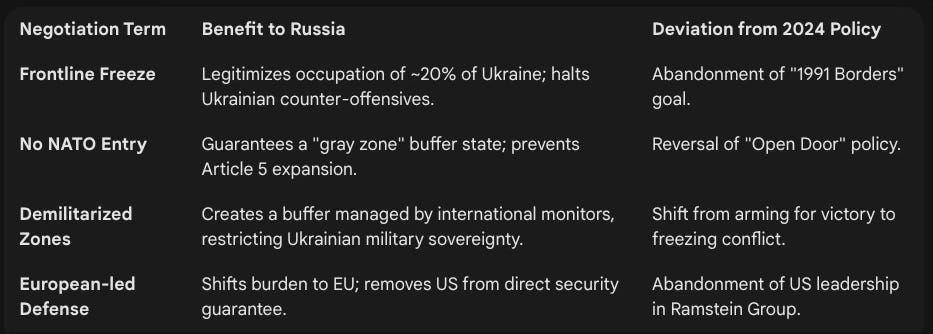
Throughout 2025, the administration deployed special envoys Steve Witkoff and Jared Kushner to broker a peace settlement between Moscow and Kyiv.8 The terms of these U.S.-backed proposals deviated significantly from previous Western positions, which emphasized Ukraine’s territorial integrity, and instead aligned closely with Russian maximalist demands.
1.4.1 Acceptance of Demilitarized Zones (DMZ)
The U.S. negotiation team pressured President Zelenskyy to accept a “freeze” of the front lines. The proposed 20-point peace plan included the creation of demilitarized zones (DMZs) along the line of contact.9
Strategic Implication: By freezing the lines where they stood, the U.S. proposal effectively cemented Russian control over occupied territories in Donetsk, Luhansk, Zaporizhzhia, and Kherson. It transformed a dynamic conflict, where Ukraine still harbored hopes of liberation, into a static frozen conflict, granting Russia de facto administrative control over the occupied regions for the foreseeable future.
1.4.2 Removal of NATO Accession
A core concession in the U.S. proposal was the removal of the requirement for Ukraine’s NATO accession. Previous U.S. policy under the “Open Door” framework supported Ukraine’s eventual membership. By dropping this support, the Trump administration granted Putin a primary war aim: the permanent neutralization of Ukraine.10
This concession effectively codified a “gray zone” status for Ukraine, leaving it outside the Article 5 security umbrella and vulnerable to future Russian coercion. The plan replaced NATO membership with “security guarantees” that notably excluded direct U.S. military intervention, shifting the burden of security entirely to European allies.12
1.4.3 Legitimation of Territorial Acquisition
The latest iterations of the peace plan dropped demands for immediate Russian withdrawal from the Donetsk region. Instead, the plan recognized the “line of troop deployment” as the legitimate boundary for the cessation of hostilities.10 This recognition, even if termed “de facto” rather than “de jure,” provided the Kremlin with the domestic political narrative of victory: the successful expansion of the Russian state’s borders.
2. Dismantling the Sanctions Enforcement Architecture: A Systematic Relief Campaign
Perhaps the most structural and enduring benefit delivered to the Kremlin in 2025 was the systematic dismantling of the U.S. Department of Justice (DOJ) and Treasury mechanisms designed to enforce economic sanctions. By deprioritizing enforcement, disbanding key task forces, and delisting strategic entities, the administration effectively hollowed out the punitive economic regime without needing to repeal the underlying statutes (such as the CAATSA or IEEPA) through Congress.
2.1 Disbanding Task Force KleptoCapture
On February 5, 2025, newly confirmed Attorney General Pam Bondi issued a directive disbanding Task Force KleptoCapture.14 Established in March 2022, this interagency body was responsible for enforcing sanctions, export restrictions, and economic countermeasures against Russian oligarchs and state actors. Its dissolution marked the end of the U.S. government’s aggressive pursuit of Russian illicit finance.
2.1.1 The “Total Elimination of Cartels” Pivot
The DOJ memorandum explicitly stated that resources previously devoted to seizing oligarch assets and enforcing Russia-related sanctions would be redirected toward “the total elimination of Cartels and Transnational Criminal Organizations (TCOs)”.15
Strategic Benefit: This pivot removed the primary threat of U.S. prosecution for sanctions evasion. It signaled to global financial institutions and intermediaries that the U.S. Department of Justice was no longer prioritizing the policing of Russia-related transactions. The “risk premium” for doing business with Russia dropped significantly, as the likelihood of a DOJ investigation plummeted.
2.1.2 End of the “Seize and Repurpose” Strategy
The disbanding of the task force halted the aggressive strategy of seizing oligarch assets (yachts, real estate, bank accounts) with the intent of repurposing them for Ukrainian reconstruction.16
While previously seized assets like the yacht Amadea were subject to auction, the investigative pipeline for future seizures was effectively shut down.18 This signaled to the Russian elite—the “siloviki” and oligarchs who form Putin’s power base—that their western-held assets were no longer primary targets of U.S. law enforcement. This move restabilized the social contract between Putin and his elite class, reducing the internal pressure on the regime that Western sanctions had hoped to generate.
2.2 Withdrawal from the Oil Price Cap Coalition
Throughout 2025, the U.S. administration largely withdrew from the active enforcement of the G7 oil price cap policy. This policy, designed to limit Russian oil revenues to $60 per barrel, relied heavily on U.S. Treasury enforcement of bans on maritime insurance and shipping services for non-compliant cargoes.
2.2.1 The Breakdown of G7 Unity
Reports indicated that the Trump administration opted out of plans to lower the cap or rigorously enforce existing limits.19 European allies, led by the UK and EU, attempted to proceed with lowering the cap to $45 per barrel, but acknowledged that without U.S. participation—and specifically without the threat of U.S. secondary sanctions—the mechanism lost its global coercive power.21
2.2.2 Revenue Restoration and the Shadow Fleet
By signaling that it would no longer aggressively police the “shadow fleet” or punish third-party buyers (like India or China) for purchasing above the cap, Washington allowed Russian oil revenues to stabilize. The discount on Urals crude narrowed, restoring the fiscal health of the Russian state. This revenue stream is critical for financing the Russian military-industrial complex and social payments that maintain regime stability.22 The U.S. withdrawal effectively rendered the G7’s most powerful economic weapon toothless.
2.3 Strategic Delistings of Sanctions Evaders (December 18, 2025)
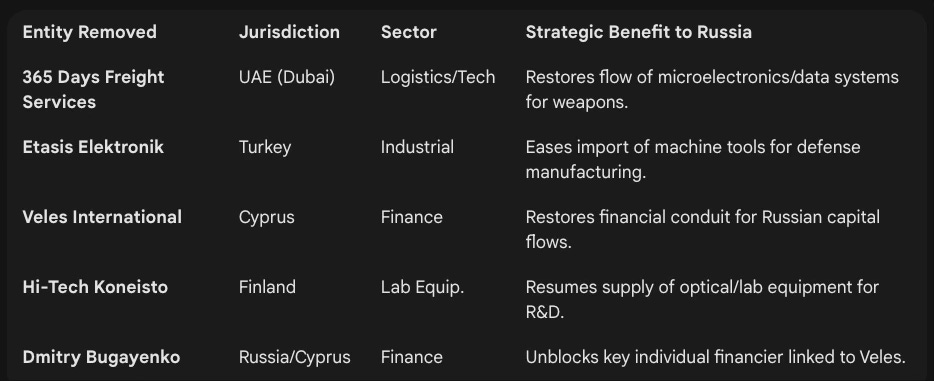
On December 18, 2025, the Office of Foreign Assets Control (OFAC) executed a series of targeted removals from the Specially Designated Nationals (SDN) and Foreign Sanctions Evaders (FSE) lists. These delistings were not broad, humanitarian waivers, but highly specific removals of entities integral to Russia’s military supply chain.23
2.3.1 365 Days Freight Services FZCO (Dubai)
One of the most significant delistings was 365 Days Freight Services FZCO, a Dubai-based logistics firm.
Role: This company had been sanctioned for specializing in moving high-value goods, including computer components and data transmission machines, to Russia.25
Benefit: Its removal from the SDN list reopens a critical logistics node for the importation of dual-use electronics. These components are vital for the guidance systems of Russian missiles and drones. By delisting this specific entity, the U.S. effectively sanctioned the “gray market” flow of technology back into the Russian defense sector.
2.3.2 Etasis Elektronik (Turkey)
Similarly, the Turkish company Etasis Elektronik was removed from the sanctions list.23
Role: Etasis was previously designated for exporting Western-made machine tools and industrial equipment to the Russian defense sector.
Benefit: Russia suffers from a chronic shortage of high-precision machine tools necessary for manufacturing artillery barrels and aircraft engines. Delisting Etasis eases the procurement bottleneck, directly aiding the Russian effort to reconstitute its defense industrial base (DIB).
2.3.3 Clearing the “Foreign Sanctions Evaders” List
In a move of profound symbolic and practical importance, OFAC announced on December 18, 2025, that the Foreign Sanctions Evaders (FSE) List was effectively empty after the removal of the final names.28
Implication: This action essentially declared an amnesty for those who had previously violated sanctions regimes. It sent a message to global intermediaries that the era of U.S. pursuit of sanctions evasion was over, encouraging a flood of new actors to engage in trade with Russia without fear of U.S. retribution.
3. Diplomatic Normalization and the Restoration of Political Legitimacy
Beyond military and economic measures, the administration took significant steps to end Russia’s diplomatic isolation. These moves conferred legitimacy upon the Putin regime and signaled a return to “great power” bilateralism, bypassing the interests of smaller European states and effectively normalizing Russia’s status on the world stage despite the ongoing occupation of Ukraine.
3.1 The Alaska Summit (August 2025)
In August 2025, President Trump hosted Vladimir Putin for a summit in Alaska.21 This meeting was the first high-level bilateral summit between U.S. and Russian leaders since the invasion of Ukraine began in 2022.
Symbolic Victory: The visual of the U.S. President meeting Putin on American soil (even in Alaska) was a massive propaganda victory for the Kremlin. It shattered the Western narrative of Russia as a pariah state. Domestically, Putin used the summit to demonstrate to his populace that Russia remained a respected superpower that could not be ignored or isolated by Washington.
Bilateralism over Multilateralism: The summit prioritized direct negotiations between Washington and Moscow, explicitly sidelining Kyiv and Brussels. This validated Russia’s preferred “Yalta-style” diplomacy, where global spheres of influence are delineated by superpowers without the input of “vassal” states.30
3.2 The Istanbul Process: Rebuilding Diplomatic Infrastructure
In February 2025, U.S. and Russian officials met in Istanbul to negotiate the normalization of embassy operations. These talks, led by U.S. Deputy Assistant Secretary Sonata Coulter and Russian diplomat Alexander Darchiyev, yielded concrete benefits for Moscow’s diplomatic corps.31
3.2.1 Embassy Staffing and Visa Services
The U.S. agreed to discuss restoring staffing levels at the Russian embassy in Washington and the U.S. embassy in Moscow. This alleviated the “diplomatic starvation” strategy employed by the previous administration, which had sought to limit the number of Russian intelligence officers operating under diplomatic cover in the U.S..31
3.2.2 Reopening Consulates
Discussions advanced toward reopening the U.S. consulates in Vladivostok and Yekaterinburg, which had been suspended.34 Normalizing these posts facilitates visa processing and business travel, easing the isolation of the Russian populace and business elite. It signals a return to “business as usual” and facilitates the movement of Russian nationals to the United States.
3.2.3 Direct Flights
The talks included Russian demands for the resumption of direct flights between the two countries.35 While not fully implemented immediately, the U.S. willingness to discuss this issue weakened the air blockade imposed by Western nations, which forces Russian travelers to transit through hubs like Istanbul or Dubai.
3.3 The G7/G8 Re-invitation Proposal
During the lead-up to the G7 summit in Canada (June 2025), President Trump publicly advocated for the readmission of Russia to the group, effectively proposing a return to the G8 format. He argued that excluding Russia was a “mistake” and that Russia’s presence was necessary for global stability.36
Fracturing the Coalition: Even though the proposal was not immediately adopted by all members due to resistance from Canada and the UK, the mere act of the U.S. President advocating for it shattered the G7’s unified front. It signaled to the Global South (e.g., BRICS nations) that Russia’s isolation was temporary and conditional, encouraging them to deepen ties with Moscow without fear of long-term U.S. retribution.
4. The Information Domain: Dismantling Counter-Disinformation Capabilities
In a move that fundamentally reshaped the information battlespace, the administration dismantled the U.S. government’s infrastructure for monitoring and countering foreign propaganda. This retreat provided Russian state media and covert influence operations with unprecedented freedom of maneuver within the United States, effectively disarming the U.S. in the cognitive domain of the conflict.
4.1 Closure of the Global Engagement Center (GEC)
On April 16, 2025, Secretary of State Marco Rubio announced the immediate closure of the Global Engagement Center (GEC), also known as the Counter Foreign Information Manipulation and Interference (R/FIMI) hub.39
4.1.1 Rationale and Effect
The administration framed the GEC’s activities as “censorship” of American voices. Secretary Rubio stated, “Over the last decade, Americans have been slandered... for simply voicing their opinions. That ends today.”
Benefit to Russia: The GEC was the primary State Department body responsible for exposing Russian disinformation campaigns abroad. It had played a key role in identifying Russian narratives in Latin America and Africa. Its closure left the U.S. with no dedicated office to track or counter Kremlin narratives globally. This effectively unilaterally disarmed the U.S. in the information war, allowing Russian narratives regarding the war in Ukraine (”NATO aggression,” “denazification”) to proliferate unchecked.39
4.2 Disbanding the Foreign Influence Task Force (FITF)
Concurrently, Attorney General Bondi disbanded the FBI’s Foreign Influence Task Force (FITF) in February 2025. This unit had been established to police influence campaigns aimed at sowing discord in U.S. elections and domestic politics.16
4.2.1 FARA Deprioritization
With the FITF dissolved, the Department of Justice deprioritized the enforcement of the Foreign Agents Registration Act (FARA) against foreign media entities. New guidelines limited FARA prosecutions to cases resembling “traditional espionage” (i.e., spycraft) rather than information warfare or influence peddling.45
4.2.2 Rehabilitating RT and Sputnik
This policy shift effectively reversed the 2017 and 2024 designations of Russian state media outlets RT (Russia Today) and Sputnik as “foreign missions.” By relaxing FARA enforcement, these outlets were allowed to operate with the legal status of normal media organizations rather than registered agents of a foreign power. This allowed them to resume aggressive operations within the U.S. media ecosystem, recruiting American commentators and broadcasting Kremlin-aligned narratives without the “foreign agent” disclaimer.47
5. Commercial Facilitation and Resource Trade Expansion
While the narrative of “sanctions” persisted in some public rhetoric, the trade data and regulatory actions of 2025 reveal a significant deepening of commercial ties in specific strategic sectors. The administration utilized loopholes, general licenses, and policy inaction to facilitate increased imports of Russian commodities, providing the Kremlin with vital hard currency.
5.1 The Uranium and Nuclear Fuel Trade
Despite earlier legislative attempts to wean the U.S. off Russian nuclear fuel, 2025 saw a surge in the importation of Russian enriched uranium.
Volume Surge: Imports of Russian uranium and associated radioactive chemicals rose by nearly 30% in 2025, contributing to a total import volume from Russia approaching $5 billion.49
Strategic Dependency: By continuing to purchase Russian enriched uranium, the U.S. energy sector provided direct hard currency revenue to Rosatom, the Russian state nuclear corporation. Rosatom is a key pillar of the Russian state, involved not only in energy but in the maintenance of Russia’s nuclear arsenal. The administration’s refusal to enforce stricter tariffs or a total ban allowed this dependency to persist, effectively subsidizing the very nuclear complex that threatens U.S. security.51
5.2 Fertilizer and Agricultural Inputs
The U.S. Treasury and Department of Agriculture adopted a highly permissive stance toward the import of Russian fertilizers (potash, urea, ammonia), categorizing them as essential for global food security to avoid domestic price spikes in the agricultural sector.
Market Dominance: In the first half of 2025, U.S. imports from Russia surged to $3.95 billion, with fertilizers constituting a dominant share.53 Russia retained an 83% share of U.S. imports of phosphatic fertilizer mixes.
Sanctions Exemptions: The administration ensured that payment channels for these commodities remained open, shielding a multi-billion dollar sector of the Russian economy from financial interdiction.54 This allowed Russian fertilizer giants (often owned by oligarchs close to Putin) to maintain profitability.
5.3 Technology and Dual-Use Goods Deregulation
The Department of Commerce’s Bureau of Industry and Security (BIS) implemented rule changes that, while technical, loosened the stranglehold on Russian technology acquisition.
The “Affiliates Rule” Nuance: While ostensibly expanding controls, the implementation of the “Affiliates Rule” in September 2025 included “savings clauses” and transition periods that allowed shipments en route to proceed.55 More importantly, the administration’s focus on “traditional espionage” rather than export control enforcement (as seen in the DOJ pivot) meant that the rigorous end-user checks required to stop diversion were deprioritized.
Specific Delistings: As noted in Section 2.3, the removal of logistics firms like 365 Days Freight Services from the sanctions list was the practical manifestation of this deregulation, facilitating the flow of dual-use goods.
6. Legal Shields: Protecting Russian Assets and Personnel
The philosophical shift in the Department of Justice under Attorney General Bondi prioritized domestic crime (drugs, borders) over international geopolitical crimes. This zero-sum allocation of resources provided a legal shield for Russian interests in the U.S. court system.
6.1 The Amadea Yacht Saga and Asset Protection
The disposition of the superyacht Amadea, seized from oligarch Suleiman Kerimov, became a microcosm of the administration’s new stance on Russian assets.
Legal Gridlock: Instead of expeditiously liquidating the asset and transferring funds to Ukraine (as permitted under new forfeiture laws), the DOJ allowed legal challenges from “straw owners” (like Eduard Khudainatov) to stall the process indefinitely.57
Cost to Taxpayers: The U.S. government continued to pay approximately $1 million per month for the yacht’s maintenance, rather than forcing a sale. This delay served the interests of the oligarch owner by preventing the irreversible loss of the asset and the transfer of its value to Kyiv.59
Policy Signal: The failure to execute high-profile forfeitures in 2025 signaled that the “risk” to oligarch assets in the U.S. had diminished. The aggressive pursuit of “ill-begotten gains” promised by the previous administration was effectively abandoned.
6.2 The International Criminal Court (ICC) Counter-Move
In a significant legal and diplomatic maneuver, OFAC issued General License 11 on December 18, 2025, titled “Authorizing the Wind Down of Transactions Involving Certain Persons Blocked on December 18, 2025” related to the ICC.23
Context: The ICC had issued arrest warrants for Vladimir Putin and other Russian officials for war crimes in Ukraine. The Biden administration had quietly supported these investigations.
The Reversal: The Trump administration designated ICC officials (including prosecutor Karim Khan) and entities on the SDN list, viewing the court as a threat to U.S. sovereignty. General License 11 authorized a “wind down” of U.S. interaction with the court.
Benefit to Putin: By sanctioning the ICC and obstructing its operations, the U.S. aligned itself with Russia’s position that the court is illegitimate. This provided immense diplomatic cover to Putin, delegitimizing the international legal body attempting to hold him accountable and making it politically safer for other nations to ignore the ICC warrants.
7. Deep Dive: General License 131A and the “Endless Wind Down”
A specific regulatory action taken in late 2025 exemplifies the administration’s approach of using technical bureaucracy to effectuate strategic relief.
7.1 General License 131A (Lukoil)
On December 10, 2025, OFAC issued Russia-related General License 131A, titled “Authorizing Certain Transactions for the Negotiation of and Entry Into Contingent Contracts for the Sale of Lukoil International GmbH and Related Maintenance Activities”.60
The Mechanism: This license extended the authorization for Western entities to engage with Lukoil, Russia’s second-largest oil company, for the purpose of “maintenance and wind down.”
The Extension: Crucially, the expiration date was set for January 2026.62 By repeatedly extending “wind down” licenses rather than forcing a hard exit, the administration allowed Lukoil’s European and international subsidiaries to continue operating, generating revenue, and maintaining asset value under the guise of an exit process that never concludes.
Strategic Impact: This preserves Lukoil’s market share and infrastructure in the West. It prevents the fire-sale of Russian energy assets and ensures that Lukoil (and by extension, the Russian tax base) continues to derive value from its international operations. It is a “soft sanction” that functions, in practice, as a permission slip for continued business.
Conclusion
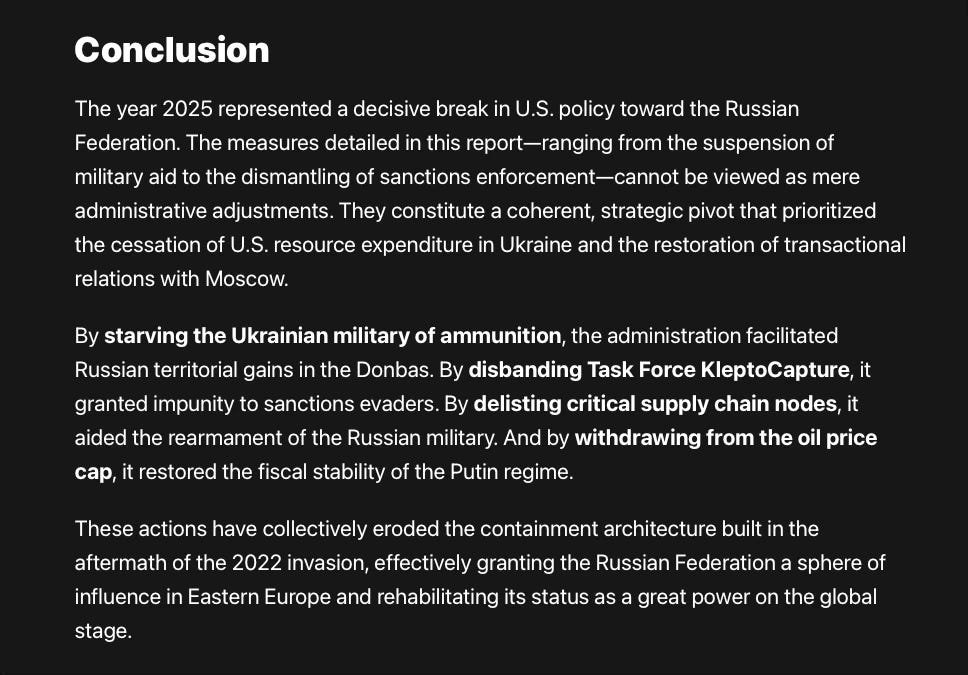
The year 2025 represented a decisive break in U.S. policy toward the Russian Federation. The measures detailed in this report—ranging from the suspension of military aid to the dismantling of sanctions enforcement—cannot be viewed as mere administrative adjustments. They constitute a coherent, strategic pivot that prioritized the cessation of U.S. resource expenditure in Ukraine and the restoration of transactional relations with Moscow.
By starving the Ukrainian military of ammunition, the administration facilitated Russian territorial gains in the Donbas. By disbanding Task Force KleptoCapture, it granted impunity to sanctions evaders. By delisting critical supply chain nodes, it aided the rearmament of the Russian military. And by withdrawing from the oil price cap, it restored the fiscal stability of the Putin regime.
These actions have collectively eroded the containment architecture built in the aftermath of the 2022 invasion, effectively granting the Russian Federation a sphere of influence in Eastern Europe and rehabilitating its status as a great power on the global stage.
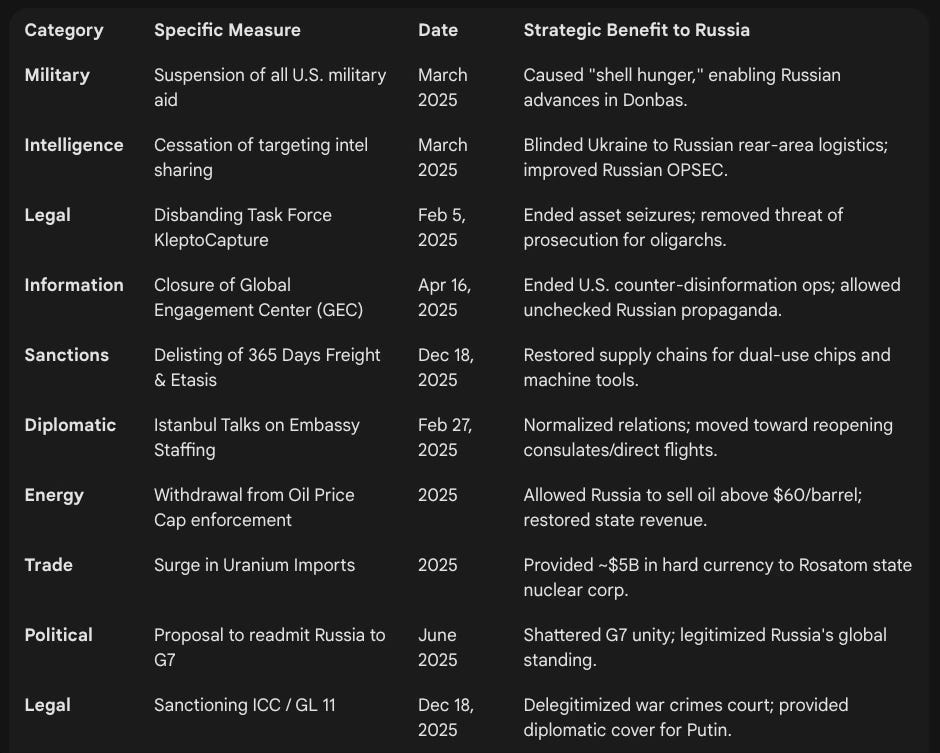
Summary of Key Beneficial Measures (2025)
This report is based on open-source intelligence and administrative records available as of December 2025.
Works cited
How Trump is driving US towards Russia – a timeline of the president’s moves, accessed December 24, 2025, https://www.theguardian.com/us-news/2025/mar/09/trump-ukraine-russia-explainer
US suspends all military aid to Ukraine in wake of Trump-Zelenskyy row - The Guardian, accessed December 24, 2025, https://www.theguardian.com/world/2025/mar/04/us-military-aid-ukraine-pause-trump-zelenskyy-updates
Military assistance to Ukraine: What has changed in 2025? - House of Commons Library, accessed December 24, 2025, https://commonslibrary.parliament.uk/research-briefings/cbp-10308/
U.S. Security Cooperation with Ukraine - United States Department of State, accessed December 24, 2025, https://www.state.gov/bureau-of-political-military-affairs/releases/2025/01/u-s-security-cooperation-with-ukraine
Pause in Aid Introduced Uncertainty into Ukraine’s Military Planning - American University, accessed December 24, 2025, https://www.american.edu/sis/news/20250307-pause-in-aid-introduced-uncertainty-into-ukraines-military-planning.cfm
US military withdrawal: is Nato’s eastern flank safe? | eurotopics.net, accessed December 24, 2025, https://www.eurotopics.net/en/347671/us-military-withdrawal-is-nato-s-eastern-flank-safe
Trump administration’s Europe troop drawdown fuels concern amid NATO allies, draws fire even from Republicans - CBS News, accessed December 24, 2025, https://www.cbsnews.com/news/trump-us-troop-drawdown-europe-nato-concern-republican-rebuke/
US says talks with Ukraine, Europe on ending war with Russia ‘constructive’, accessed December 24, 2025, https://apnews.com/article/russia-ukraine-war-witkoff-dmitriev-kushner-talks-trump-1ad3b82d8a2b5c449968d8c62e818a04
US and Ukraine edge closer to joint plan to end war – with Moscow’s response uncertain, accessed December 24, 2025, https://www.theguardian.com/world/2025/dec/24/us-ukraine-edge-closer-joint-plan-end-war-moscow-response-uncertain
Zelenskyy says draft plan freezes front line and opens way for concessions, accessed December 24, 2025, https://www.japantimes.co.jp/news/2025/12/24/world/ukraine-war-draft-plan/
Ukraine peace plan might include demilitarized zones, Zelenskyy says, accessed December 24, 2025, https://www.cbsnews.com/news/russia-ukraine-war-demilitarized-zones-zelenskyy/
Ukraine’s Zelenskyy says progress in US-led peace talks is ‘quite solid’, accessed December 24, 2025, https://apnews.com/article/russia-ukraine-war-drone-attacks-d92b40dab1055df4e3512f77c27eb5c9
Zelenskyy says U.S.-negotiated proposals to end the war in Ukraine could be presented to Russia within days - PBS, accessed December 24, 2025, https://www.pbs.org/newshour/world/zelenskyy-says-u-s-negotiated-proposals-to-end-the-war-in-ukraine-could-be-presented-to-russia-within-days
Task Force KleptoCapture - Wikipedia, accessed December 24, 2025, https://en.wikipedia.org/wiki/Task_Force_KleptoCapture
Bondi’s Dismantling of the Kleptocracy Team Threatens National Security | Lawfare, accessed December 24, 2025, https://www.lawfaremedia.org/article/bondi-s-dismantling-of-the-kleptocracy-team-threatens-national-security
Trump administration ends Biden-era task force aimed at seizing Russian oligarchs’ assets, accessed December 24, 2025, https://www.pbs.org/newshour/politics/trump-administration-ends-biden-era-task-force-aimed-at-seizing-russian-oligarchs-assets
Yacht Amadea Auction Set for September - Megayacht News, accessed December 24, 2025, https://megayachtnews.com/2025/08/yacht-amadea-auction/
US auctions Russian luxury yacht Amadea - AP News, accessed December 24, 2025, https://apnews.com/article/seized-superyacht-amadea-auction-russia-ukraine-war-f19607ad3a9a544601673bcc7efb11b0
Will Trump’s Sanctions Make a Dent in Russia’s Oil Exports?, accessed December 24, 2025, https://carnegieendowment.org/russia-eurasia/politika/2025/10/russia-new-sanctions-effects?lang=en
Rest of G7 prepared to lower Russian oil price cap without U.S. - The New Voice of Ukraine, accessed December 24, 2025, https://english.nv.ua/nation/g7-ready-to-lower-russian-oil-price-cap-without-u-s-50521714.html
Tightening the oil-price cap to increase the pressure on Russia | Chatham House, accessed December 24, 2025, https://www.chathamhouse.org/2025/09/tightening-oil-price-cap-increase-pressure-russia
Phase Two of the Price Cap on Russian Oil: Two Years After Putin’s Invasion - Treasury.gov, accessed December 24, 2025, https://home.treasury.gov/news/featured-stories/phase-two-of-the-price-cap-on-russian-oil-two-years-after-putins-invasion
Foreign Sanctions Evaders Determination Removal; Issuance of Iran-related and International Criminal Court-related General Licenses | Office of Foreign Assets Control, accessed December 24, 2025, https://ofac.treasury.gov/recent-actions/20251218
Sanctions List Updates - Office of Foreign Assets Control, accessed December 24, 2025, https://ofac.treasury.gov/recent-actions/sanctions-list-updates
US Treasury Department lifts sanctions on several companies that supplied equipment to Russia’s military industry, accessed December 24, 2025, https://www.pravda.com.ua/eng/news/2025/12/19/8012540/
US quietly removes sanctions from firms accused of supplying Russia’s military, accessed December 24, 2025, https://euromaidanpress.com/2025/12/19/us-quietly-removes-sanctions-from-firms-accused-of-supplying-russias-military/
U.S. Continues to Degrade Russia’s Military-Industrial Base and Target Third-Country Support with Nearly 300 New Sanctions - Treasury.gov, accessed December 24, 2025, https://home.treasury.gov/news/press-releases/jy2318
FSE list | Treasury.gov, accessed December 24, 2025, https://www.treasury.gov/ofac/downloads/fse/fselist.pdf
Additional Sanctions Lists | Office of Foreign Assets Control, accessed December 24, 2025, https://ofac.treasury.gov/other-ofac-sanctions-lists
How will Trump’s new Russian oil sanctions shift the war? - Atlantic Council, accessed December 24, 2025, https://www.atlanticcouncil.org/content-series/fastthinking/how-will-trumps-new-russian-oil-sanctions-shift-the-war/
Russian and U.S. Officials Discussed Restoring Embassy Staff, Direct Flights at Istanbul Talks - The Moscow Times, accessed December 24, 2025, https://www.themoscowtimes.com/2025/02/28/russian-and-us-officials-discussed-restoring-embassy-staff-direct-flights-at-istanbul-talks-a88198
U.S.-Russia Delegations Meet in Istanbul on February 27, accessed December 24, 2025, https://ru.usembassy.gov/february-27-meeting-in-istanbul/
Russia in Review, Feb. 21-28, 2025, accessed December 24, 2025, https://www.russiamatters.org/news/russia-review/russia-review-feb-21-28-2025
Limited Reopening of US Visa Processing at Consulates in Russia - Steptoe, accessed December 24, 2025, https://www.steptoe.com/en/news-publications/international-compliance-blog/limited-reopening-of-us-visa-processing-at-consulates-in-russia.html
U.S. ‘Not Ready’ to Fully Restore Work of Embassies, Putin Adviser Says, accessed December 24, 2025, https://www.themoscowtimes.com/2025/06/25/us-not-ready-to-fully-restore-work-of-embassies-putin-adviser-says-a89569
51st G7 summit - Wikipedia, accessed December 24, 2025, https://en.wikipedia.org/wiki/51st_G7_summit
Donald Trump Calls For Russia’s Return To Join G7 | World News | WION - YouTube, accessed December 24, 2025
WATCH: Trump says ‘not a bad idea’ to include China in G7, removing Russia ‘a mistake’, accessed December 24, 2025, https://www.pbs.org/newshour/world/watch-trump-says-not-a-bad-idea-to-include-china-in-g7-removing-russia-a-mistake
Trump administration shutters US office countering foreign disinformation - The Guardian, accessed December 24, 2025, https://www.theguardian.com/us-news/2025/apr/16/trump-state-department-foreign-disinformation
Protecting and Championing Free Speech at the State Department, accessed December 24, 2025, https://www.state.gov/protecting-and-championing-free-speech-at-the-state-department
Shuttering of State office leaves US largely defenseless against foreign influence warfare, officials say - Defense One, accessed December 24, 2025, https://www.defenseone.com/threats/2025/04/shuttering-state-office-leaves-us-largely-defenseless-against-foreign-influence-warfare-officials-say/404670/
United States Champions Free Expression, Ceases Censorship Frameworks, accessed December 24, 2025, https://www.state.gov/releases/office-of-the-spokesperson/2025/09/united-states-champions-free-expression-ceases-censorship-frameworks
DOJ Implements Major Changes to National Security Priorities | White & Case LLP, accessed December 24, 2025, https://www.whitecase.com/insight-alert/doj-implements-major-changes-national-security-priorities
DOJ disbands foreign influence task force, limits scope of FARA prosecutions - CyberScoop, accessed December 24, 2025, https://cyberscoop.com/doj-disbands-foreign-influence-task-force/
State Department classifies six Russian state-owned news outlets ‘foreign missions’, accessed December 24, 2025, https://pressfreedomtracker.us/all-incidents/state-department-classifies-six-russian-state-owned-news-outlets-foreign-missions/
Attorney General Announces Shift in Foreign Agents Registration Act Enforcement Priorities | Insights | Skadden, Arps, Slate, Meagher & Flom LLP, accessed December 24, 2025, https://www.skadden.com/insights/publications/2025/02/attorney-general-announces-shift-in-foreign-agents
Treasury Takes Action as Part of a U.S. Government Response to Russia’s Foreign Malign Influence Operations, accessed December 24, 2025, https://home.treasury.gov/news/press-releases/jy2559
Trump’s 2025 Executive Orders | Holland & Knight, accessed December 24, 2025, https://www.hklaw.com/en/general-pages/trumps-2025-executive-orders-chart
U.S. imports from Russia are up 30% this year, likely to hit $5 billion, accessed December 24, 2025, https://www.progressivepolicy.org/u-s-imports-from-russia-are-up-30-this-year-likely-to-hit-5-billion/
US imports of Russian fertilizer rise in 2025 - POLITICO Pro, accessed December 24, 2025, https://subscriber.politicopro.com/article/2025/09/us-imports-of-russian-fertilizer-rise-in-2025-00575536
The U.S. imports virtually all its uranium for nuclear power - Cipher News, accessed December 24, 2025, https://www.ciphernews.com/articles/the-u-s-imports-virtually-all-its-uranium-for-nuclear-power/
Enriched Uranium Fuels Russia’s War Machine. But the US Still Imports It - Bellona.org, accessed December 24, 2025, https://bellona.org/news/nuclear-issues/2025-03-enriched-uranium-fuels-russias-war-machine-but-the-u-s-still-imports-it
U.S.–Russia Imports Rebound in 2025: Fertilizers, Metals & Nuclear Materials Concentrate Trade - GTAIC, accessed December 24, 2025, https://gtaic.ai/trends/us-imports-from-russia-surge-in-2025
United States Imports from Russia of Fertilizers - 2025 Data 2026 Forecast 1992-2024 Historical, accessed December 24, 2025, https://tradingeconomics.com/united-states/imports/russia/fertilizers
BIS Expands Entity List Controls to All Unlisted Foreign Affiliates Owned 50% or More by Listed Parties - Squire Patton Boggs, accessed December 24, 2025, https://www.squirepattonboggs.com/insights/publications/bis-expands-entity-list-controls-to-all-unlisted-foreign-affiliates-owned-50-percent-or-more-by-listed-parties/
BIS Expands Entity List End-User Controls to Cover Affiliates of Listed Entities | SmarTrade, accessed December 24, 2025, https://www.thompsonhinesmartrade.com/2025/10/bis-expands-entity-list-end-user-controls-to-cover-affiliates-of-listed-entities/
U.S. to auction seized Russian yacht worth hundreds of millions - CBS News, accessed December 24, 2025, https://www.cbsnews.com/news/u-s-to-auction-seized-russian-yacht-worth-hundreds-of-millions/
U.S. Court OKs Sale Of $325M Yacht Linked To Russian Oligarch After 3-Year Legal Fight, accessed December 24, 2025, https://www.rferl.org/a/russia-sanctions-yacht-oligarch-amadea/33348093.html
The U.S. seized a Russian yacht. Now taxpayers are footing the bill. - Washington Post, accessed December 24, 2025, https://kessleronforfeiture.com/wp-content/uploads/2025/01/The-U.S.-seized-a-Russian-yacht.-Now-taxpayers-are-footing-the-bill.-Washington-Post.pdf
Selected General Licenses Issued by OFAC | Office of Foreign Assets Control, accessed December 24, 2025, https://ofac.treasury.gov/selected-general-licenses-issued-ofac
Issuance of Amended Russia-related General License - Office of Foreign Assets Control, accessed December 24, 2025, https://ofac.treasury.gov/recent-actions/20251210
OFFICE OF FOREIGN ASSETS CONTROL Russian Harmful Foreign Activities Sanctions Regulations 31 CFR part 587 GENERAL LICENSE NO. 1, accessed December 24, 2025, https://ofac.treasury.gov/media/934801/download?inline
By aligning with Russia and adopting its grievances against the Western liberal order, the administration validates its own domestic war against the “globalists” who built that order.

The Convergence of Retribution and Realignment: An Exhaustive Strategic Analysis of the Trump-Russia-China Triad (2025)