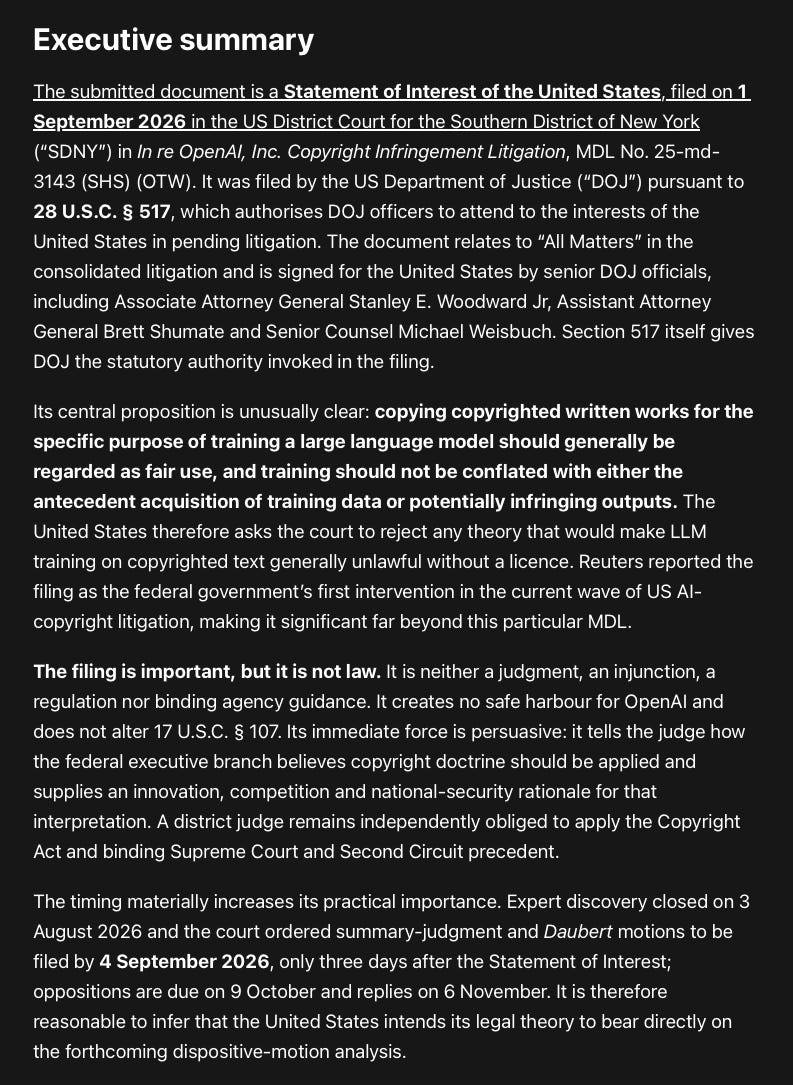
Summary: The U.S. DOJ’s 1 September 2026 filing argues that copying copyrighted written works specifically for LLM training should generally qualify as fair use, while acquisition of the works and infringing outputs must be assessed separately; importantly, the filing is persuasive advocacy, not binding law.
Its biggest significance is the government’s attempt to narrow copyright “market harm” to genuine substitution of protected expression, rejecting broader theories that AI-generated competition alone should require licensing—a position more permissive than the U.S. Copyright Office’s case-specific approach.
Ethically and practically, the strongest path is neither “all training is theft” nor “all training is free”: AI developers should prove lawful provenance, transformation and anti-regurgitation safeguards, while creators need meaningful transparency, protection against piracy and substitution, and workable licensing where genuine protected markets exist.
The United States’ September 2026 Statement of Interest on AI Training and Copyright: Legal Meaning, Strategic Importance and Global Implications
by ChatGPT-5.6
Executive summary
The submitted document is a Statement of Interest of the United States, filed on 1 September 2026 in the US District Court for the Southern District of New York (“SDNY”) in In re OpenAI, Inc. Copyright Infringement Litigation, MDL No. 25-md-3143 (SHS) (OTW). It was filed by the US Department of Justice (“DOJ”) pursuant to 28 U.S.C. § 517, which authorises DOJ officers to attend to the interests of the United States in pending litigation. The document relates to “All Matters” in the consolidated litigation and is signed for the United States by senior DOJ officials, including Associate Attorney General Stanley E. Woodward Jr, Assistant Attorney General Brett Shumate and Senior Counsel Michael Weisbuch. Section 517 itself gives DOJ the statutory authority invoked in the filing.
Its central proposition is unusually clear: copying copyrighted written works for the specific purpose of training a large language model should generally be regarded as fair use, and training should not be conflated with either the antecedent acquisition of training data or potentially infringing outputs. The United States therefore asks the court to reject any theory that would make LLM training on copyrighted text generally unlawful without a licence. Reuters reported the filing as the federal government’s first intervention in the current wave of US AI-copyright litigation, making it significant far beyond this particular MDL.
The filing is important, but it is not law. It is neither a judgment, an injunction, a regulation nor binding agency guidance. It creates no safe harbour for OpenAI and does not alter 17 U.S.C. § 107. Its immediate force is persuasive: it tells the judge how the federal executive branch believes copyright doctrine should be applied and supplies an innovation, competition and national-security rationale for that interpretation. A district judge remains independently obliged to apply the Copyright Act and binding Supreme Court and Second Circuit precedent.
The timing materially increases its practical importance. Expert discovery closed on 3 August 2026 and the court ordered summary-judgment and Daubert motions to be filed by 4 September 2026, only three days after the Statement of Interest; oppositions are due on 9 October and replies on 6 November. It is therefore reasonable to infer that the United States intends its legal theory to bear directly on the forthcoming dispositive-motion analysis.
The strongest part of the DOJ submission is its insistence on disaggregating the AI lifecycle. It distinguishes: acquisition or collection of a copy; copying during model training; and dissemination of model outputs. That distinction fits the Supreme Court’s insistence in Andy Warhol Foundation v Goldsmith that fair use examines the particular challenged “use”, and it fits Second Circuit precedent such as Authors Guild v Google, which separately analysed different functions arising from Google’s mass digitisation project. It also explains why an AI developer could conceivably prevail on fair use for model training while still being liable for obtaining pirated copies or for outputs reproducing protected expression.
The submission is more contestable when it approaches a near-categorical view of market harm. DOJ argues that competition from non-substantially-similar AI output is not the kind of substitution copyright protects and sharply attacks a broader “market dilution” theory. The US Copyright Office has taken a more qualified position: its 2025 generative-AI report says training can be transformative but that fair use depends on the works, their source, training purpose, output controls and market effects; it regards non-commercial analysis as relatively strong fair use but commercial training involving illegally accessed expressive material that produces competing content as potentially outside established boundaries. That disagreement is one of the most consequential aspects of the document.
For stakeholders, the correct response is not to read the filing as permission to scrape first and litigate later. US developers should establish lawful provenance, segregate acquisition from training in their records, document the non-substitutive purposes of training, employ effective anti-memorisation and anti-regurgitation controls, and preserve evidence capable of proving those facts. Rights holders should correspondingly concentrate on provable acquisition misconduct, memorisation, substantial similarity, actual substitution and credible licensing markets rather than relying only on the abstract proposition that AI competes with human creators. US policymakers should resist either extreme—a sweeping compulsory licensing requirement or a blanket statutory immunity—while the courts develop doctrine and licensing markets mature. The Copyright Office itself has recommended allowing voluntary licensing to develop before broad government intervention.
Outside the United States, the filing has no automatic legal effect. EU providers of general-purpose AI models already face an AI Act obligation to maintain a policy complying with Union copyright law and respecting rights reservations, as well as a public training-content summary; full Commission enforcement began on 2 August 2026, and relevant non-compliance can attract fines of up to €15 million or 3 per cent of worldwide annual turnover. The UK meanwhile retains a substantially narrower copyright exception for text and data mining for non-commercial research and has not yet enacted a general commercial AI-training exception. A multinational AI company therefore cannot safely treat a favourable US fair-use decision as a global licence.
ChatGPT’s overall ethical assessment is consequently qualified rather than absolutist. Lawfully sourced, non-substitutive machine learning that expands knowledge and capability can plausibly advance copyright’s public-interest purpose; opaque appropriation of pirated or technically restricted works while externalising all economic costs onto creators is much harder to justify. The DOJ is persuasive in resisting an automatic “every training copy requires payment” rule, but its policy enthusiasm for US AI leadership should not be allowed to collapse copyright’s case-specific balancing exercise into an industrial-policy exemption.
What the document is and what legal weight it carries
The document’s formal characteristics matter because they define what it can—and cannot—accomplish.
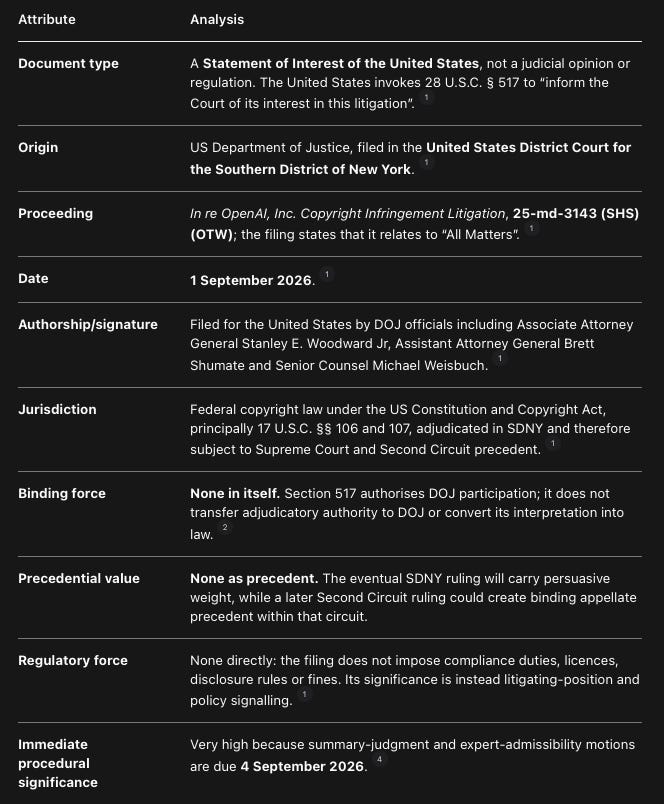
Section 517 is deliberately broad: the Attorney General may send a DOJ officer to attend to federal interests in a case pending in either federal or state court. The Statement therefore resembles an amicus submission functionally, but it is more accurately described by its statutory title. The United States has not intervened as a plaintiff or defendant and is not taking responsibility for OpenAI’s alleged conduct. Indeed, the filing expressly disclaims any contention that the alleged activities were authorised by, consented to, or undertaken for the benefit of the government within 28 U.S.C. § 1498.
That point is essential when evaluating headlines that the government has “backed OpenAI”. It has backed a legal theory important to OpenAI, not necessarily every fact OpenAI asserts or every alleged act of data acquisition and generation. Reuters accurately describes the government as supporting OpenAI’s fair-use position, but the text itself is more carefully delimited.
The institutional context is also revealing. The administration has adopted an expressly pro-innovation AI policy, including a January 2025 executive order aimed at sustaining US global AI leadership and economic and national-security advantages. The Statement builds that policy directly into its copyright argument: restricting domestic model development, it says, could impair national security, scientific research, competition and US technological leadership. Those considerations explain why DOJ entered the case, but they are not substitutes for the statutory four-factor fair-use inquiry.
What the United States argues and how persuasive the argument is
The decisive conceptual move: separate acquisition, training and outputs
The filing begins with a technically and legally important taxonomy. Model development involves at least three potentially relevant phases:
Collection/acquisition involves obtaining and storing the works; training involves making copies so data can be processed to adjust model parameters and learn relationships and statistical patterns; output involves responding to user prompts. The government expressly limits its principal submission to the second question: whether using copies as training material is fair use.
That is a stronger proposition than saying “everything AI companies do with data is fair use”. It leaves several liability pathways intact.
An unlawfully obtained copy may generate liability even if a later computational use is transformative. An output that reconstructs protected expression may separately infringe. A system designed or controlled so that protected passages are predictably reproduced may affect the fair-use analysis differently from a model whose outputs cannot substitute for its sources. The Copyright Office likewise treats collection, training and deployment as legally distinguishable stages.
This disaggregation is particularly important for future compliance architecture. A company capable of proving that its acquisition layer used licensed, public-domain or lawfully accessed sources, that its training layer transformed those sources into non-expressive statistical functionality, and that its deployment layer suppresses memorised reproduction presents a materially better legal case than a company that cannot identify where its training data came from.
Transformativeness
On the first statutory factor—the purpose and character of the use—the United States characterises LLM training as extraordinarily transformative. A newspaper article is written to communicate expressive content to readers; a training system, DOJ says, processes the article together with enormous amounts of other language in order to learn linguistic and statistical relationships and construct a general-purpose model capable of many unrelated tasks.
The argument draws heavily on three lines of precedent.
First, Google LLC v Oracle America supports substantial intermediate copying where the defendant uses existing material to facilitate a materially different technological environment and new creation. Second, Authors Guild v Google—particularly important because it is binding Second Circuit authority—held mass digitisation of books fair in connection with search and snippet functions. Third, Warhol requires courts to define the actual challenged use rather than describing transformation at an abstract level.
This is doctrinally formidable but not automatic. Warhol can cut both ways. It supports DOJ’s demand to isolate “training” as the challenged use, but it also warns against describing a secondary use at excessive generality. A court may therefore ask not merely whether “building AI” differs from “reading journalism”, but what this defendant copied, from what source, for what particular model, for what intended commercial service and with what capacity to expose or substitute for protected material. That more granular approach resembles the Copyright Office’s framework.
The whole-work copying problem
The third factor asks how much of each work was used. Training often requires complete copies, apparently favouring rights holders at first sight. DOJ responds that whole-work copying can nevertheless be reasonable where the transformative technical function requires it and where the copy itself is not exposed to the public. It relies particularly on Authors Guild, which distinguished the amount ingested from the amount made available as a substitute.
That proposition has substantial precedent behind it: search indexing and other computational analysis would often be useless if limited to arbitrarily selected excerpts. But the conclusion depends heavily on what subsequently becomes accessible. A model that reliably reproduces long protected passages is different from one in which complete ingestion is merely an intermediate computational step. This is why output testing, memorisation metrics and safeguards are not merely product-safety issues; they can become copyright evidence.
Market harm is where the doctrinal fight becomes most important
The fourth factor is the filing’s most consequential—and most controversial—section.
DOJ argues that copyright’s market inquiry concerns substitutive competition in protected expression. Merely enabling someone to generate a new article, book or other work that competes economically with human-created material should not constitute cognisable copyright harm if the new output does not reproduce protected expression. Otherwise, copyright would indirectly give an author control over genres, ideas, style or the general ability of other writers to compete.
The submission attacks the reasoning in Kadrey v Meta to the extent that the Northern District of California contemplated “market dilution” from large volumes of AI-generated works even where those works were not substantially similar to plaintiffs’ books. DOJ says this impermissibly merges training with later output competition and expands copyright beyond protected expression.
There is real force in that objection. Copyright does not ordinarily entitle an author to prevent a rival from learning facts, ideas, methods, conventions or genre characteristics and using them to create a different work. Academic literature has long identified this distinction between non-expressive learning and expressive substitution. Lemley and Casey’s Fair Learning is a leading articulation of the former perspective, while Benjamin Sobel warned earlier that generative and expressive machine-learning systems make the analogy more difficult because they may compete directly in creative markets. More recent scholarship likewise proposes separating permissive input-side training from stricter control over substitutive outputs.
But DOJ goes further than is necessary to establish that point. The Copyright Office’s report does not regard “training is transformative” as dispositive. It says first and fourth factors will often be especially important and expressly identifies source lawfulness, output controls and market conditions as relevant. In its conclusion, the Office contrasts non-commercial research with commercial training on illegally accessed expressive works intended to generate content competing in existing markets.
The most analytically sound middle position is therefore:
Ordinary marketplace competition by independently expressive AI outputs should not automatically count as copyright substitution; but training cannot be evaluated wholly in isolation from demonstrable facts about memorisation, intended outputs, access methods and genuine protected markets.
That gives proper weight both to copyright’s idea/expression boundary and to § 107’s expressly case-specific character.
Licensing markets and circularity
Licensing is another fault line. Rights holders contend that a growing market for AI-training licences proves economic harm when developers train without paying. Developers respond that allowing the existence of a proposed licence to determine whether the underlying use requires permission is circular: every new fair use could be converted into infringement by inventing a licence for it.
The Copyright Office takes neither extreme. It observes that voluntary AI-training licensing is already occurring, considers it workable in at least some sectors, but recognises serious scale, transaction-cost and coverage problems; it recommends further market development rather than immediate comprehensive statutory intervention.
DOJ’s own position is similarly not “licensing is unlawful”. The Statement expressly recognises that publishers and developers can—and do—license specialised access to current, paywalled, proprietary or otherwise valuable content even if basic model training is fair. This distinction creates a plausible future market structure in which commodity historical corpus access may often be litigated as fair use while freshness, structured metadata, provenance guarantees, exclusivity, retrieval rights and premium archivescommand contractual value.
Legal, commercial and regulatory significance
Why this filing matters despite having no precedential force
The document matters for at least four interconnected reasons.
First, it places the full litigating authority of the United States behind a training/output distinction immediately before potentially case-dispositive motions. The current MDL schedule requires summary-judgment and Daubert motions on 4 September 2026, oppositions on 9 October and replies on 6 November. The inference that DOJ intends to influence this phase is strong, although the ultimate legal decision belongs to Judge Sidney H. Stein.
Second, the case sits in a particularly important jurisdiction. The underlying New York Times litigation has already survived substantial motions to dismiss on several copyright-related theories, with the April 2025 SDNY opinion allowing core infringement litigation to proceed while dismissing or narrowing other claims. A substantive fair-use ruling in the MDL will therefore emerge from a court applying Second Circuit precedent including Authors Guild v Google rather than Ninth Circuit law.
Third, national appellate law remains unsettled. The Thomson Reuters v Ross Intelligenceappeal in the Third Circuit is still pending; the underlying district-court case rejected fair use where a non-generative legal-research competitor used copyrighted Westlaw headnotes to develop a directly competing service. Because Ross involves a different kind of system and a direct competing product, either side would be mistaken to assume its eventual appellate ruling mechanically answers the generative-LLM question. It could nevertheless provide the first major federal appellate treatment of AI-related training and factor-four market harm.
Fourth, the Statement exposes a meaningful difference within the federal copyright-policy ecosystem. DOJ’s filing is aggressively sceptical of market-dilution theories; the Copyright Office’s Part 3 report is materially more cautious and expressly refuses a categorical answer, predicting that some training uses will be fair and others will not. That divergence makes congressional rather than administrative resolution more conceivable if courts produce inconsistent outcomes.
Enforcement and litigation exposure
The filing does not remove the very substantial remedial stakes of copyright litigation. Federal courts may grant temporary and permanent copyright injunctions under 17 U.S.C. § 502. Copyright owners may seek actual damages and attributable profits or, where statutory prerequisites are satisfied, statutory damages; § 504 establishes a normal statutory range of $750 to $30,000 per work and provides enhanced treatment for wilful infringement. Courts also possess discretion to award costs and reasonable legal fees to prevailing parties under § 505.
For US works, registration or preregistration is ordinarily required before bringing a civil infringement action. That makes rights-management records, registrations, ownership chains and proof linking particular works to particular datasets strategically important. At corpus scale, even disputes over a fraction of works can produce extremely large claimed exposure, which in turn increases settlement pressure and makes class certification, representativeness, work-level proof and damages methodology central battlegrounds.
The major practical consequence of DOJ’s theory is therefore risk reallocation rather than risk elimination:
risk associated with an abstract claim that “the model learned from my protected expression” falls;
risk associated with pirated or otherwise unlawful acquisition remains;
risk from memorised or regurgitated protected output remains;
risk from evidence of direct market substitution remains;
contractual, database, technological-measure and non-US legal risks remain separate.
The SDNY litigation itself illustrates why a developer cannot reduce the dispute to § 107 alone. The court has already addressed DMCA copyright-management-information theories, data-preservation issues and allegations involving technological controls in associated matters.
Industries affected
The direct subject of this Statement is written material: journalism, books and other textual works. DOJ expressly says its legal arguments apply to related author and publisher cases as well as the New York Times dispute. The immediate commercial effects are consequently greatest for newspapers, magazine publishers, book publishers, authors, research databases, educational content businesses, AI developers, search platforms and cloud/model infrastructure providers.
The reasoning will nevertheless be watched by music, visual-art, photography, film and software sectors because they face analogous training questions. Any extrapolation must be cautious: the “nature of the copyrighted work”, technical training process, memorisation characteristics, output similarity and established licensing markets vary substantially by medium, and § 107 remains fact-specific. The Copyright Office likewise treats AI training as a spectrum rather than a single use.
The principal economic opportunity created by a pro-training rule is lower input cost for new entrants, researchers and specialised model builders. DOJ expressly argues that mandatory corpus-scale licensing could favour only the largest technology companies capable of buying huge portfolios while directing much of the revenue towards established media institutions. The Copyright Office independently records the same competition concern: expensive licensing may entrench large developers, even though it also recognises copyright-owner interests.
The corresponding risk is that a rule too permissive towards training could impair the bargaining position of the very publishers and creators whose works make high-quality models possible, particularly where AI interfaces displace visits, subscriptions or commissions. That distributional problem is not eliminated merely because a machine-generated replacement is technically dissimilar at sentence level. It may be a serious economic and ethical problem even where copyright doctrine ultimately decides it is not a legally protected form of substitution.
Cross-border implications and stakeholder responses
The United States will not set the worldwide rule
AI training is intrinsically cross-border: datasets may be collected in one country, copied or processed in another, model weights produced in a third and services deployed globally. The resulting compliance position cannot sensibly be governed by the most permissive jurisdiction alone.
The EU is the clearest counter-example. General-purpose AI providers placing models on the Union market must maintain technical documentation, implement a policy to comply with Union copyright law and related rights—including identifying and respecting rights reservations—and publish a sufficiently detailed summary of training content. These duties apply even to non-EU providers placing qualifying models on the Union market. From 2 August 2026, the Commission can enforce full compliance with GPAI obligations; failure to provide the mandatory training-content summary can attract a fine of up to €15 million or 3 per cent of the provider’s annual worldwide turnover, whichever is higher. Models already on the market before 2 August 2025 have a transitional compliance date of 2 August 2027.
Underlying EU copyright law also takes a structurally different approach. Article 4 of the Digital Single Market framework permits text and data mining of lawfully accessible works subject to an ability for rights holders to reserve their rights, rather than relying on an open-ended US-style fair-use doctrine. Academic analysis identifies the Article 4(3) reservation mechanism as a central constraint on commercial TDM.
The UK is different again. Government guidance states that the existing UK computational-analysis exception permits text and data mining where the researcher has lawful access for non-commercial research; it is not a general commercial training exemption. Following extensive consultation, the Government’s March 2026 impact assessment said it would not reform copyright until confident that reform satisfied its economic and citizen-facing objectives. In practical terms, a commercial developer relying on US fair use should therefore assume that the same corpus may require a different legal basis in Britain.
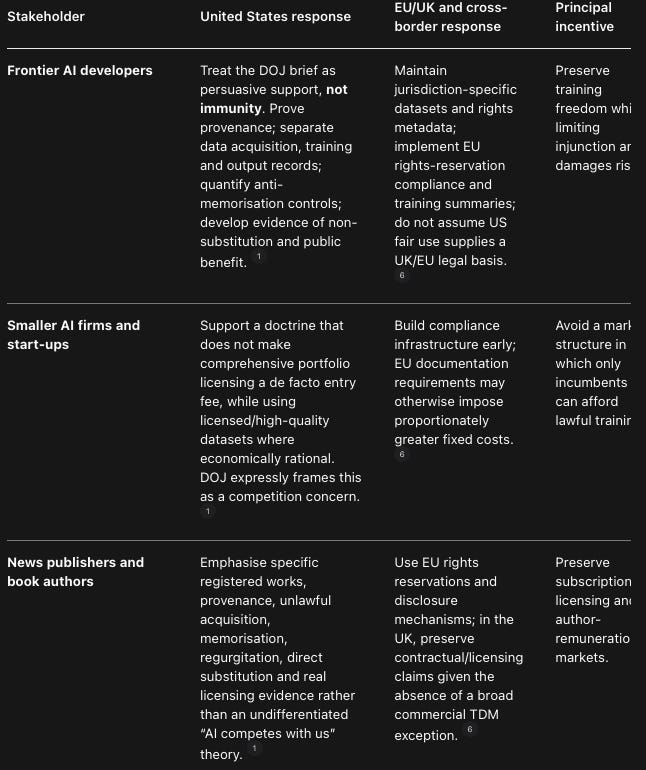
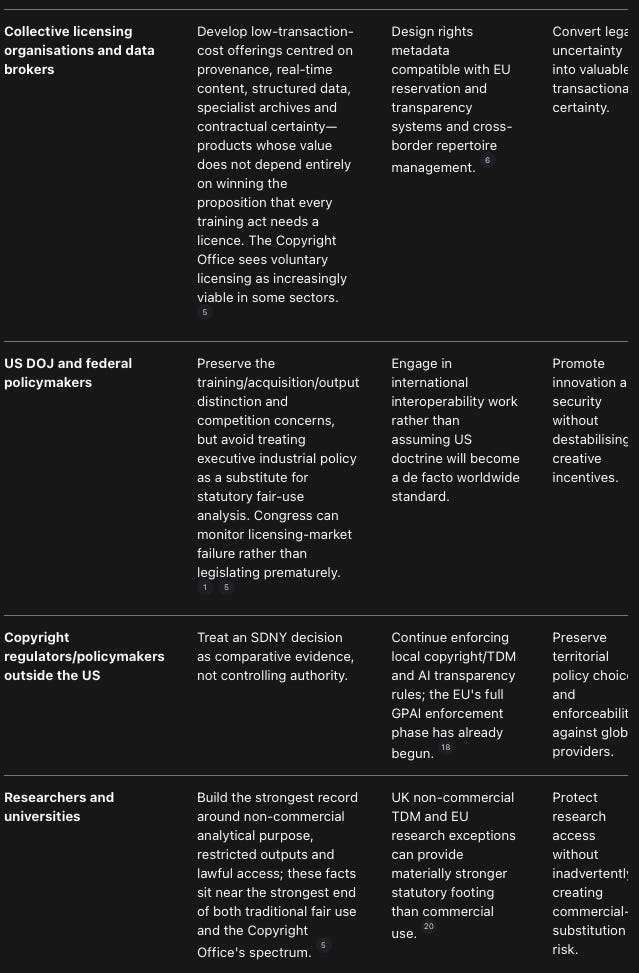
Comparative response matrix
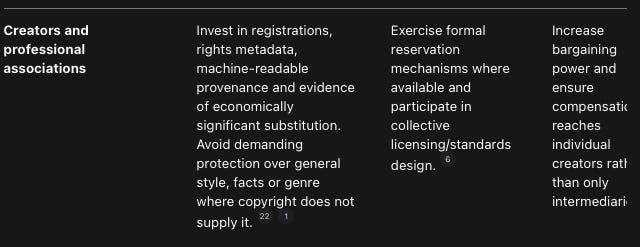
Recommended litigation strategy
For AI defendants, the most important evidential lesson is that “training is transformative” should be proved technically, not asserted rhetorically. They should be able to demonstrate how training copies are processed, what remains in parameters, how frequently protected sequences can be extracted, what safeguards are used, whether model behaviour changed after mitigation, and why outputs are not substitutes for plaintiff works. They should also maintain evidence separating lawfully acquired and allegedly unlawful source copies. This approach aligns both with DOJ’s use-by-use theory and with the Copyright Office’s emphasis on source, purpose and controls.
For plaintiffs, the strongest response is to refuse the defendant’s invitation to litigate at the level of “AI in general”. A publisher that can identify a particular corpus, prove unauthorised or unlawful acquisition, establish memorisation, show repeatable reproductions, quantify displaced traffic or subscriptions, and demonstrate a functioning licensing market presents a much stronger fourth-factor case than one relying solely on macroeconomic predictions about AI-generated competition.
That strategy also hedges against the possibility that Judge Stein accepts the government’s conceptual distinction. Even if “training as such” is fair, acquisition misconduct and infringing outputs remain separately justiciable under the Statement’s own logic.
Recommended regulatory response
US regulators should resist turning the present dispute into a binary choice between uncompensated AI and licence-every-copy copyright. The Copyright Office’s evidence suggests a more promising path: allow voluntary markets to mature, monitor areas where transaction costs or bargaining asymmetries prevent workable deals, and revisit collective solutions only where a demonstrable market failure remains.
A useful federal framework could improve dataset provenance, transparency and rights metadata without legislating the fair-use outcome itself. Such measures would improve litigation accuracy, licensing efficiency and creator bargaining while preserving courts’ ability to decide § 107 case by case. Congress is already considering multiple copyright-and-AI proposals, demonstrating that legislative attention to transparency and related AI/copyright issues remains active in the 119th Congress.
Competition agencies should separately watch whether either extreme produces concentration. Mandatory comprehensive licensing may disproportionately favour cash-rich incumbents, as DOJ warns; conversely, a rule permitting powerful platforms to appropriate premium creative inputs while eliminating publishers’ bargaining leverage could itself accelerate concentration on the content side. Copyright and competition policy therefore need coordination rather than the assumption that either “free data” or “paid data” is inherently competitive.
Timeline and likely milestones
The near-term procedural dates below are fixed by the SDNY’s March 2026 scheduling order. Later judicial dates are forecasts, not court-ordered deadlines. The EU transition date is fixed by the Commission’s GPAI implementation framework.
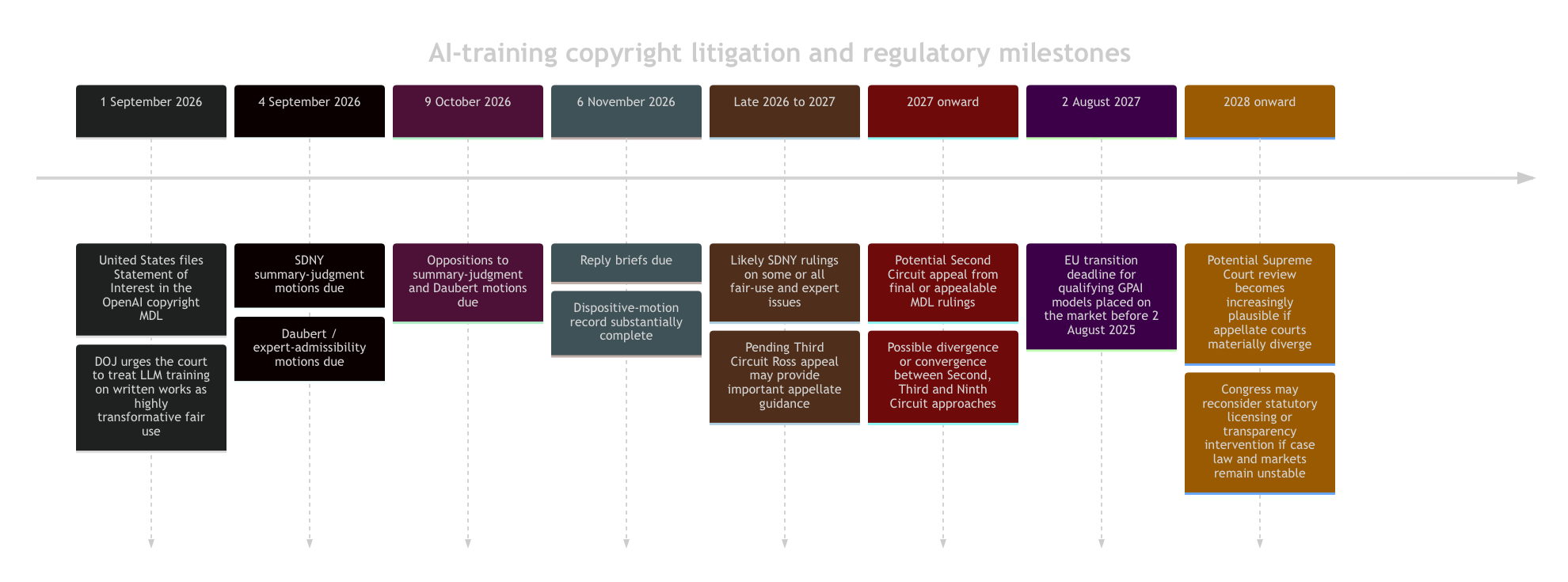
The highest-confidence near-term milestone is the summary-judgment phase. Because fair use is a mixed legal-factual inquiry that can be resolved on summary judgment when the material facts are sufficiently settled, the court could issue a major ruling without a full trial. The April 2025 SDNY opinion has already narrowed other claims while allowing the core copyright controversy to continue.
The outstanding Ross appeal is a second major variable. The district court there rejected fair use for use of Westlaw headnotes in a competing legal-research product, and the appeal remained pending in 2026. A Third Circuit judgment would not bind SDNY or the Second Circuit, but its treatment of transformation, training inputs, licensing markets and direct competition could become highly persuasive.
A Second Circuit decision in the OpenAI MDL would be more consequential for this dispute because it would bind federal district courts within that circuit and necessarily confront its own Authors Guild v Google precedent. The most important future appellate question is likely to be how far the Google Books model of permissible intermediate copying extends when the resulting technology itself generates expressive material.
Supreme Court intervention is possible but should not be described as imminent. It becomes substantially more plausible if circuits adopt materially incompatible rules—for example, one treating generative-model training as presumptively transformative and another giving decisive weight to training-licensing or broader market-dilution theories.
Ethical assessment and conclusion
The Statement of Interest deserves to be taken seriously as legal analysis, but not uncritically as a neutral description of copyright law. It is both a doctrinal brief and a piece of national industrial strategy. Its text explicitly links fair use to US technological leadership, competition, scientific advancement and national security. That perspective is consistent with the administration’s wider policy of sustaining American AI leadership.
Ethically, its strongest proposition is the insistence that learning is not equivalent to republication. Copyright exists to stimulate public knowledge and creative progress, not to confer ownership of facts, ideas, language patterns, genres or the general capacity to learn from prior culture. A legal rule under which every computational observation of protected material necessarily required individual permission could make socially valuable research and technological experimentation prohibitively difficult, particularly for universities, start-ups and smaller developers. The academic “fair learning” tradition reflects precisely that concern.
The Statement is also ethically persuasive in warning about concentration. A licensing obligation that seems creator-friendly in the abstract could, if transaction costs reach very large scales, entrench the richest model developers and the largest rights aggregators. DOJ’s concern that copyright policy should not unintentionally produce a two-sided oligopoly deserves serious consideration. The Copyright Office acknowledges the same competitive issue even while reaching a more balanced fair-use analysis.
Yet the opposite distributional problem is equally real. Human authors, journalists, illustrators and publishers incur the costs of producing trustworthy, original material. Where a commercial AI provider systematically captures that value without meaningful transparency, builds a service partly capable of displacing the original source, and then invokes “transformation” to deny any obligation to share resulting gains, the formal copyright analysis may diverge from intuitions of reciprocity and fairness. Sobel’s early scholarship correctly anticipated that expressive generative systems make the simple non-expressive-learning analogy ethically unstable.
The ethical importance of source provenance is particularly strong. Training on a lawfully purchased, subscribed-to, open or deliberately licensed corpus is different in moral character from deliberately assembling a shadow library of unauthorised copies even if a court ultimately regards the subsequent mathematical training operation as transformative. The Copyright Office’s approach appropriately treats the source of material as part of the overall analysis. A legal system that ignores provenance risks creating a perverse incentive to acquire first and ask permission never.
Transparency matters for the same reason. Rights holders cannot exercise contractual rights, bring well-founded claims, negotiate licences or distinguish harmless learning from substitution when they have essentially no information about what was used. The EU’s requirement for training-content summaries and copyright-compliance policies represents one regulatory answer to that information asymmetry, regardless of whether Europe ultimately adopts the economically optimal substantive copyright rule.
The ethically preferable position is therefore a conditional fair-learning model:
Lawfully sourced copying genuinely necessary for non-substitutive model training should ordinarily enjoy substantial legal and ethical latitude. Developers should not owe a royalty merely because their models learned uncopyrightable facts, ideas, linguistic relationships or general techniques from protected works. But that latitude should be coupled with auditable provenance, meaningful anti-regurgitation controls, respect for independently applicable technical and contractual restrictions, liability for substantially infringing outputs, and functioning markets for premium or otherwise licensable data. Where mass-market licensing proves impossible, policymakers should investigate targeted collective mechanisms rather than automatically criminalising or immunising an entire technology.
On that basis, the submitted Statement should be understood as a highly significant, sophisticated but intentionally one-sided intervention at a formative moment in US copyright law. Its distinction between acquisition, training and outputs is likely to survive even if the court does not accept all of its conclusions. Its broader suggestion that training-related market harm is almost entirely irrelevant unless the resulting expression is substantially similar is less secure and conflicts with the more contextual approach of the Copyright Office.
For litigants, the implication is to litigate facts rather than slogans. For AI companies, it means proving lawful provenance, transformation and non-substitution rather than treating the filing as a safe harbour. For copyright owners, it means proving concrete protected-market harm and acquisition or output misconduct rather than asking copyright to insulate human creators from competition as such. For regulators, it means solving transparency, bargaining and competition failures without prematurely fixing a universal price for machine learning. And for organisations operating internationally, it means accepting that US fair use, EU rights-reservation rules and the UK’s narrower TDM regime will coexist for the foreseeable future, requiring jurisdiction-specific compliance rather than a single worldwide answer.
The best ethical equilibrium is neither “all training is theft” nor “all training is free”. It is a system in which machines may learn from human culture when the use is genuinely transformative and non-substitutive, while the humans and institutions that sustain that culture retain meaningful protection against piracy, replication, opacity and exploitative market substitution.
Sources and authorities
Primary document. United States Department of Justice, Statement of Interest of the United States, In re OpenAI, Inc. Copyright Infringement Litigation, 25-md-3143 (SHS) (OTW), filed 1 September 2026.
US statutory and judicial materials. 28 U.S.C. § 517, authorising DOJ to attend to US interests in pending litigation. 17 U.S.C. §§ 411, 502, 504 and 505, concerning registration and civil remedies. SDNY, The New York Times Company v Microsoft Corporation et al., 4 April 2025. SDNY scheduling order governing expert discovery and September–November 2026 dispositive briefing.
US Copyright Office. Copyright and Artificial Intelligence, Part 3: Generative AI Training, pre-publication version, May 2025; the Office says a final version will contain no expected substantive change to its analysis or conclusions. Its conclusion stresses case-specific fair use, source lawfulness, output controls, market effects and continued development of voluntary licensing.
US executive policy and contemporary reporting. White House materials on the January 2025 policy of strengthening US AI leadership. Reuters, 2 September 2026, reporting the federal government’s intervention in the OpenAI/New York Times litigation. Reuters and subsequent legal reporting on Thomson Reuters v Ross Intelligence.
European Union official materials. European Commission guidelines for general-purpose AI providers, including copyright-compliance policies, rights reservations, documentation and training-content summaries. Commission guidance on mandatory training-content summaries, enforcement from 2 August 2026 and transitional compliance for earlier models.
United Kingdom official materials. UK Government, Report and Impact Assessment on Copyright and Artificial Intelligence, 18 March 2026. UK Intellectual Property Office guidance confirming that the present text-and-data-mining exception is confined to computational analysis for non-commercial research with lawful access.
Academic literature. Mark A. Lemley and Bryan Casey, Fair Learning, Texas Law Review. Benjamin L.W. Sobel, “Artificial Intelligence’s Fair Use Crisis”, 41 Columbia Journal of Law & the Arts 45 (2017). Jiawei Zhang, “Input out, output in: towards positive-sum solutions to AI-copyright tensions”, Journal of Intellectual Property Law & Practice (2025). Arne Radeisen, “Open Foundation Models and TDM Exceptions to Copyright – Building Blocks for an AI Ecosystem”, GRUR International (2026).
Comparative scholarship. Research on the EU Article 4(3) text-and-data-mining opt-out examines the tension between rights-holder control and barriers to European AI development, illustrating why US fair use cannot simply be transposed into the European framework.