Summary: The Harvey episode shows how a specialist legal AI can produce a polished, authoritative-looking document while containing serious hidden errors in law, citations, currency, scope and procedural status.
The deeper problem is systemic across high-stakes AI: retrieval and strong models reduce error but do not guarantee that long, complex outputs are correct, internally consistent or properly grounded in current authoritative sources.
The answer is therefore neither blind trust nor rejecting AI, but stronger assurance architecture—version-aware sources, claim-level provenance, non-generative citations, automated checks and human verification proportional to the consequences of an error.
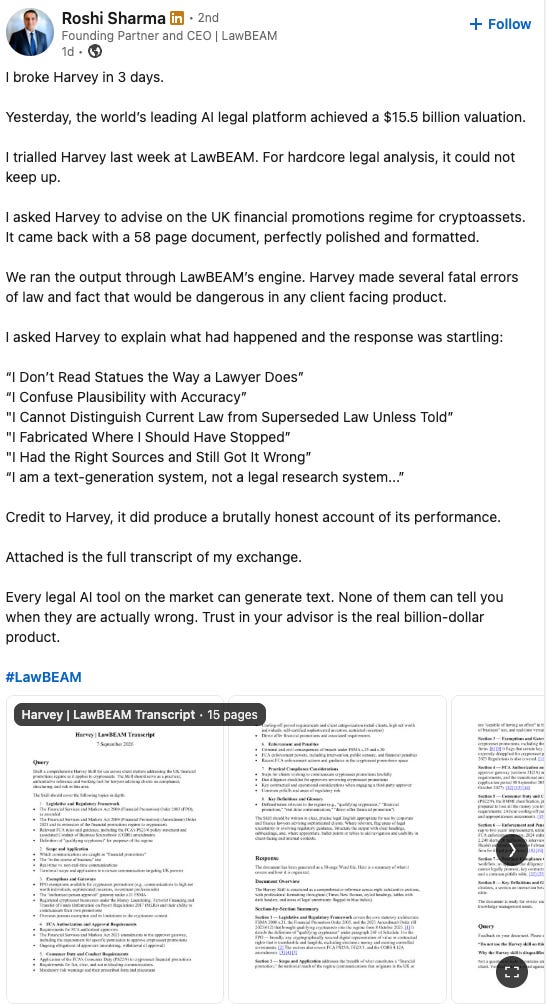
Source: LinkedIn
When a Market-Leading Legal AI Produces a Polished but Unsafe Answer: A Deep Analysis
by ChatGPT-5.6
Executive assessment
The LinkedIn post documents a genuinely serious failure of legal AI, but it needs to be interpreted with precision.
On 7 September 2026, the user asked Harvey to create a comprehensive, authoritative working “Skill” on the UK cryptoasset financial-promotions regime. The request was unusually well specified: it named the principal legislation, the FCA policy materials, the questions to address, the intended professional audience, and expressly required uncertainty and evolving guidance to be flagged. Harvey says it produced a polished 58-page document. The subsequent review identified numerous errors concerning investor categorisation, approval of promotions, appropriateness testing, risk-warning provisions, the statutory definition of a qualifying cryptoasset, exemptions, criminal liability, current guidance, and live litigation. Harvey then conceded those errors and offered an extensive self-diagnosis.
ChatGPT’s independent check against the current FCA Handbook and FCA materials confirms that most of the substantive criticisms in the transcript are correct. For example, qualifying cryptoassets are not included in the self-certified sophisticated-investor limb of COBS 4.12A.21R(2); FCA-registered crypto businesses cannot approve third-party promotions; COBS 4.12A.7R concerns incentives rather than the prescribed risk warning; and an order following a failed appropriateness assessment may not simply proceed after a warning. [1]
The incident is therefore much more than a typo or an isolated hallucinated citation. The most concerning pattern is:
accurate-looking structure + authoritative tone + genuine sources + specific citations + multiple hidden substantive failures.
That combination is dangerous because it can make an erroneous document more, rather than less, persuasive.
There are, however, two important qualifications.
First, the post contains the 15-page transcript and critique, not the underlying 58-page Skill itself. We can therefore audit all the failures evidenced in the transcript, but cannot establish the total error rate of the original 58 pages, determine how much of it was correct, or rule out additional errors.
Second, some of Harvey’s subsequent explanation of why it failed should not be treated as forensic evidence. Statements such as “I prioritised comprehensiveness over accuracy”, “I retrieved chunks”, or “I defaulted to a narrative pattern in my training data” are plausible hypotheses, but the assistant simultaneously says that it cannot see which underlying model was used. Without retrieval logs, prompts, source-ranking logs, document-generation traces and model/version metadata, the conversation cannot establish whether a particular error originated in the foundation model, Harvey’s retrieval layer, source versioning, tool orchestration, document assembly, or some interaction among them.
That distinction matters because “the LLM hallucinated” is an incomplete root-cause analysis of a domain AI platform.
There is another striking piece of contemporary evidence. Harvey itself now distinguishes between high average scores on its BigLaw Bench and far lower performance under its much stricter Legal Agent Benchmark, which requires successful end-to-end completion of multi-step legal work. In 2026 it reported, for example, 11.7% all-pass for Opus 5 and 2.5% for GPT-5.6 Sol on LAB even while those models achieved roughly 90%+ aggregate BigLaw Bench scores. Harvey explicitly says there remains substantial room to improve at completing every step of long, multi-step tasks without a miss. [2]
That is remarkably relevant to this incident. A 58-page regulatory manual is not a one-question benchmark. It is an all-pass problem containing potentially hundreds of independently falsifiable propositions.
As a simple illustration, even a hypothetical system that is independently 99% correct on each of 100 propositions has only about a 36.6% probability of getting all 100 right. At 99.5% proposition accuracy, all 100 are correct only about 60.6% of the time. At 98%, the all-correct probability falls to about 13.3%. Real errors are not independent, so those figures are only illustrative, but they demonstrate why “very good on average” and “unsafe as a long-form authoritative reference” can coexist.
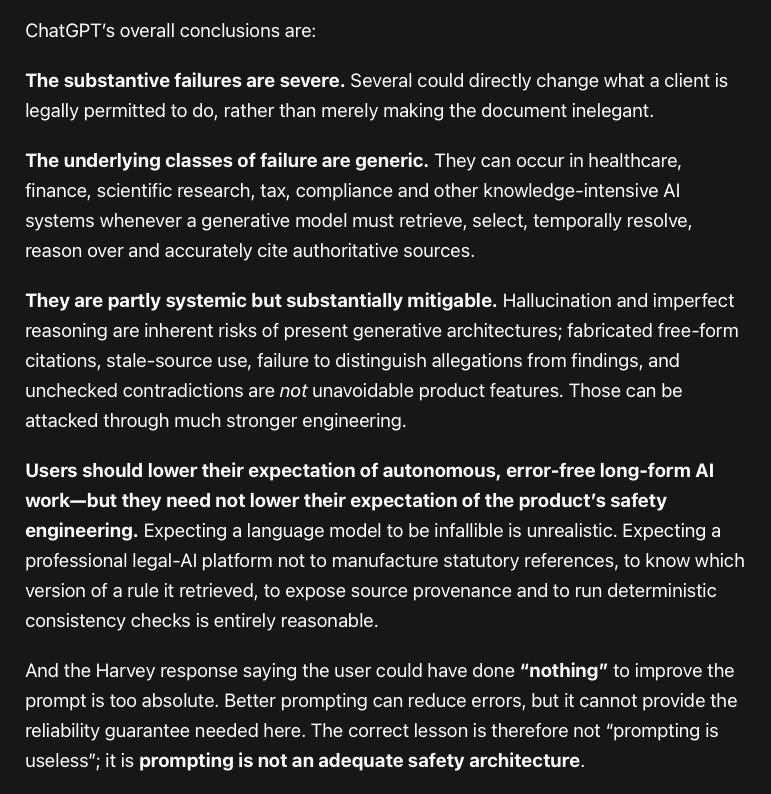
ChatGPT’s overall conclusions are:
The substantive failures are severe. Several could directly change what a client is legally permitted to do, rather than merely making the document inelegant.
The underlying classes of failure are generic. They can occur in healthcare, finance, scientific research, tax, compliance and other knowledge-intensive AI systems whenever a generative model must retrieve, select, temporally resolve, reason over and accurately cite authoritative sources.
They are partly systemic but substantially mitigable. Hallucination and imperfect reasoning are inherent risks of present generative architectures; fabricated free-form citations, stale-source use, failure to distinguish allegations from findings, and unchecked contradictions are not unavoidable product features. Those can be attacked through much stronger engineering.
Users should lower their expectation of autonomous, error-free long-form AI work—but they need not lower their expectation of the product’s safety engineering. Expecting a language model to be infallible is unrealistic. Expecting a professional legal-AI platform not to manufacture statutory references, to know which version of a rule it retrieved, to expose source provenance and to run deterministic consistency checks is entirely reasonable.
And the Harvey response saying the user could have done “nothing” to improve the prompt is too absolute. Better prompting can reduce errors, but it cannot provide the reliability guarantee needed here. The correct lesson is therefore not “prompting is useless”; it is prompting is not an adequate safety architecture.
What actually happened
The task was demanding, but not unfair
The original instruction asked for a practical and authoritative treatment of the financial-promotions regime for cryptoassets across eight areas: legislation, scope, exemptions, approval, conduct requirements, enforcement, compliance processes and terminology. It specifically named FSMA 2000, the FPO, the 2023 Amendment Order, PS23/6, the FCA Handbook, MLR-registered firms, Consumer Duty and enforcement consequences. It also asked for areas of uncertainty and evolving regulation to be identified.
This matters because the incident cannot plausibly be attributed to a vague request such as “tell me about crypto law”. The user supplied a professional research specification.
Nor was the task inherently adversarial. It required difficult legal synthesis, but the trick was not to solve an obscure riddle. The essential facts were contained in published FCA rules and legislation. Much of the challenge consisted of distinctions that practising lawyers routinely have to maintain: current versus superseded text, general versus product-specific rules, communicating versus approving a promotion, a regulatory allegation versus a judicial finding, and the difference between an exemption that is expressly carved out and one that simply does not extend to the relevant investment type. [3]
The output appears to have crossed the dangerous “polish threshold”
Harvey reported producing a 58-page Word document with formal headings, tables and styled presentation, then summarised it as a comprehensive treatment of the regime and said it was “ready for review”.
The critical problem is not professional formatting itself. It is the mismatch between presentation certainty and epistemic certainty.
A rough memorandum containing “[CHECK ARTICLE]” is conspicuously unfinished. A beautifully formatted table saying “Article 15 FPO — one-off communications” conveys that the legal research has already been done. The second output is more useful when correct, but substantially more dangerous when wrong.
This is a recognised human-AI problem: people do not merely consume an AI’s underlying accuracy rate. They react to its fluency, explanations and interface. Human-factors research has found that AI support can alter users’ reliance decisions and that explanations do not necessarily solve the problem; under some circumstances they increase over-reliance on incorrect AI recommendations. [4]
The timing makes the version-control problem particularly revealing
The transcript is dated 7 September 2026. The regulatory landscape was not frozen at its 2023 implementation state. By then FG24/1 had replaced the earlier FCA social-media guidance, the Government had made the new 2026 cryptoasset regulations, the FCA had confirmed that the new regulatory regime would start on 25 October 2027, and HTX litigation remained active in the High Court. [5]
An enterprise legal AI therefore needed to do more than “know crypto financial promotions”. It needed to answer the temporal question:
What is law/guidance/status as at 7 September 2026?
That is fundamentally a data-governance and retrieval problem as well as a language-model problem.
The incident occurred against extremely strong market positioning
Two days after the dated transcript, Harvey announced a $550 million funding round at a $15.5 billion valuation and said that 80% of the Am Law 100 used Harvey. [6]
That does not prove a contractual promise of zero errors, and valuation is obviously not a measure of legal accuracy. But it explains why the episode feels qualitatively different from an ordinary consumer chatbot getting an article number wrong. The product is deployed specifically into professional legal workflows.
The public post’s phrase “I broke Harvey in 3 days” should nonetheless be treated as rhetoric rather than a statistically established conclusion. One documented matter cannot establish Harvey’s population-wide error rate, and the full 58-page output is unavailable here. What it establishes is narrower but still important: a professionally specified, high-stakes regulatory assignment was capable of producing a collection of serious, plausibly hidden errors.
The exact foundation model responsible cannot be inferred. Harvey offers multiple models in 2026, and the transcript itself states that the assistant did not have visibility into the model version. [7]
Failure audit and severity
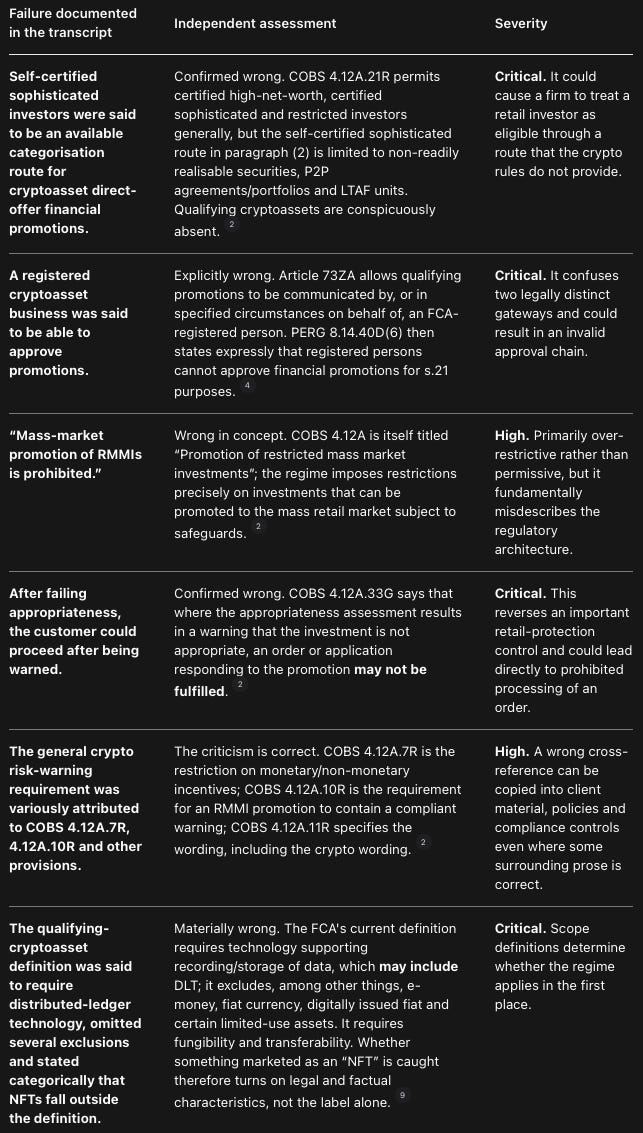
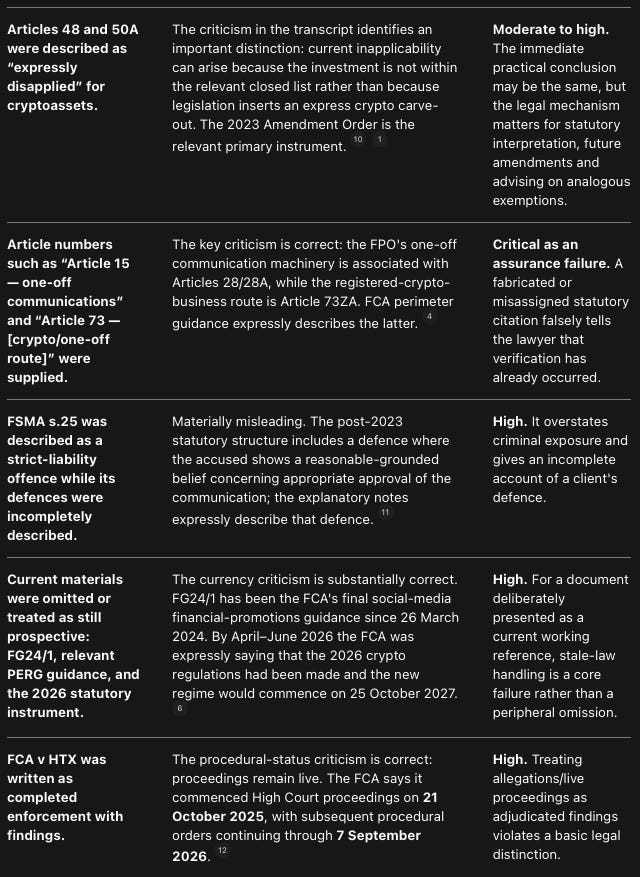
I would divide the documented errors into critical, high and moderate severity.
“Critical” here does not mean that a client necessarily suffered harm. It means that, if relied on as legal guidance, the proposition could materially change whether conduct is permitted, which route a client can use, whether a transaction may proceed or how regulatory/criminal exposure is assessed.
The substantive legal failures
Two corrections to the critique itself
The critique posted on LinkedIn is very good, but independent research reveals two small corrections that demonstrate why even a critique should itself be source-checked.
First, it says HTX proceedings were issued on 22 October 2025. The FCA’s current proceedings page states that proceedings commenced on 21 October 2025; the application notice was dated 22 October. [18]
Second, the critique says that Harvey attributed FCA “findings” about corporate opacity that “do not exist”. There were indeed no concluded judicial findings on the merits. But the FCA’s own February 2026 announcement explicitly asserted that HTX “operates an opaque organisational structure”. The accurate formulation is therefore: that characterisation existed as an FCA allegation/assertion, but it was wrong to transform it into a concluded finding. [19]
Those nuances do not rescue the original Harvey treatment. They reinforce the central lesson: legal reliability often lies in seemingly tiny distinctions between claim, allegation, regulator statement, finding, order and judgment.
The deeper failures were not individual mistakes but failures of assurance
The ten legal clusters above reveal at least seven more fundamental system failures.
Source authority failure. The system apparently had access to authoritative material but did not reliably anchor each operative proposition to the controlling text.
Temporal-resolution failure. Superseded policy material and current law were insufficiently separated. Current FCA pages can themselves expose effective dates and future versions, meaning this is exactly the sort of metadata an enterprise legal platform should capture. [20]
Rule-specificity failure. Rules for “RMMIs” were apparently generalised across different investment types even though the Handbook contains product-specific subparagraphs. COBS 4.12A.21R is an unusually clean example: the crypto result changes simply because “qualifying cryptoasset” does not appear in paragraph (2). [8]
Citation-integrity failure. The system generated legal identifiers rather than restricting itself to identifiers returned from an authoritative source.
Cross-document consistency failure. According to the transcript, the glossary contradicted substantive sections on mass marketing and appropriateness. That means the document assembly process did not perform a reliable proposition-level reconciliation.
Procedural-status failure. The HTX example collapsed a live claim into an enforcement outcome. Current FCA material makes the procedural sequence readily identifiable. [18]
Uncertainty-calibration failure. Weakly supported propositions were rendered in the same professional voice as well-grounded ones. This is closely related to a broader metacognition problem observed in LLM research: models can give highly confident answers even where critical information is missing or the correct option is unavailable. [21]
The result is a particularly dangerous form of error: not nonsense, but professionally plausible wrongness.
What actually caused the failure
Harvey’s own post-error explanation contains useful observations, but it mixes three very different levels that should be separated: foundation-model limitations, platform/system design and workflow design.
Foundation-model behaviour is part of the explanation
Modern generative language models are extraordinarily capable statistical language systems, but generation itself does not provide a mathematical guarantee that each proposition is true. NIST treats “confabulation”—confidently produced false or erroneous content—as a cross-sector generative-AI risk requiring explicit management. [22]
This explains why fictitious-but-plausible citations are a natural failure mode when a system is allowed to produce identifiers freely. “Article 28B” has exactly the linguistic characteristics that make such an error hard to spot: the format is valid, similar articles exist, and the surrounding prose remains grammatical.
Long-context use creates another problem. Research on long-context models has shown that simply putting the correct information into a large context does not guarantee that the model will use it robustly; performance can change substantially with the position of relevant material and historically has been weaker for information buried in the middle of long contexts. [23]
So the statement in the transcript that “I had the right sources and still got it wrong” is technically plausible. Retrieval is only the first half of the problem.
Retrieval-augmented generation is not a truth machine
RAG changes the model’s evidence environment: instead of relying solely on model parameters, the system can retrieve current documents and provide them to the generator. That can greatly improve performance. It does not logically constrain every output sentence to be entailed by those documents.
This has been empirically demonstrated in legal research tools. A preregistered Stanford/Yale evaluation of prominent RAG-based legal-research products found that they materially reduced hallucinations relative to general-purpose chatbots but still produced hallucinations in roughly 17–33% of tested responses. Those results relate to 2024 systems, not Harvey in 2026, so they should not be treated as Harvey performance figures; their significance is architectural: domain RAG lowers risk but does not automatically eliminate it. [24]
The same distinction appears in other disciplines. Retrieval-enhanced medical systems can markedly reduce errors, and in one narrow 2025 radiology experiment no hallucinations were observed among 100 RAG-assisted synthetic consultations versus 8% in the baseline system. That is encouraging evidence for engineering improvements, not proof of universal hallucination-free medicine—the experimental sample and task were bounded. [25]
But several failures are better viewed as product-engineering failures than unavoidable LLM failures
This is where Harvey’s “I’m a text-generation system” explanation becomes too forgiving of the platform.
A professional legal research system does not have to permit the language model to invent citation strings. The workflow can require the model to choose only from identifiers attached to retrieved source passages.
It does not have to treat source dates as prose. The retrieval index can store effective_from, effective_to, version, jurisdiction, document_type, and supersedes metadata and filter before generation.
It does not have to rely on a model’s memory to decide whether proceedings are live. A case-status component can classify source documents into claim, judgment, order, settlement or regulator announcement and refuse to turn an allegation into a finding without supporting material.
It does not have to hope that a 58-page glossary agrees with the body. Defined propositions can be extracted, normalised and automatically compared.
And it does not have to trust one generative pass to both draft and verify its own work.
These are system-architecture choices.
Harvey’s own public benchmarking implicitly acknowledges the distinction between impressive component performance and flawless end-to-end execution. In July 2026 it reported GPT-5.6 Sol at 92.7% on BigLaw Bench but only 2.5% all-pass on the stricter LAB benchmark, specifically noting room for improvement in areas including regulatory/advising and transaction structuring. Opus 5 achieved 11.7% on the same all-pass LAB measure. [26]
That is not evidence that the model used in this matter scored 2.5% or 11.7%; we do not know which model was used. It is evidence that Harvey itself regards perfect completion of multi-stage professional assignments as substantially harder than achieving a high average legal-quality score.
The length of the requested artefact amplified the risk
The prompt did not merely ask, “Can a self-certified sophisticated investor receive this crypto promotion?” It asked for a reusable 58-page authority.
Long artefacts create multiple compounding problems:
A retrieval error can contaminate several sections. A mistaken categorisation rule can reappear in a table, explanatory prose, workflow and glossary. A wrong citation may be copied repeatedly. Different drafting passes may use different source snapshots. A subsequent summary can introduce inconsistencies into material that was correct earlier.
That appears to have happened here: the transcript identifies the same subject being described correctly in one section and incorrectly in another.
For reusable professional “Skills”, therefore, document-level correctness is a much harsher standard than paragraph-level quality.
Harvey’s self-diagnosis is not a reliable root-cause report
This deserves particular emphasis.
After being challenged, the Harvey assistant confidently explains that it:
· retrieved chunks,
· generalised from summaries,
· prioritised completeness over accuracy,
· defaulted to narrative patterns in training data,
· failed to run a reconciliation pass.
Those may all be true. But the same assistant says it cannot see the exact model version underneath.
There is no retrieval log in the attachment showing which passage produced the self-certified-investor error. There is no ranking trace showing PS22/10 displaced the current Handbook. There is no model telemetry establishing that a particular HTX sentence originated from “a common narrative pattern in training data”.
Accordingly, the later conversation should be read as a useful conceptual explanation, not as an engineering incident report.
A real root-cause analysis would ask:
Which model and model version generated each section?
What system prompt and research-agent instructions were active?
Which source documents and exact versions were retrieved for each claim?
Did the model have access to current Handbook text or a cached copy?
What were the retrieval scores?
Were older PS22/10 materials and current COBS provisions present simultaneously?
Was the 58-page output generated in one context or assembled from multiple calls?
Was there a separate citation-validation pass?
Did an automated checker compare cited provisions with source content?
Was the glossary generated independently from the main analysis?
Were live-web/current-state queries used for HTX and the 2026 SI?
Without that evidence, assigning every failure to “the model” is premature.
How generic the risks are across law, healthcare, finance and scientific research
The central mechanisms are highly generic. The consequences differ by domain.
Law is especially vulnerable to “almost-right” answers
Legal work combines several conditions that are unfriendly to unconstrained generation:
authoritative sources coexist with commentary; provisions have hierarchical cross-references; exceptions are often dispositive; effective dates matter; language changes over time; procedural status matters; and very small lexical distinctions can reverse an answer.
The COBS categorisation error illustrates this perfectly. The model did not need to misunderstand the philosophy of investor protection. It merely had to flatten an investment-specific list. The omission of “qualifying cryptoasset” from one subparagraph changes the answer. [8]
Earlier empirical work confirms that plausible legal hallucination is not unique to this vendor. Research on general LLMs found high hallucination rates when models were asked verifiable questions about US federal cases and also found that models could fail to recognise when their legal answers were wrong. Specialised RAG legal products performed considerably better, but not perfectly. [27]
Healthcare has the same mechanisms, but the cost function changes
Substitute:
· “superseded COBS rule” with superseded clinical guideline;
· “wrong Article number” with non-existent study or incorrect dosage reference;
· “wrong investment-specific exception” with wrong contraindication or population-specific exception;
· “allegation treated as finding” with preliminary study treated as established clinical evidence.
The underlying information problem is strikingly similar.
A 2025 multi-model study inserted one fabricated clinical detail into each of 300 physician-validated simulated cases. Across models and conditions, systems frequently elaborated on the false premise; a mitigation prompt reduced the average rate substantially but did not eliminate the phenomenon. The study is deliberately adversarial, so its percentages should not be extrapolated to routine clinical use, but it demonstrates exactly the failure mode seen in legal AI: a plausible false premise can be accepted and fluently developed rather than challenged. [28]
Metacognition is also directly relevant. In MetaMedQA, twelve tested models could perform strongly on standard medical questions while still struggling to recognise missing knowledge or the absence of a correct answer, sometimes producing confident responses despite those deficiencies. [21]
Yet healthcare research simultaneously shows that careful RAG, curated guidelines and constrained systems can dramatically improve reliability. That is why the lesson is not “LLMs can never be used in medicine”; it is that application architecture, boundedness, evaluation and human oversight matter at least as much as raw language-model capability. [29]
Finance recreates the versioning and provenance problem almost exactly
Financial research frequently requires selecting:
· the correct company;
· correct reporting period;
· correct filing;
· correct accounting definition;
· correct table;
· correct currency/unit;
· and sometimes information dispersed across notes.
This is analogous to selecting the correct version and subparagraph of an FCA rule.
FinanceBench’s original evaluation found large weaknesses even when advanced language models were paired with retrieval, although those 2023-era results should not be treated as estimates of 2026 performance. [30]
More recent work illustrates why the problem persists at the retrieval layer. FinRank, released in 2026, deliberately uses hard negative evidence from confusable companies, reporting periods and disclosures. Its baseline results show substantial deterioration when systems must distinguish genuinely relevant evidence from highly plausible alternatives. [31]
That is exactly the stale-authority problem in another costume: retrieving a company’s 2024 disclosure when the question concerns the 2025 disclosure may produce excellent prose and a completely wrong answer.
Financial regulators are therefore treating GenAI as an operational and supervisory risk rather than assuming output quality can be solved by prompting. FINRA’s 2026 oversight material identifies concerns around agent autonomy, scope and authority, auditability and transparency, while noting that summarisation and information extraction are already leading industry use cases. [32]
Scientific research has a particularly acute citation problem
The scientific analogue of “Article 15 FPO” is a beautifully formatted reference to a paper that either does not exist or does not support the claim.
OpenScholar’s researchers evaluated scientific literature synthesis across multiple disciplines and found very high citation-hallucination rates for an ungrounded GPT-4o baseline in their benchmark; their retrieval-centred OpenScholar system substantially improved citation quality and answer correctness. The figures come from the authors’ own benchmark and an older model generation, so they should be read as evidence of the mechanism rather than current universal rates. [33]
Conversely, PaperQA2 research reported that a carefully designed literature agent could match or outperform domain experts on particular search and synthesis tasks, including cited summaries. [34]
Those two results are not contradictory. They demonstrate something extremely important for interpreting the Harvey incident:
“LLMs hallucinate” and “AI systems can outperform experts” can both be true.
An unconstrained language model, a basic RAG chatbot and a carefully engineered agent with retrieval, reranking, citation validation, iteration and task-specific evaluation are not equivalent systems.
The generic failure taxonomy
Across all four domains, essentially the same classes recur:
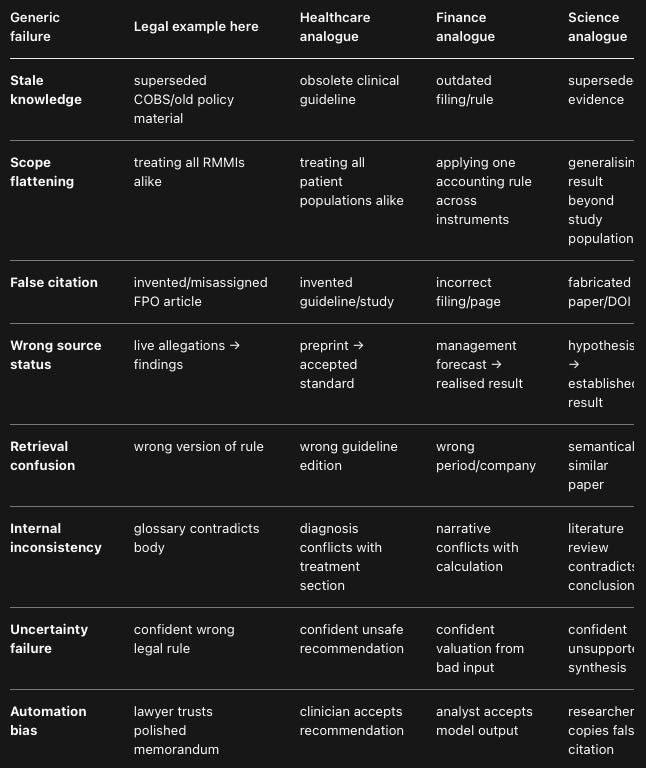
These are therefore not “Harvey bugs” in the narrow sense. They are system-level risks for any generative knowledge tool whose output is allowed to outrun its evidence. NIST’s cross-sector GenAI risk framework recognises precisely this need to manage risks at the overall system and lifecycle level rather than treating model accuracy as the whole problem. [22]
Are the failures systemic, and what is actually fixable?
The useful answer is neither “yes, AI is fundamentally broken” nor “no, the next model will fix it”.
Some properties are structural limitations of current generative AI. Others are avoidable engineering defects.
What is genuinely systemic
Non-zero factual error is systemic. A generative model is not intrinsically a database constraint system that proves every token from a source. Even very strong models sometimes produce unsupported conclusions. NIST therefore treats confabulation as an ongoing generative-AI risk rather than an already solved bug. [22]
Imperfect uncertainty calibration is systemic. A model’s linguistic confidence is not a dependable probability that its legal proposition is correct. Medical metacognition experiments provide a particularly clear demonstration. [21]
Long-horizon compounding is systemic. As tasks contain more independently necessary steps, the probability of a completely error-free artefact falls unless each component becomes extraordinarily reliable. Harvey’s own LAB/BigLaw Bench gap is a practical illustration of this phenomenon in legal workflows. [2]
Retrieval is probabilistic. Semantic similarity does not necessarily identify the legally or scientifically controlling document. Recent financial retrieval research explicitly demonstrates difficulty distinguishing evidence from plausible hard negatives. [31]
Automated verification itself is imperfect. An LLM reviewing its own work may share the same blind spots as the model that produced it. This is why simply adding “double-check your answer” is not equivalent to independent verification.
What should be considered fixable or strongly mitigable
The exact mistakes in this incident are much more tractable than the generic problem of hallucination.
Citation identifiers can be made non-generative
For high-stakes legal work, the system should never allow free-form generation of COBS 4.12A.X, Article YY, case citations or dates when those identifiers can be returned by a source parser.
The model should receive something akin to:
SOURCE_ID=FCA_COBS_4.12A.21R_CURRENT
and the user-facing citation should be rendered from authoritative metadata, not typed by the LLM.
That would make an invented “Article 15” substantially harder to produce.
Current-law research should be version-aware by construction
An authoritative corpus should retain effective dates and supersession relationships.
A query dated 7 September 2026 should automatically exclude or prominently flag a 2022 version unless the task specifically asks for historical evolution. The current FCA Handbook already exposes amendment and future-version information, so the source ecosystem contains data that can support such treatment. [10]
A robust system should also run an explicit temporal check on sentences containing phrases such as:
“will commence”
“has not yet been made”
“currently”
“latest guidance”
“proceedings concluded”
“effective from”
Those are exactly the claims most vulnerable to silent expiry.
Primary-source-first generation is achievable
For questions such as “Can a self-certified sophisticated investor receive a cryptoasset DOFP?”, the safest workflow is not:
search → form general answer → cite some sources
but:
identify controlling rule → extract operative subsection → determine listed conditions → draft proposition → attach source
This inversion is crucial.
The COBS 4.12A.21R mistake would be difficult to sustain under such a system because the authoritative subparagraph visibly lists four specific investment types and omits qualifying cryptoassets. [8]
Regulatory rules can partly be converted into structured logic
Certain questions are amenable to rule engines rather than unconstrained prose.
For example:
IF investment = qualifying_cryptoasset
AND client_category = self_certified_sophisticated
THEN COBS_4_12A_21R_2 = unavailable
The LLM can explain the result, but the eligibility decision need not itself be invented probabilistically.
Legal AI does not have to choose between “pure LLM” and “no AI”. Hybrid symbolic/generative approaches are especially attractive for regulatory regimes with precise gateways.
Procedural posture can be validated separately
Before describing litigation as producing “findings”, a legal AI can require the presence of a judgment, final order, consent order or equivalent source.
Here the FCA’s source page clearly labels the matter “legal proceedings”, lists a claim form and subsequent procedural orders, and remains updated through 8 September 2026. [18]
A simple source-status validator should have been capable of challenging “landmark concluded enforcement”.
Claim-level provenance is much more useful than a bibliography
The transcript’s original output appears to have used numbered references and a bibliography. That is not enough.
The critical property is not:
“This paragraph has an FCA source somewhere nearby.”
It is:
“This exact proposition is entailed by these exact words in the current version of this source.”
That distinction is increasingly central in research-oriented RAG systems and scientific synthesis. [33]
Contradictions can be checked automatically
A 58-page regulatory Skill should be parsed after drafting into atomic propositions, for example:
self-certified sophisticated investor → permitted for qualifying cryptoasset DOFP
failed appropriateness → order may proceed
RMMI → cannot be mass marketed
Then equivalent propositions elsewhere should be compared.
This would not prove correctness, but it would have caught the striking glossary-versus-body contradictions documented in the transcript.
Long outputs should be constructed modularly
A safer workflow for this task would have been:
research the statutory perimeter;
validate it;
lock those propositions;
research COBS categorisation;
validate it;
lock those propositions;
research enforcement;
validate it;
then assemble the final Skill from approved modules.
The danger of a one-shot “generate 58 polished pages” workflow is that drafting quality becomes the visible optimisation target while proposition-level validation becomes an implicit afterthought.
What cannot realistically be fixed to zero
Even after all of those controls, demanding a guarantee that an open-ended AI-generated legal memorandum contains zero substantive errors would be unrealistic with current technology.
New law can appear between indexing cycles. Primary materials can themselves be ambiguous. Different authoritative sources can conflict. Retrieval can fail. A model can misapply correctly retrieved law to unusual facts. Verification models can miss errors. Human reviewers can also miss them.
The realistic goal is therefore not “eliminate all errors” but to make the system:
less likely to err, much less likely to hallucinate silently, much easier to audit, and much more likely to fail visibly rather than invisibly.
That last distinction is crucial.
For high-stakes AI, a conspicuous abstention is often a better product outcome than a polished fabrication.
Are users expecting too much from AI?
The answer depends on which expectation.
Yes: zero-error autonomous authority is too high an expectation
It is not currently reasonable to assume that because an AI can:
draft fluently,
retrieve primary sources,
pass professional benchmarks,
produce citations,
handle large contexts, and
write in the idiom of an expert,
it will therefore produce a completely reliable 58-page professional reference without verification.
Those are different capabilities.
Historical legal evaluations show that even specialised RAG products can hallucinate. Long-context research shows that access to relevant information does not guarantee robust use of that information. Domain studies demonstrate confidence-calibration problems. And Harvey’s own current benchmark materials show a large gap between high aggregate legal-task quality and strict all-pass completion of long agentic work. [35]
Users who mentally model these products as “a better lawyer who has read everything and never forgets” are therefore assigning the wrong failure model.
A more accurate mental model is:
a potentially extremely capable research-and-drafting system that can search, reason and synthesise at extraordinary speed, but whose individual propositions still require evidence-sensitive assurance proportional to their consequences.
No: expecting basic professional safety controls is not excessive
It would be a mistake to turn the preceding conclusion into:
“AI is probabilistic, therefore users simply have to accept fake citations.”
That gives product design far too easy an escape.
A user of specialist legal AI can reasonably expect:
citations that correspond to real sources;
the source version and effective date to be known;
primary authorities to outrank obsolete consultation material;
obvious internal contradictions to be detected;
live litigation not to be silently converted into findings;
an unverified rule number not to be printed as if verified;
and limitations to be communicated in a way proportionate to the task.
Those are not demands that a neural network become omniscient. They are demands that an enterprise system engineer around known neural-network limitations.
Harvey’s current public materials themselves recognise that model performance differs materially by task and that strict end-to-end completion remains challenging. Its 2026 LAB results are arguably exactly the sort of information users need to calibrate expectations. [7]
The user’s original prompt was not the root problem
On this point, the Harvey transcript is substantially right.
The original prompt already:
named the controlling sources,
specified the jurisdiction,
specified the subject matter,
specified the professional audience,
asked for an authoritative tool, and
asked that uncertainty and evolving law be flagged.
A professional product should not require the user to add:
“Please do not invent legislation.”
Nor should a user need to know in advance every point on which the system will fail in order to instruct it not to fail there.
But Harvey’s “nothing you could have said” answer goes too far
Prompt design does affect model behaviour.
For example, an instruction such as:
“For every black-letter proposition, quote or extract the controlling primary provision first; do not state any Article/section/rule identifier unless it is present in a retrieved primary source; give the source’s effective date; compare all propositions against the current consolidated text; leave [UNVERIFIED] rather than infer a citation.”
could plausibly reduce some of these particular mistakes.
More generally, experimental medical work has found that a mitigation prompt can reduce false-premise hallucination substantially, albeit without eliminating it. [28]
So “no prompt could have helped” is not scientifically defensible as an absolute claim.
The more accurate conclusion is:
No reasonable user prompt can turn an insufficiently assured generative workflow into a safety-critical, error-proof professional system.
Prompting is one control. It cannot substitute for architecture.
The verification paradox is real
There is nevertheless a difficult economic problem.
If a lawyer must verify every word of an AI document exactly as thoroughly as if they had researched it from scratch, much of the apparent efficiency gain can disappear. Human-factors researchers have described this general automation problem: automation can shift people from producing work to evaluating machine output, and evaluation can itself become cognitively demanding—particularly because automation tends to make routine work easier while concentrating the human’s attention on difficult edge cases. [36]
This is one of the deepest issues raised by the incident.
The future value of specialist AI therefore cannot rest merely on:
“It drafts 58 pages in seconds.”
It must increasingly rest on:
“It drafts 58 pages and reduces the cost of establishing which propositions can safely be trusted.”
That requires provenance, deterministic checks, version control, traceable retrieval, auditable citations and deliberately designed human review.
The appropriate trust model is neither blind trust nor blanket distrust
The evidence does not support the conclusion that generative AI is useless in high-stakes domains.
Specialised scientific and medical systems have demonstrated substantial gains from retrieval and agentic architectures, and some controlled evaluations report expert-level or better performance on particular tasks. [37]
Equally, the evidence emphatically does not support autonomous trust merely because the output is fluent, cited, long or domain branded.
The appropriate approach is calibrated reliance:
Low-consequence transformations—formatting, extraction, first-pass summarisation—can tolerate relatively light review.
Medium-consequence drafting should be source-grounded and sampled or systematically checked.
High-consequence propositions governing legality, eligibility, diagnosis, dosage, regulatory status, financial calculations or research conclusions should have traceable authoritative evidence and an independent verification path.
That is not a temporary embarrassment unique to first-generation AI. NIST’s generative-AI framework treats risk management as an ongoing lifecycle activity, and financial regulators likewise frame AI deployment in terms of controls, oversight and auditability rather than assuming that raw model capability removes institutional responsibility. [38]
The strongest conclusion from this case is therefore more specific than “AI hallucinates”.
It is this:
The central safety problem is the gap between how reliable professional AI can look and how reliable an individual high-stakes proposition actually is.
The legal errors matter. But the truly consequential failure is that the system apparently had no sufficiently strong mechanism for making that gap visible before delivering a document designed to function as an authoritative reference.
That problem is systemic across contemporary generative AI, but the magnitude of it is not fixed by nature. Better models will help. Better retrieval will help. Better prompts will help. But the largest gains in high-stakes professional use are likely to come from designing systems in which unsupported assertions, stale authority and fabricated citations are structurally difficult to produce—and easy to detect when they nevertheless occur.
In that sense, users’ expectations require recalibration, but so do vendors’ product architectures.
The fair bargain should not be:
“Trust the AI; it is a legal expert.”
Nor should it be:
“Never trust the AI; re-do all of its work yourself.”
A credible high-stakes AI product should instead be able to say, in effect:
“Here is the answer; here is exactly what each material proposition rests on; here is which version was used; here is what I could not verify; and here is where human judgment is still required.”
The Harvey episode is significant precisely because, on the evidence supplied, that assurance layer was not strong enough.
Sources:
[1] [8] [10] [11] [12] [20] https://handbook.fca.org.uk/handbook/cobs4/cobs4s17
https://handbook.fca.org.uk/handbook/cobs4/cobs4s17
[2] https://www.harvey.ai/blog/opus-5-in-harvey
https://www.harvey.ai/blog/opus-5-in-harvey
[3] [9] [15] https://handbook.fca.org.uk/handbook/perg8
https://handbook.fca.org.uk/handbook/perg8
[4] https://www.microsoft.com/en-us/research/publication/understanding-the-role-of-human-intuition-on-reliance-in-human-ai-decision-making-with-explanations/?lang=zh-cn
[5] [17] https://www.fca.org.uk/publications/finalised-guidance/fg24-1-finalised-guidance-financial-promotions-social-media
[6] https://www.harvey.ai/blog/harvey-raises-dollar550m-at-a-dollar155b-valuation-to-help-legal-teams-own-their-intelligence
[7] https://www.harvey.ai/blog/sonnet-5-in-harvey
https://www.harvey.ai/blog/sonnet-5-in-harvey
[13] https://handbook.fca.org.uk/glossary/G3478q
https://handbook.fca.org.uk/glossary/G3478q
[14] https://www.legislation.gov.uk/uksi/2023/612/made/buynow
https://www.legislation.gov.uk/uksi/2023/612/made/buynow
[16] https://www.legislation.gov.uk/ukpga/2023/29/notes/division/6/index.htm
https://www.legislation.gov.uk/ukpga/2023/29/notes/division/6/index.htm
[18] https://www.fca.org.uk/news/statements/htx-huobi-legal-proceedings
https://www.fca.org.uk/news/statements/htx-huobi-legal-proceedings
[19] https://www.fca.org.uk/news/press-releases/fca-action-against-htx-illegal-financial-promotions
https://www.fca.org.uk/news/press-releases/fca-action-against-htx-illegal-financial-promotions
[21] https://www.nature.com/articles/s41467-024-55628-6
https://www.nature.com/articles/s41467-024-55628-6
[22] [38] https://www.nist.gov/publications/artificial-intelligence-risk-management-framework-generative-artificial-intelligence
[23] https://aclanthology.org/2024.tacl-1.9/
https://aclanthology.org/2024.tacl-1.9/
[24] [35] https://arxiv.org/abs/2405.20362
https://arxiv.org/abs/2405.20362
[25] [29] [37] https://www.nature.com/articles/s41746-025-01802-z
https://www.nature.com/articles/s41746-025-01802-z
[26] https://www.harvey.ai/blog/gpt-5-6-sol-in-harvey
https://www.harvey.ai/blog/gpt-5-6-sol-in-harvey
[27] https://arxiv.org/abs/2401.01301
https://arxiv.org/abs/2401.01301
[28] https://www.nature.com/articles/s43856-025-01021-3
https://www.nature.com/articles/s43856-025-01021-3
[30] https://arxiv.org/abs/2311.11944
https://arxiv.org/abs/2311.11944
[31] https://arxiv.org/abs/2608.07400
https://arxiv.org/abs/2608.07400
[32] https://www.finra.org/media-center/newsreleases/2025/finra-publishes-2026-regulatory-oversight-report-empower-member-firm
[33] https://arxiv.org/abs/2411.14199
https://arxiv.org/abs/2411.14199
[34] https://arxiv.org/abs/2409.13740
https://arxiv.org/abs/2409.13740
[36] https://www.microsoft.com/en-us/research/publication/ironies-of-generative-ai-understanding-and-mitigating-productivity-loss-in-human-ai-interaction/