

The Great Junior-Collapse: How AI Is Hollowing Out the Talent Pipeline (and Why That’s a Bigger Crisis Than Layoffs)
by ChatGPT-5.2
A useful way to read the latest news about job displacement due to AI, is as two “signal flares” from different parts of the same landscape. In UK advertising, the flare is visible in headcount: a sharp contraction concentrated in younger workers, fewer posted roles, and a retreat from graduate intake. In Ireland, the flare is visible in the shape of growth: highly AI-exposed sectors still expand, but the expansion increasingly happens without the same level of entry-level hiring—suggesting adjustment through the hiring funnel rather than mass redundancy.
Put plainly: the early, most serious labor impact of generative AI is not a Hollywood-style wave of pink slips. It is the quieter, more structural problem of “missing rungs” on the career ladder—especially in digitally mediated, white-collar work where junior roles are task-heavy, repeatable, and easy to wrap into an AI-enabled workflow.
What’s happening in advertising isn’t just “a tough year”—it’s a model failure under AI pressure
The UK agency numbers described in the attached reporting indicate a significant workforce contraction, with the steepest declines among younger workers and a simultaneous weakening of entry-level recruitment. The pattern matters more than the headline.
Advertising has always been a pipeline industry: juniors do the volume work, learn taste and craft through repetition and feedback, and slowly become trusted operators. Generative AI targets exactly the kind of work that traditionally trained juniors—drafting, iterating, summarizing, variant generation, rapid concepting, lightweight research, basic design exploration, versioning, and first-pass copy. When leadership frames AI primarily as an efficiency lever (“same output, fewer people”), the rational short-term move is to cut the most replaceable labor—often the newest and cheapest.
That produces an ugly contradiction: the industry saves money now by deleting the very roles that produce its future capability. In the short run, you can keep shipping campaigns with fewer people and a layer of AI assistance. In the medium run, you discover that your bench has thinned, your mid-level is undertrained, and your senior talent is doing more “quality control and exception handling” while also being expected to deliver more with less. The result is burnout at the top and disappearance at the bottom.
Even worse, advertising is unusually exposed to second-order AI risks that make talent loss more dangerous:
Homogenization risk: if many agencies use similar model stacks and prompt patterns, outputs converge. “Good enough” becomes a ceiling.
Brand safety and liability risk: AI-generated materials can smuggle bias, defamation, IP infringement, and provenance ambiguity into production—raising the need for humans who understand both creative nuance and risk controls.
Trust and authenticity risk: as synthetic content floods channels, the premium shifts to distinctiveness, credibility, and human insight—precisely the things that require cultivated talent, not just tooling.
So the seriousness isn’t just “jobs are down.” It’s that the agency production model—a human apprenticeship machine funded by billable hours—starts to break when a cheap generator eats the apprenticeship tasks.
Ireland’s “early-career impact” signal: the adjustment is happening through hiring, not displacement
The Irish government-linked analysis (as surfaced in the attached article) points to a pattern seen in other datasets: AI exposure correlates with weaker employment growth in highly digitized sectors, and the drag is most pronounced for younger workers. Crucially, it suggests the mechanism is often reduced hiring and entry, because it’s cheaper and simpler for firms to slow recruitment than to trigger redundancy costs, reputational blowback, and internal disruption.
That matters because it changes how societies experience the shock:
You don’t see one dramatic unemployment spike; you see longer job searches, weaker graduate outcomes, and underemployment.
You don’t get one loud political moment; you get a slow legitimacy crisis as young cohorts conclude the ladder is being pulled up behind them.
You don’t “solve it” with a single retraining initiative because the structural function of entry-level work was not just income—it was formation (skills, identity, networks, professional norms).
This is why “AI is creating jobs too” can be simultaneously true and socially insufficient. If the jobs created are disproportionately senior, specialized, or credential-gated, while the jobs removed are the entry points, you get a labor market that grows in aggregate but closes in practice.
Extrapolating beyond advertising: where the same hollowing-out logic is likely to hit next
Advertising is an early warning because it is a high-volume idea factory with digitized workflows and clear economic pressure. But the underlying pattern generalizes to any sector with:
heavy text/code/image throughput,
standardized deliverables,
high coordination overhead, and
a steep pyramid where juniors do repeatable tasks.
That describes a lot of “modern white-collar” work. In particular:
1) Professional services (legal, consulting, accounting, audit)
Juniors traditionally do document review, first drafts, basic research, summarization, memo scaffolding, due diligence checklists, and slide production. AI systems are already good at “first-pass” versions of those tasks. The risk is not that partners vanish; it’s that firms discover they can run leaner—and then later discover they have fewer trained seniorswith judgment forged by years of grind.
2) Finance and insurance
Analyst work often involves templated analysis, reporting, research notes, customer communications, and data-to-text explanations. AI can compress that work into smaller teams, especially when combined with process automation. But the cost is a thinner analyst class and greater dependence on opaque model-mediated workflows—raising systemic risk when “automated plausibility” replaces slow verification.
3) Software and IT operations
Entry-level devs and support roles are exposed to code assistants, automated testing generation, troubleshooting copilots, and AI-enabled ticket deflection. The near-term effect is frequently a hiring slowdown and higher expectations for “already productive” candidates. The longer-term danger is that fewer people get the chance to become genuinely expert engineers through real-world exposure.
4) Media, publishing, and content-heavy knowledge industries
Here the stakes include not only jobs but epistemic integrity: provenance, citation discipline, editorial judgment, and the social trust of information. If entry roles are cut while output volume increases via AI, you can get a quantity explosion with quality decay—and a workforce less able to detect subtle errors, manipulation, or model-shaped narratives.
5) Public sector administration and “paperwork states”
Many governments run on forms, correspondence, case notes, and procedural writing. AI can accelerate these, but if it’s used to justify headcount reductions without redesigning accountability, you risk creating a thin human oversight layer rubber-stamping machine-produced text—exactly the wrong direction for legitimacy in democratic institutions.
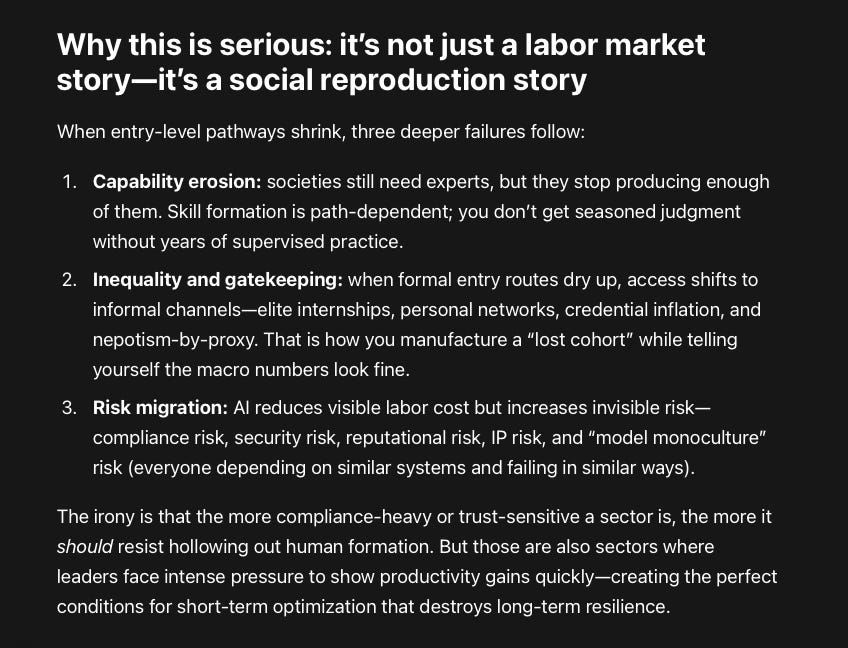
Why this is serious: it’s not just a labor market story—it’s a social reproduction story
When entry-level pathways shrink, three deeper failures follow:
Capability erosion: societies still need experts, but they stop producing enough of them. Skill formation is path-dependent; you don’t get seasoned judgment without years of supervised practice.
Inequality and gatekeeping: when formal entry routes dry up, access shifts to informal channels—elite internships, personal networks, credential inflation, and nepotism-by-proxy. That is how you manufacture a “lost cohort” while telling yourself the macro numbers look fine.
Risk migration: AI reduces visible labor cost but increases invisible risk—compliance risk, security risk, reputational risk, IP risk, and “model monoculture” risk (everyone depending on similar systems and failing in similar ways).
The irony is that the more compliance-heavy or trust-sensitive a sector is, the more it should resist hollowing out human formation. But those are also sectors where leaders face intense pressure to show productivity gains quickly—creating the perfect conditions for short-term optimization that destroys long-term resilience.
A prediction: the next phase is a polarized workforce, not a job apocalypse
Here is the most likely trajectory over the next 3–7 years if current incentives persist:
Hiring remains the main adjustment lever. Firms continue to avoid dramatic layoffs where possible and instead shrink junior intake, outsource more, and demand “AI-fluent” experience upfront.
Workforces polarize. You get a smaller number of highly paid “judgment/relationship/ownership” roles, a larger periphery of contract labor and creators-in-the-market, and fewer stable pathways in between.
Credential inflation accelerates. Because firms want ready-made productivity, they raise the entry bar—more degrees, more portfolio proof, more “already done it” requirements.
Organizations discover a delayed expertise deficit. After several cycles, sectors realize they have fewer people who can truly own complex work end-to-end without the toolchain—and fewer leaders who understand when the toolchain is lying.
Regulation and procurement react late. Policy tends to chase visible harm; hiring slowdowns and missing rungs are politically harder to “prove” than layoffs, so interventions lag.
That produces a world that is not “AI took all the jobs,” but rather: AI reshaped opportunity, compressed training, and concentrated power. And that has consequences—economic, political, and cultural.
Possible consequences if this continues unchecked
A permanent early-career scarring effect: weaker lifetime earnings and delayed family formation for cohorts entering during the transition.
Lower innovation quality: fewer apprentices means fewer future masters; creativity and problem-solving capacity degrade.
Institutional fragility: thinner human oversight around automated workflows increases the chance of cascading failures—financial, informational, operational.
Legitimacy backlash: resentment grows when people feel the system is “closed,” especially if AI gains are captured by owners and incumbents.
Cultural flattening: if synthetic output becomes default and human craft becomes boutique, public culture can tilt toward repetition, mimicry, and lowest-common-denominator persuasion.
The practical fork in the road
The same evidence can support two very different futures:
“Efficiency extraction” future: AI used to cut labor cost and increase throughput; entry-level hollowed out; quality managed by overburdened seniors; inequality rises; trust decays.
“Capability compounding” future: AI used to redesign training—new apprenticeships, supervised AI workflows, internal academies, portfolio-based progression, and explicit investment in human judgment and verification.
In advertising, the second path looks like treating AI as a co-creator while rebuilding the talent engine—otherwise the industry risks becoming a thin orchestration layer on top of commoditized generation tools, competing mainly on price and account access rather than creative advantage.
In the wider economy, the second path requires confronting a hard truth: if AI deletes the rungs, you must rebuild them deliberately—because markets won’t do it automatically.
"Missing rungs" is a better framing than the doom-and-gloom layoff talk. It's quieter but the long-term damage is worse. I keep coming back to the same question: if nobody hires juniors now, who's going to be the senior reviewing AI-generated code in 2032? Covered this exact tension from the hiring side recently: https://reading.sh/the-hiring-playbook-in-2026-looks-nothing-like-2023-9fe9c2a52ffb