
The comparison between a “free” US and a “regulated” EU is futile, not because the EU is flawless, but because the premise of American openness is a myth.
The US has not removed barriers to entrepreneurship; it has privatized them. Washington is enforcing a Pax Technologica where “freedom” is defined as extraterritorial immunity of American platforms.

The Technopolar Paradox: Oligarchic Capture, Weaponized Deregulation, and the Geopolitics of Artificial Intelligence in 2025
by Gemini 3.0, Deep Research. Warning, LLMs may hallucinate!
1. Introduction: The False Dichotomy of the Transatlantic AI Schism
The year 2025 has witnessed a fundamental realignment of the global technological order, characterized not by the triumph of free markets, but by the consolidation of what political economists are increasingly terming “technopolar oligarchy.” The prevailing narrative, aggressively propagated by Silicon Valley elites—the so-called “Tech Bros”—and the administration of President Donald Trump, posits a binary world. On one side stands the United States, portrayed as a dynamic, “barrier-free” frontier of permissionless innovation, surging toward Artificial General Intelligence (AGI) through radical deregulation. On the other stands the European Union (EU), depicted as a sclerotic, bureaucratic museum, regulating itself into irrelevance through the implementation of the AI Act.1
This report challenges that binary as fundamentally deceptive. The comparison between a “free” US and a “regulated” EU is futile, not because the EU is flawless, but because the premise of American openness is a myth. The United States in late 2025 has not removed barriers to entrepreneurship; it has privatized them. Through the mechanisms of the Department of Government Efficiency (DOGE), the dismantling of public oversight bodies, and the weaponization of antitrust policy, the US has replaced democratic regulation with oligarchic gatekeeping.
Furthermore, this internal restructuring is inextricably linked to an external strategy of coercion. The US is actively leveraging its financial dominance and security umbrella to export this deregulatory model, punishing nations that attempt to assert digital sovereignty. From the punitive tariffs on Brazil 3 to the threats against India’s data localization 4 and the restriction of AI chip exports to European allies 5, Washington is enforcing a Pax Technologica where “freedom” is defined as the extraterritorial immunity of American platforms.
This comprehensive analysis investigates the structural reality of the US AI ecosystem, the mechanics of the “DOGE” purge, the surveillance architecture underpinning the new immigration crackdown, and the geopolitical pressure campaigns targeting the EU and the Global South. It concludes with a strategic framework for how pressured regions can leverage asymmetric advantages to resist vassalage in this new technopolar era.
2. The Myth of the Open Frontier: Deconstructing the US AI Economy
The central tenet of the “tech bro” critique is that the US offers a frictionless environment for innovation, while Europe is bogged down by “red tape.” However, a granular examination of the US market in 2025 reveals that while government barriers have been removed, market barriers have risen to insurmountable levels, creating a feudal dynamic where innovation is contingent upon the permission of a handful of incumbents.
2.1 The Capital Wall: Compute as the New License to Operate
In previous technological cycles, such as the internet boom of the late 1990s or the mobile app revolution of the 2010s, the capital requirements for market entry were relatively low. A small team with laptops and a server could disrupt established industries. In the AI era of 2025, this logic has been inverted. The primary input for frontier AI development—compute—has become exponentially expensive, creating a structural barrier that functions more effectively than any government regulation.
The training of frontier models in late 2025 requires access to massive clusters of GPUs, specifically Nvidia’s B200 and subsequent architectures. The cost of assembling such clusters runs into the billions of dollars. This reality has bifurcated the US market into two distinct classes: the “Hyperscalers” (Microsoft, Google, Amazon, Meta) who own the infrastructure, and the “Rentiers,” comprising the vast majority of startups that must pay exorbitant fees to access this infrastructure.6
The Trump administration’s “AI Action Plan,” released in July 2025, exacerbates this concentration. By prioritizing “unquestioned and unchallenged global technological dominance” 8, the federal government has effectively aligned itself with the largest players, viewing their scale as a national security asset rather than an antitrust liability. This policy stance has led to the dismissal of FTC investigations into the “kill zones” created by these giants, where potential competitors are either acquired or suffocated through predatory pricing on cloud compute.10
The “freedom” to innovate in the US is thus highly conditional. It is the freedom to innovate within the ecosystems of the giants, or the freedom to be acquired by them. For an independent entrepreneur seeking to build a foundational model that competes with GPT-5 or Gemini, the US market is not barrier-free; it is a fortress.
2.2 The Regulatory Patchwork: Federal Deregulation vs. State Sovereignty
A critical oversight in the “deregulation” narrative is the chaotic fracture between federal and state jurisdiction. While the White House has aggressively rescinded federal safety mandates—revoking the Biden-era Executive Order 14110 and dismantling the AI Safety Institute—individual states have moved to fill the vacuum. This has resulted in a legal quagmire that is arguably more difficult to navigate than the EU’s unified framework.
In 2025, over 1,000 AI-related bills were introduced across US states, creating a discordant “patchwork” of compliance obligations.11 The most significant of these is California’s legislative suite, including SB 976 (mandating parental consent for algorithmic feeds) and SB 53 (requiring transparency for high-risk AI models).10 Given that California is the world’s fifth-largest economy and the physical home of Silicon Valley, its laws function as a de facto national standard, forcing companies to comply with regulations that the federal government ostensibly opposes.
The conflict reached a constitutional crisis point in December 2025 with the issuance of Executive Order 14365, titled “Ensuring a National Policy Framework for Artificial Intelligence.” This order explicitly attempts to preempt state laws, directing the Department of Justice to challenge “onerous” state regulations that “threaten to stymie innovation”.11
For an entrepreneur in 2025, this is not a deregulated paradise; it is a zone of legal warfare. Startups face the contradictory imperatives of a federal government demanding “permissionless innovation” (often a euphemism for ignoring safety and bias) and state attorneys general enforcing strict consumer protection statutes. The “uncertainty” that tech billionaires decry in Europe is, ironically, rampant in their own backyard, driven by an ideological battle between a nativist federal executive and progressive state legislatures.
2.3 The Consolidation of the “Broligarchy”
The term “Tech Bros”—often used pejoratively—refers in this context to a specific sociopolitical faction of venture capitalists and founders, centered around figures like Elon Musk, David Sacks, and Marc Andreessen, who have successfully fused their private interests with state power. This faction does not merely advocate for free markets; they advocate for oligarchic capture.
Through Super PACs like “Leading the Future,” which raised over $100 million to influence the 2026 midterms and oppose state-level AI regulations 10, these actors have purchased a regulatory environment tailored to their business models. The dismissal of the FTC’s antitrust case against Meta’s acquisitions of Instagram and WhatsApp in November 2025 10 serves as a potent symbol of this capture. The ruling, which declared Meta “not a monopolist” despite its overwhelming market share, effectively legalized the “catch and kill” strategy, ensuring that no new social media challenger can emerge without the implicit consent of the incumbents.
The “barrier-free” US is, therefore, a myth. The barriers have simply shifted from democratic laws (designed to protect the public) to oligarchic tolls (designed to extract rent). The “freedom” celebrated by the administration is the freedom of the strong to dominate the weak without government interference.
3. The Dismantling of the Public State: DOGE and the Privatization of Governance
The primary instrument for reshaping the US regulatory landscape in 2025 has been the Department of Government Efficiency (DOGE). While ostensibly a temporary advisory body focused on cost-cutting, DOGE has functioned as a “wood chipper” for the administrative state, executing a targeted purge of technical competence and regulatory oversight that has fundamentally altered the relationship between the US government and the tech sector.
3.1 The Purge of Technical Capacity: 18F and USDS
One of the most consequential and least understood actions of DOGE was the systematic dismantling of the government’s internal technology capabilities. Agencies like 18F (within the General Services Administration) and the United States Digital Service (USDS) were established to bring private-sector tech talent into government service, allowing the state to build its own software, manage its own digital infrastructure, and reduce reliance on expensive external contractors.
In early 2025, these offices became the targets of a coordinated disinformation campaign. Figures associated with DOGE, including right-wing influencers and media outlets, characterized 18F as a “far-left cell” and a “coven” of ideologues.14 Elon Musk himself amplified these claims, posting that the group had been “deleted.” By March 2025, the staff of 18F were laid off, and the office was effectively shuttered.14
The destruction of 18F and USDS was not a cost-saving measure; it was a strategic move to enforce vendor dependency. By eliminating the government’s ability to build its own tech, DOGE ensured that federal agencies would be forced to contract with private firms for all digital needs. This paved the way for massive contracts to be awarded to companies allied with the administration, effectively privatizing the nervous system of the US government.
3.2 The Human Cost: A “Wood Chipper” for the Civil Service
The scale of the reduction in the federal workforce is staggering. Reports indicate that between 150,000 and 300,000 federal employees left the government in 2025, driven out by a combination of buyouts, firings, and a hostile work environment orchestrated by DOGE.15 This exodus was not random; it was targeted.
Agencies with regulatory authority over the technology and industrial sectors saw the deepest cuts. The Environmental Protection Agency (EPA), whose regulations were viewed as hindrances to the construction of massive AI data centers and power plants, was decimated. Similarly, the staff at the Federal Trade Commission (FTC) and the Securities and Exchange Commission (SEC) faced aggressive downsizing, removing the institutional memory and legal expertise required to prosecute complex antitrust and securities fraud cases against tech giants.15
The replacement of career civil servants with political appointees and “special government employees” (often on loan from the tech industry) has created a revolving door of unprecedented speed. DOGE member Antonio Gracias, a billionaire investor and close associate of Elon Musk, was embedded within the FDA and FAA, agencies that directly regulate the companies in his investment portfolio (e.g., Neuralink, SpaceX).14 This blatant conflict of interest was framed as “efficiency,” but in practice, it represented the direct capture of regulatory agencies by the entities they were meant to oversee.
3.3 The Residue of DOGE: A Hollowed State
Although Elon Musk formally stepped down from his role at DOGE in June 2025 following a scandal 14, the structural damage was permanent. The “residue” of DOGE is a federal government stripped of its immune system. The independent scientific advisory boards, the career technologists, and the regulatory enforcers have been purged. In their place is a hollowed-out infrastructure staffed by loyalists and dependent on private contractors.
This transformation has profound implications for the “futile comparison” with Europe. The US government in late 2025 lacks the capacity to regulate AI, even if it wanted to. It has voluntarily lobotomized its own regulatory apparatus, creating a vacuum that is filled by the private governance of the tech platforms themselves.
4. The Panopticon of Liberty: Surveillance, Censorship, and Propaganda
The “deregulation” of the US tech sector has often been framed in the language of civil liberties—”free speech,” “privacy from the state,” and “freedom to transact.” However, the reality of 2025 demonstrates a dark paradox: as corporate restrictions are lifted, the surveillance powers of the state are massively expanded, often utilizing the very platforms that champion “liberty.”
4.1 The Immigration Dragnet: Palantir and the “Data Lake”
The Trump administration’s signature policy in 2025—the mass deportation of millions of undocumented immigrants—relies entirely on a sophisticated AI-driven surveillance architecture. This effort is spearheaded by the integration of government databases into a unified “Data Lake,” a project accelerated by DOGE’s mandate to break down “information silos”.18
The Department of Homeland Security (DHS) and Immigration and Customs Enforcement (ICE) have operationalized “ImmigrationOS,” a platform developed by data analytics firm Palantir. This system aggregates data from the IRS, the Social Security Administration (SSA), and even commercial sources (such as utility bills and location data purchased from brokers) to identify, track, and predict the location of targeted individuals.18
This application of AI represents a profound shift in the social contract. Data collected for the administration of social services (taxes, retirement benefits) is now weaponized for law enforcement. The “deregulation” of privacy protections—specifically the erosion of barriers preventing data sharing between agencies—has enabled the creation of a digital panopticon. For the 170 million Americans who use apps like TikTok (or its US equivalents), the threat is not just that their data is being sold to advertisers, but that it is being fed into a state apparatus designed to categorize and purge populations.
4.2 “Catch and Revoke”: Algorithmic Ideological Screening
The surveillance state has also extended its reach into the realm of ideological conformity. The State Department’s “Catch and Revoke” program, revealed in March 2025, utilizes AI to scan the social media history of visa holders and applicants for “anti-American” sentiment.19 Using tools from companies like Clearview AI (which scrapes billions of images from the open web), the government automates the revocation of visas based on algorithmic interpretations of political speech.
This program highlights the hypocrisy of the administration’s “free speech” rhetoric. While the President decries “censorship” on social media platforms, his administration uses those same platforms to police the speech of non-citizens. The definition of “support for terror groups” or “antisemitic activity” is often left intentionally vague, allowing the AI to flag broad categories of dissent (e.g., criticism of US foreign policy) as grounds for deportation or exclusion.
4.3 The Propaganda Feedback Loop: X and Meta
The transformation of the US information ecosystem in 2025 is characterized by the alignment of major platforms with state propaganda goals. The “deregulation” of content moderation—championed by Elon Musk at X (formerly Twitter) and adopted by Meta—has effectively dismantled the guardrails against hate speech and disinformation.
Meta’s internal policy shift, revealed in leaked documents in early 2025, instructed moderators to stop flagging certain anti-immigrant slurs as hate speech, citing a need to align with “mainstream discourse”.20 This capitulation was not merely a market decision; it was a response to political pressure. With the threat of antitrust enforcement and Section 230 revocation hanging over them, tech giants have chosen to align their algorithms with the nativist rhetoric of the administration.
Conversely, foreign platforms that refuse to align with US narratives face existential threats. The scrutiny of the Chinese AI model DeepSeek 21 and the continued pressure on TikTok 22 are framed as national security issues. However, the “DeepSeek” report explicitly criticizes the Chinese model for “censoring and manipulating information pursuant to Chinese law.” The irony is palpable: the US condemns Chinese AI for serving Chinese state interests, while simultaneously demanding that US AI serve American state interests. The “free internet” is increasingly bifurcated into competing spheres of digital influence, where “freedom” is defined by allegiance to the sovereign.
5. Empire of Algorithms: Extraterritoriality, Extortion, and Coercion
The most aggressive dimension of the US strategy in 2025 is the extraterritorial projection of its deregulatory agenda. The US administration recognizes that a “deregulated” America cannot fully succeed if the rest of the world enforces strict standards. If the EU’s AI Act or Brazil’s content laws become global norms (the “Brussels Effect”), US companies will be forced to comply, effectively importing regulation back into the US. To prevent this, Washington has launched a coordinated campaign of economic and diplomatic coercion.
5.1 Brazil: The Test Case for Corporate Sovereignty
The conflict between the Brazilian judiciary and Elon Musk’s X serves as the defining case study of the new “Technopolar” diplomacy. When Brazil’s Supreme Court Justice Alexandre de Moraes ordered the suspension of X for refusing to remove accounts implicated in coup-plotting and for failing to maintain legal representation in the country, the response from the US was not diplomatic engagement, but retaliation.
President Trump issued Executive Order 14323, titled “Addressing Threats to the United States by the Government of Brazil”.23 The order declared Brazil’s enforcement of its own laws an “unusual and extraordinary threat” to the US economy and national security. It authorized the imposition of a 40% punitive tariff on Brazilian exports to the US.3
This action represents a watershed moment in international relations. The US government used its economic might to punish a sovereign nation for regulating a private American corporation. It effectively asserted that US tech platforms enjoy extraterritorial immunity; they are subject only to US law, regardless of where they operate. For Brazil, the cost of enforcing its digital sovereignty was the destabilization of its export economy.
5.2 The European Union: Tariffs, Chips, and NATO
The pressure on the European Union has been equally intense, though more multifaceted. The US views the EU’s AI Act and Digital Markets Act (DMA) not as legitimate policy choices, but as protectionist trade barriers designed to hobble American “national champions.”
Tariff Threats: The Office of the US Trade Representative (USTR) has threatened “any means necessary” to stop the enforcement of the DMA, explicitly floating tariffs on European automotive and luxury goods if fines are levied against US tech giants.24 This linkage—threatening German cars to save Google’s ad monopoly—demonstrates the transactional nature of the administration’s trade policy.
The Chip Embargo: In a move that shocked transatlantic observers, the US implemented export controls on advanced AI chips (such as Nvidia’s H100 and B200 series) to specific EU member states deemed to have “leaky” export controls or overly restrictive domestic regulations.5 This weaponization of the supply chain threatens to strangle Europe’s AI development at the hardware layer. It sends a clear message: access to the cutting edge of AI is a privilege granted by Washington, contingent on regulatory alignment.
The Security Lever: The “2025 National Security Strategy” implies a transactional approach to alliances.27 By deemphasizing “shared values” and focusing on “economic security,” the administration has subtly linked the US security guarantee (NATO) to economic compliance. The subtext is that if Europe wants US protection against Russia, it must accept US technology standards.
5.3 India: The Battle for Data
India’s attempt to assert “data sovereignty” through localization laws—requiring that data generated by Indian citizens be stored and processed within India—has met with fierce resistance. The US threatened 25% tariffs on Indian goods if these laws were not relaxed.4
The US argument is that data localization is a barrier to “digital trade.” However, this stance is hypocritical. The US demands the free flow of data out of India (to train US models) but strictly controls the flow of technology into India (via export controls). The “Major Defense Partner” status of India has provided little shield against this coercion; in the tech domain, India is treated as a resource colony—a source of data and users, but not a sovereign regulator.
6. The European Reality: Between Regulation and Stagnation
Is the “Tech Bro” critique correct? Is the EU failing because of the AI Act? The data suggests a more complex reality. The EU does face a significant innovation gap, but the AI Act is often a scapegoat for deeper, structural failures that the “deregulation” narrative ignores.
6.1 Diagnosing the Gap: Structural vs. Regulatory
The primary drivers of the EU’s lag in AI adoption (where only ~13% of firms actively use AI 2) are structural:
Capital Fragmentation: Europe lacks a unified capital market. A startup in Berlin cannot easily access capital from Paris or Milan. The “Capital Markets Union” remains an aspiration. Consequently, EU startups rely on risk-averse bank loans rather than the deep venture capital pools available in the US.30
The Investment Gap: The EU faces an annual investment deficit of €700 billion compared to the US in technology and innovation.30
Compute Deficit: Europe hosts only roughly 5% of the world’s AI compute capacity.32 Without the physical infrastructure (data centers, energy), no amount of deregulation will create a European competitor to OpenAI.
6.2 The “CERN for AI” Initiative: A Public Option for Intelligence
Recognizing that it cannot compete with the US on private capital deployment, the EU has launched the “CERN for AI” initiative as part of a broader €50 billion InvestAI plan.33 This project aims to replicate the success of the particle physics laboratory by pooling resources across member states to create a shared, public AI infrastructure.
Approved in late 2025, the initiative includes the establishment of “AI Factories”—supercomputing centers dedicated to training large models.33 This represents a “Third Way” between the US model (corporate feudalism) and the Chinese model (state authoritarianism). By treating AI compute as a public utility, the EU hopes to lower the barrier to entry for researchers and startups who cannot afford the “rent” charged by US hyperscalers.
However, the success of this initiative is far from guaranteed. It requires overcoming the EU’s notorious bureaucratic inertia and ensuring that the “sovereignty” it builds is real, not just “sovereignty washing” where the underlying hardware is still American.35
7. Strategic Horizons: A Manifesto for Resistance in a Technopolar World
The world in late 2025 is not witnessing a competition between a “free” US and a “regulated” Europe; it is witnessing the expansion of an American Techno-Oligarchy that seeks to impose its rules globally. For countries and regions under pressure—the EU, Brazil, India, and others—capitulation is not a viable strategy. Deregulating to match the US will not create local innovation; it will simply clear the path for US monopolies to extract data and value more efficiently.
7.1 Weaponizing the Supply Chain: The ASML Lever
The most powerful asymmetry the EU possesses is in the hardware supply chain. While the US dominates software and cloud design, the physical production of advanced AI chips is entirely dependent on Extreme Ultraviolet (EUV) lithography machines produced by the Dutch company ASML, and high-precision optics from the German firm Zeiss.
If the US continues to weaponize export controls on AI chips to Europe 5, the EU must be prepared to counter-leverage. A credible threat to restrict the export of lithography components or maintenance services to US chipmakers (or their foundries in Taiwan/Arizona) would create an immediate crisis for the US AI ambition. The US cannot achieve “technological dominance” without European hardware. This “Mutual Assured Destruction” in the supply chain is the only language the US security establishment respects.
7.2 The Digital Non-Aligned Movement
Individual nations—even large ones like Brazil or India—can be bullied by US tariff threats. However, collectively, the “pressured nations” represent the vast majority of the world’s digital users and data producers.
Data Cartels: Data is the essential fuel for AI models. The “Global South,” along with the EU, should form a “Digital OPEC.” They should standardize data taxation and localization laws. If Brazil, India, Indonesia, and the EU enforce a common “sovereign data tax” or liability standard, the US tech giants cannot afford to exit all of these markets simultaneously.
Open Source Alignment: Pressured nations should pivot their public sector technology stacks to open-source models (such as those developed by France’s Mistral or decentralized communities) to reduce dependency on the “black box” APIs of OpenAI/Microsoft/Google. Governments should mandate that any AI used for public services must be open weights and auditable, effectively disqualifying the closed US models from massive government contracts.
7.3 Decoupling Security from Technology
The US strategy relies on the conflation of security (NATO/defense treaties) with technology policy. The EU must call this bluff. The US commitment to NATO is not an act of charity; it is a strategic necessity for the US to prevent the Eurasian landmass from falling under Chinese/Russian control.
Action: The EU should strictly decouple its trade and tech policy from its security arrangements. It should continue to meet its NATO defense spending targets (2%+) to remove that lever of criticism, while simultaneously enforcing the Digital Markets Act and AI Act with maximum rigor. The threat that “regulating Google hurts NATO” is rhetorically powerful but strategically hollow.
7.4 Conclusion: The Necessity of Friction
The comparison between the US and the EU is indeed “futile,” but not because the US is a utopia of freedom. It is futile because the two regions have fundamentally different objectives. The US has chosen a path of Techno-Patrimonialism, where the state and the oligarchs are fused to pursue raw power. The EU, imperfectly, is attempting to preserve Digital Humanism, where technology remains subject to democratic law.
For the pressured regions, the “friction” that the Tech Bros complain about—the regulations, the taxes, the safety checks—is not a bug; it is a feature. It is the friction of sovereignty. It is the only thing preventing their societies from becoming data colonies of the new American empire. The response to US pressure must not be to smooth out this friction, but to reinforce it, building a resilient, sovereign infrastructure that can stand independent of the Silicon Valley stack.
Table 1: Comparative Analysis of AI Ecosystem Barriers (2025)
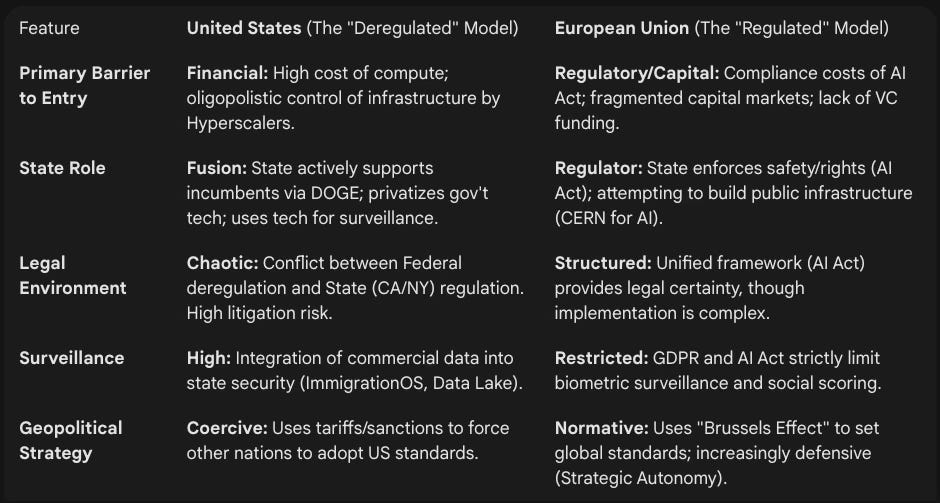
The path forward for the world is not to emulate the US model, which sacrifices the many for the dominance of the few, but to forge a pluralistic digital order where innovation serves the public interest, and where sovereignty is respected, not extinguished by the algorithm.
Works cited
EU and US AI Policies Head Their Own Way - Strategy International · Think Tank & Consulting Services, accessed December 28, 2025, https://strategyinternational.org/2025/10/14/publication208/
Better Regulation and the EU’s Artificial Intelligence Act - Intereconomics, accessed December 28, 2025, https://www.intereconomics.eu/contents/year/2025/number/3/article/better-regulation-and-the-eu-s-artificial-intelligence-act.html
Modifying the Scope of Tariffs on the Government of Brazil - The White House, accessed December 28, 2025, https://www.whitehouse.gov/presidential-actions/2025/11/modifying-the-scope-of-tariffs-on-the-government-of-brazil/
India’s Digital Sovereignty: Risks from US Tech Dependence in 2025 - https://debuglies.com, accessed December 28, 2025, https://debuglies.com/2025/09/15/indias-digital-sovereignty-risks-from-us-tech-dependence-in-2025/
DIGITALEUROPE’s reaction to the US export controls on chips for AI, accessed December 28, 2025, https://www.digitaleurope.org/news/digitaleuropes-reaction-to-the-us-export-controls-on-chips-for-ai/
Potential competition policy responses in AI infrastructure - OECD, accessed December 28, 2025, https://www.oecd.org/en/publications/competition-in-artificial-intelligence-infrastructure_623d1874-en/full-report/component-7.html
Locke Lord QuickStudy: Antitrust and Artificial Intelligence: The FTC Identifies Competition Concerns in Generative AI Markets, accessed December 28, 2025, https://www.troutman.com/insights/locke-lord-quickstudy-antitrust-and-artificial-intelligence-the-ftc-identifies-competition-concerns-in-generative-ai-markets/
Artificial Intelligence – Trump’s deregulation and the oligarchization of politics, accessed December 28, 2025, https://www.eurac.edu/en/blogs/eureka/artificial-intelligence-trump-s-deregulation-and-the-oligarchization-of-politics
America’s AI Action Plan - The White House, accessed December 28, 2025, https://www.whitehouse.gov/wp-content/uploads/2025/07/Americas-AI-Action-Plan.pdf
November 2025 US Tech Policy Roundup | TechPolicy.Press, accessed December 28, 2025, https://www.techpolicy.press/november-2025-us-tech-policy-roundup/
Unpacking the December 11, 2025 Executive Order: Ensuring a National Policy Framework for Artificial Intelligence, accessed December 28, 2025, https://www.sidley.com/en/insights/newsupdates/2025/12/unpacking-the-december-11-2025-executive-order
Washington’s Great AI Tug-of-War: Federal Deregulation Collides with State-Level Oversight, accessed December 28, 2025, https://markets.financialcontent.com/stocks/article/marketminute-2025-12-25-washingtons-great-ai-tug-of-war-federal-deregulation-collides-with-state-level-oversight
Ensuring a National Policy Framework for Artificial Intelligence - The White House, accessed December 28, 2025, https://www.whitehouse.gov/presidential-actions/2025/12/eliminating-state-law-obstruction-of-national-artificial-intelligence-policy/
Elon Musk, AI and the antichrist: the biggest tech stories of 2025 ..., accessed December 28, 2025, https://www.theguardian.com/technology/2025/dec/22/biggest-tech-stories-2025
One word that was CEOs’ ‘favourite’ and employees’ ‘nightmare’ in 2025 across technology companies; inclu, accessed December 28, 2025, https://timesofindia.indiatimes.com/technology/tech-news/one-word-that-was-ceos-favourite-and-employees-nightmare-in-2025-across-technology-companies-including-amazon-google-microsoft-meta-salesforce-and-others/articleshow/126200183.cms
Department of Government Efficiency - Wikipedia, accessed December 28, 2025, https://en.wikipedia.org/wiki/Department_of_Government_Efficiency
DOGE agency deployments raise ethical and influence concerns - Government Executive, accessed December 28, 2025, https://www.govexec.com/management/2025/01/doge-agency-deployments-raise-ethical-and-influence-concerns/402204/
How tech powers immigration enforcement - Brookings Institution, accessed December 28, 2025, https://www.brookings.edu/articles/how-tech-powers-immigration-enforcement/
Trump’s Immigration Crackdown Is Built on AI Surveillance and Disregard for Due Process, accessed December 28, 2025, https://freedomhouse.org/article/trumps-immigration-crackdown-built-ai-surveillance-and-disregard-due-process
Big Tech is powering Trump’s immigration crackdown | Social Media | Al Jazeera, accessed December 28, 2025, https://www.aljazeera.com/opinions/2025/2/9/big-tech-is-powering-trumps-immigration-crackdown
DeepSeek report - Select Committee on the CCP |, accessed December 28, 2025, https://chinaselectcommittee.house.gov/sites/evo-subsites/selectcommitteeontheccp.house.gov/files/evo-media-document/DeepSeek%20Final.pdf
National Security and the TikTok Ban | American University, Washington, D.C., accessed December 28, 2025, https://www.american.edu/sis/news/20250123-national-security-and-the-tik-tok-ban.cfm
Addressing Threats to the United States by the Government of Brazil - Federal Register, accessed December 28, 2025, https://www.federalregister.gov/documents/2025/08/05/2025-14896/addressing-threats-to-the-united-states-by-the-government-of-brazil
US trade office threatens EU with fines over digital rules - POLITICO Pro, accessed December 28, 2025, https://subscriber.politicopro.com/article/2025/12/us-trade-office-threatens-eu-with-fines-over-digital-rules-00692996
Trump administration fires warning shots over Big Tech regulations - POLITICO Pro, accessed December 28, 2025, https://subscriber.politicopro.com/article/2025/12/trump-administration-fires-warning-shots-over-big-tech-regulations-00703945
US export controls of AI chips: debate with the Commission | 10-02-2025 | News, accessed December 28, 2025, https://www.europarl.europa.eu/news/en/agenda/plenary-news/2025-02-10/6/us-export-controls-of-ai-chips-debate-with-the-commission
National Security Strategy | The White House, accessed December 28, 2025, https://www.whitehouse.gov/wp-content/uploads/2025/12/2025-National-Security-Strategy.pdf
Breaking down Trump’s 2025 National Security Strategy - Brookings Institution, accessed December 28, 2025, https://www.brookings.edu/articles/breaking-down-trumps-2025-national-security-strategy/
Trump’s tariff threat shows US-India aren’t really allies - Asia Times, accessed December 28, 2025, https://asiatimes.com/2025/07/trumps-tariff-threat-shows-us-india-arent-really-allies/
Is Europe closing the innovation gap with the U.S.? - VDS 2025, accessed December 28, 2025, https://vds.tech/news/europe-innovation-gap-us/
Do Digital Regulations Hinder Innovation? - The Regulatory Review, accessed December 28, 2025, https://www.theregreview.org/2025/10/09/huang-do-digital-regulations-hinder-innovation/
Submission to the call for evidence on the Cloud and AI Development Act, accessed December 28, 2025, https://cfg.eu/special-compute-zones-submission/
EU to invest €50B to ‘supercharge’ innovation in artificial intelligence - Science|Business, accessed December 28, 2025, https://sciencebusiness.net/news/eu-budget/eu-invest-eu50b-supercharge-innovation-artificial-intelligence
CERN Approves Strategy For Organization-Wide AI Use - Quantum Zeitgeist, accessed December 28, 2025, https://quantumzeitgeist.com/cern-ai-ai-strategy/
State of AI 2025: five key charts for Europeans - Science|Business, accessed December 28, 2025, https://sciencebusiness.net/news/ai/state-ai-2025-five-key-charts-eu
Brilliant breakdown of how compute infrastructure has become the new choke point. The capital wall section really nails something I saw firsthand trying to build in this space—the rhetoric around 'permissionless innovation' crumbles when model training costs mean you're basically forced to beg for acces to hyperscaler compute. The way oligarchic gatekeeping replaced democratic oversight isn't talked about nearly enough.