Tech conglomerates and infrastructure developers employ sophisticated legal, technical, and administrative maneuvers to bypass environmental protections and public oversight.
This poses existential risks to regional power grids, local water sovereignty, and the democratic integrity of urban planning.

The Shadow Infrastructure: Global Paradigms of Regulatory Circumvention in Data Center Development
by Gemini 3.0, Deep Research. Warning, LLMs may hallucinate!
The rapid ascension of artificial intelligence as the primary driver of global computational demand has fundamentally altered the landscape of digital infrastructure. As hyperscale data centers—facilities of unprecedented scale and resource intensity—become the physical backbone of the AI era, a profound tension has emerged between the technological imperative of “move fast and break things” and the regulatory frameworks governing energy, water, and spatial planning. The current epoch is defined by a systemic pattern of circumvention, where tech conglomerates and infrastructure developers employ sophisticated legal, technical, and administrative maneuvers to bypass environmental protections and public oversight. This unbridled development, often occurring in the “shadows” of outdated zoning laws and through the exploitation of regulatory loopholes, poses existential risks to regional power grids, local water sovereignty, and the democratic integrity of urban planning.
The Architectural Loophole: Threshold Evasion and the “Salami Slicing” Phenomenon
A primary mechanism used by developers to bypass restrictive national policies is the strategic partitioning of single, massive projects into multiple, legally distinct smaller entities. This tactic, colloquially known as “salami slicing,” is designed to keep individual permit applications below the technical thresholds that would otherwise trigger a classification as “hyperscale,” thereby avoiding mandatory national bans or rigorous Environmental Impact Assessments (EIAs).
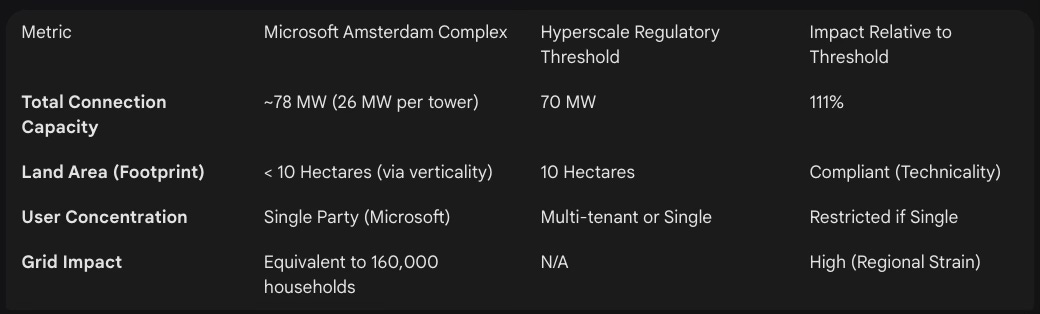
In the Netherlands, this method has been utilized with surgical precision. Following a 2022 national interim ban on the permitting of new hyperscale data centers—defined as facilities or integrated groups of buildings covering more than 10 hectares with an electrical connection capacity of at least 70 MW—the industry sought alternative routes to expansion.1 A notable instance involves a project in Amsterdam’s Western Port Area consisting of three 85-meter-high towers.2 While the combined complex functions as a singular infrastructure node for a single user (Microsoft), the project was divided into three separate permits.2 Because each tower individually falls below the 10-hectare threshold and is treated as a “small” data center by provincial authorities, the project circumvented the national ban.1
The consequences of such threshold evasion are tangible and systemic. The combined power demand of these towers is equivalent to the entire household electricity consumption of the city of Haarlem.2 In a region where the grid is already under extreme pressure, this massive draw has effectively “crowded out” essential social infrastructure. Amsterdam faces an acute capacity shortage where over 591 customers are on waiting lists for connections, potentially delaying the construction of 30,000 homes, 50 schools, and numerous daycare centers for at least a decade.1 This highlights a critical failure in regulatory geometry: by focusing on the physical footprint of individual applications rather than the aggregate load and end-user concentration, governments lose control over who accesses grid capacity and how it is utilized.2
The “Portable” Power Gambit: xAI and the Memphis Methane Crisis
Perhaps the most aggressive example of circumvention in recent history is found in the deployment of “temporary” energy infrastructure to bypass the Clean Air Act. In Memphis, Tennessee, Elon Musk’s xAI “Colossus” supercomputer achieved operational status in a record 122 days by utilizing a fleet of 35 truck-sized methane gas turbines.4 These turbines were deployed to supply the massive power required for 100,000 GPUs, circumventing the standard years-long process for securing a permanent high-capacity grid connection.4
The circumvention strategy relied on a specific interpretation of federal and local law regarding “nonroad engines”.7 xAI argued that because the turbines were portable and would not remain in one location for more than 364 days, they were exempt from the stringent permitting requirements for stationary sources of air pollution.5 However, the scale of these “mobile” sources—capable of emitting over 2,000 tons of smog-forming nitrogen oxides—far exceeded the intent of the exemption, which was originally designed for construction equipment or small backup generators.4
The environmental and health consequences for the South Memphis community, which already suffers from elevated asthma and cancer rates, are severe.4 Methane turbines of this scale emit not only nitrogen oxides, but also carbon dioxide, formaldehyde, and benzene, a known carcinogen with no safe level of exposure.4 By the time the Environmental Protection Agency (EPA) issued a clarifying ruling in January 2026—stating that large methane turbines require air permits regardless of their “portable” status—the facility had already been operating unpermitted for over a year.5 This demonstrates a “fait accompli” strategy: build first, operate illegally, and then litigate or wait for the regulator to catch up, all while reaping the economic benefits of being first-to-market in the AI race.5
Jurisdictional Arbitrage: The Southeast Asian Displacement
When regulatory environments become too restrictive in established hubs, data center capital does not vanish; it migrates to neighboring regions with lower thresholds, a process known as jurisdictional arbitrage. This is most visible in the “digital triangle” of Singapore, Malaysia, and Indonesia.
Singapore, facing extreme land and energy scarcity, imposed a moratorium on new data center construction in 2019.10 In a city-state where data centers consume 7% of total electricity (projected to reach 12% by 2030), the government realized that unbridled growth threatened national energy security and climate commitments.11 Even after the moratorium was partially lifted in 2022, the new requirements—capping capacity at 60 MW per year and mandating a Power Usage Effectiveness (PUE) of 1.3 or below—made large-scale expansion nearly impossible for most operators.11
Consequently, the industry shifted its gaze toward the Malaysian state of Johor and the Indonesian island of Batam.10 Malaysia has aggressively courted this displaced capital, offering 100% tax exemptions on investments and launching the “Green Lane Pathway,” which allows data centers to bypass standard electricity connection wait times, reducing the “delivery time” to a fraction of the norm.10 While this has led to a boom in investment—Johor is projected to host RM17 billion in new developments by end-2024—it creates a “race to the bottom” for resource management.10 The rapid construction of these parks in Malaysia and Indonesia, often situated just across the border from Singapore to maintain low-latency connectivity, effectively exports the environmental strain of Singapore’s digital economy to jurisdictions that may lack equivalent sustainability mandates or grid resilience.10

Institutional Failure and the “Administrative Overrule”
In the United Kingdom, circumvention has taken the form of administrative overrides, where central government ministers use their power to overrule local planning rejections. This creates a disconnect between local environmental concerns and national industrial policy. In Iver, Buckinghamshire, the local council rejected plans for a 90 MW data center at Woodlands Park due to its impact on the Green Belt and the immense strain it would place on local utilities.14 However, the Deputy Prime Minister subsequently overruled this decision, granting approval despite a blatant lack of detail regarding the project’s environmental costs.14
Legal challenges later revealed a “serious logical error” in the government’s approval.17 The Ministry of Housing and Communities had accepted a developer’s claim that the facility would draw power from an “Iver Power Station”—a facility that is actually a substation and generates no electricity.14 By the time the government admitted the error in January 2026 and agreed that the permission should be quashed, the project had already established a dangerous precedent: that the “need for data centers” can outweigh local environmental law based on faulty technical premises.15 This highlights how the perceived urgency of the “AI agenda” can cause national regulators to be “asleep at the wheel,” neglecting the foundational requirements for Environmental Impact Assessments (EIAs) and binding mitigation measures.16
Environmental Pillage: The Water Sovereignty Backlash
While energy consumption often dominates the headlines, the circumvention of water regulations has become the primary flashpoint for social resistance, particularly in the Global South and the arid American Southwest. Data centers require massive quantities of water for cooling—an average 100 MW facility can consume 2 million liters per day, equivalent to 6,500 households.18
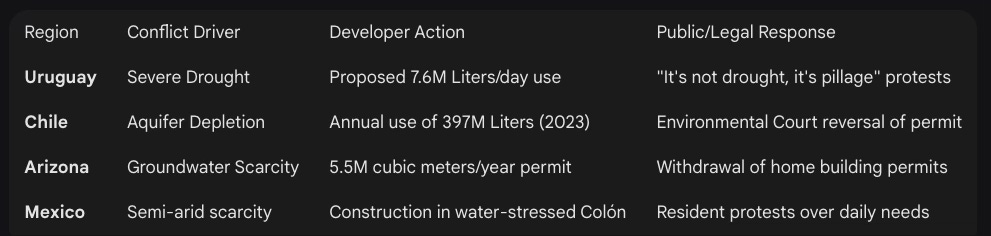
The industry frequently employs a “wait and see” approach to water permitting, often operating without tracking their true usage. A 2021 survey found that only 51% of data center operators track water consumption, and even fewer monitor it across their entire facility portfolio.18 In regions like Uruguay, which recently suffered a three-year drought so severe that authorities mixed seawater with freshwater to sustain the supply, the introduction of a new Google data center sparked massive protests under the slogan “It’s not drought, it’s pillage”.20 The proposed facility was projected to consume 7.6 million liters of freshwater daily—usage that residents argued was catastrophic given the national water insecurity.20
Similar conflicts have emerged in Chile and Mexico. In Santiago, an environmental court partially reversed Google’s permit after finding the project would further deplete the Central Santiago Aquifer during a 15-year “mega-drought”.18 In Arizona, while the state was revoking construction permits for new homes due to groundwater depletion, Google’s Mesa data center secured a permit for 5.5 million cubic meters of water annually.18 The industry’s response to these crises is often to switch to air-cooling systems only after significant legal and public pressure, even though such systems increase capital expenditure by 20-50% and raise energy consumption, creating a perpetual “water-energy tradeoff” that is rarely addressed in the initial, often secretive, permitting phases.21
The Information Gap: Non-Disclosure and Misinformation as a Service
A critical pillar of regulatory circumvention is the strategic use of Non-Disclosure Agreements (NDAs) and the classification of resource data as “proprietary confidential business information.” This prevents local planning boards and the public from understanding the true impact of a facility until it is operational.
In Lelystad, the city council was famously “misinformed” about the energy consumption of a new Equinix data center, which will eventually consume more power than the entire city.23 In the United States, lawmakers have highlighted that the contracts between data centers and utility companies are almost always confidential, leaving the public in the dark about why their residential electric bills are “skyrocketing”—in some cases by as much as 267% over five years.24 This secrecy allows tech giants to “pay lip service” to sustainability while simultaneously opposing local efforts to regulate their energy costs or resource usage.24
The consequence of this information asymmetry is a systemic erosion of public trust and the “industrialization” of rural and suburban areas without the consent of the people living there. As data centers become the “new NIMBY flashpoint,” replacing traditional targets like factories or retail sprawl, communities are organizing into sophisticated coalitions—such as the Data Center Reform Coalition in Virginia—to combat what they perceive as “regulatory secrecy” and a “massive transfer of wealth” from ordinary ratepayers to trillion-dollar tech companies.25
Taxonomic Analysis of Circumvention Methods
To provide a comprehensive overview for regulators, the following clusters categorize the primary methods currently being used to bypass restrictions:
1. The Threshold Manipulation Cluster
This involves manipulating the physical or legal definitions of a project to avoid restrictive categories.
Verticality for Footprint Evasion: Building towers to stay under hectare limits while maintaining high power density.1
Project Slicing: Dividing one massive site into multiple, independently permitted “minor” sources.2
Grandfathering: Filing applications just before new, stricter zoning laws take effect.28
2. The Mobility and Temporality Cluster
This exploits loopholes designed for temporary or non-stationary equipment.
Nonroad Engine Exemption: Claiming large turbines are “portable” to avoid Clean Air Act stationary source permits.4
Operational Waivers: Using short-term waivers to run unpermitted power sources for “up to 364 days”.4
3. The Institutional Arbitrage Cluster
This leverages higher-level political power to bypass local scrutiny.
Ministerial Overrule: Overturning local planning rejections at the national level.14
Jurisdictional Relocation: Moving projects to nearby states or countries with lower standards (e.g., from Singapore to Malaysia).10
4. The Information Secrecy Cluster
This uses legal mechanisms to hide the facility’s actual footprint.
NDA Abuse: Using non-disclosure agreements with utilities and local governments to hide energy/water data.24
Proprietary Data Shielding: Claiming water usage records are “trade secrets” to avoid environmental reporting.22
Towards a Robust Governance Framework: Recommendations for Global Regulators
The unbridled expansion of data centers has outpaced existing planning and environmental review frameworks. To ensure that digital infrastructure development is aligned with the long-term health and economic stability of communities, regulators should adopt the following measures:
Mandatory Aggregate Impact Assessment
Regulators must close the “salami slicing” loophole by requiring that Environmental Impact Assessments (EIAs) and grid studies be based on the aggregate impact of all buildings on a site or under a single parent company’s control. If the total capacity exceeds a threshold (e.g., 10 MW or 10 hectares), it must be classified as a “hyperscale” project regardless of how many individual permits are filed.1
Codification of Data Center Zoning
Data centers should be removed from the broad “light industrial” category and given a specific, high-impact zoning designation. This would include:
Mandatory Setbacks: Minimum distances (e.g., 200 feet) from residential properties to mitigate noise and visual pollution.28
Equipement Enclosure: Requiring all cooling and power equipment to be fully enclosed in sound-dampening structures.28
By-Right Removal: Eliminating the “by-right” status for data centers, ensuring every project must undergo a full public hearing and discretionary approval by elected officials.28
The “Bring Your Own Power” (BYOP) Mandate
To protect residential ratepayers from “skyrocketing” bills, large energy users should be required to:
On-Site Generation: Provide their own dispatchable power generation or storage for facilities over a certain size (e.g., 10 MVA).27
Renewable Additionality: Prove that at least 80% of their annual energy demand is met by new renewable projects in the same region, ensuring they do not cannibalize the existing green grid.27
Grid Feedback: Require on-site assets to feed power back into the national grid during peak demand or system emergencies.27
Transparency and Anti-NDA Legislation
State and local governments should be prohibited from signing NDAs that prevent the public from learning about the resource requirements of a project. Legislation like Florida’s SB 484, which makes such provisions void and subjects violating agencies to fines, should be a global standard.29 Furthermore, “proprietary business information” should never be used to shield data regarding water and energy consumption, which are public resources.22
Implementing the “Responsible Pause”
In jurisdictions where the grid or water supply is at a breaking point, a three-year moratorium on new data center permits should be implemented. This “responsible pause” allows the state to conduct comprehensive studies on the industry’s impact on ratepayers and the environment, ensuring that future development is data-driven and sustainable.26
The current trajectory of data center development—marked by “insatiable appetite” and regulatory evasion—is fundamentally unsustainable. Only through rigorous, transparent, and binding oversight can the benefits of the AI era be realized without sacrificing the environmental and social foundations upon which all communities depend.
Works cited
Microsoft’s upcoming data center in Amsterdam raises power and land use concerns, accessed February 10, 2026, https://w.media/microsofts-upcoming-data-center-in-amsterdam-raises-power-and-land-use-concerns/
Microsoft leases new hyperscale data center in Amsterdam - Techzine Global, accessed February 10, 2026, https://www.techzine.eu/news/infrastructure/138253/microsoft-leases-new-hyperscale-data-center-in-amsterdam/
Massive Amsterdam Microsoft data centre gets green light - DutchNews.nl, accessed February 10, 2026, https://www.dutchnews.nl/2026/01/massive-amsterdam-microsoft-data-centre-gets-green-light/
In South Memphis, Elon Musk’s Colossus Operated Gas Turbines ..., accessed February 10, 2026, https://outrider.org/climate-change/articles/south-memphis-elon-musks-colossus-operated-gas-turbines-without-appropriate
Elon Musk’s xAI datacenter generating extra electricity illegally, regulator rules, accessed February 10, 2026, https://www.theguardian.com/technology/2026/jan/15/elon-musk-xai-datacenter-memphis
AI and Data Center Infrastructure Face Zoning Law Hurdles, accessed February 10, 2026, https://news.bloomberglaw.com/legal-exchange-insights-and-commentary/ai-and-data-center-infrastructure-face-zoning-law-hurdles
EPA confirms that large methane gas turbines require permits, accessed February 10, 2026, https://www.selc.org/press-release/epa-confirms-that-large-methane-gas-turbines-require-permits/
Groups appeal permit for xAI’s South Memphis data center, decisions around unpermitted methane gas turbines - Southern Environmental Law Center, accessed February 10, 2026, https://www.selc.org/press-release/groups-appeal-permit-for-xais-south-memphis-data-center-decisions-around-unpermitted-methane-gas-turbines/
Updated EPA Rules Put xAI’s ‘Colossus’ AI Data Center in Legal Limbo - PCMag, accessed February 10, 2026, https://www.pcmag.com/news/xais-data-center-may-have-acted-illegally-as-epa-clarifies-turbine-loophole
JS-SEZ offers data centre opportunities by the bucketful - MIDA | Malaysian Investment Development Authority, accessed February 10, 2026, https://www.mida.gov.my/mida-news/js-sez-offers-data-centre-opportunities-by-the-bucketful/
Why Singapore Can’t Afford More Data Centers: A Shift to Malaysia and Indonesia, accessed February 10, 2026, https://content.headhuntershq.com/why-singapore-cant-afford-more-data-centers-a-shift-to-malaysia-and-indonesia/
The Singapore–Malaysia–Indonesia triangle can be a data centre powerhouse | East Asia Forum, accessed February 10, 2026, https://eastasiaforum.org/2024/08/14/the-singapore-malaysia-indonesia-triangle-can-be-a-data-centre-powerhouse/
Issue 103: Singapore courts data centres; Indonesia traces commodities, accessed February 10, 2026, https://www.businesstimes.com.sg/newsletters/esg-insights/issue-103-singapore-courts-data-centres-indonesia-traces-commodities
Stop the Government forcing through Destructive Data Centres - CrowdJustice, accessed February 10, 2026, https://www.crowdjustice.com/case/datacentre-challenge/
Government accepts it wrongly approved data centre - Yahoo News Canada, accessed February 10, 2026, https://ca.news.yahoo.com/government-accepts-wrongly-approved-data-054041410.html
Legal challenge over approval of data centre - Leigh Day, accessed February 10, 2026, https://www.leighday.co.uk/news/press-releases/2025-news/legal-challenge-launched-over-government-approval-of-buckinghamshire-hyperscale-data-centre/
Press release: UK Government admits “serious error” in forcing through hyperscale data centre without environmental protections - Foxglove, accessed February 10, 2026, https://www.foxglove.org.uk/2026/01/22/uk-government-admits-serious-error-data-centre/
The Cloud is Drying our Rivers: Water Usage of AI Data Centers | EthicalGEO, accessed February 10, 2026, https://ethicalgeo.org/the-cloud-is-drying-our-rivers-water-usage-of-ai-data-centers/
Cloud’s hidden cost: Data centre water consumption creates a global crisis, accessed February 10, 2026, https://www.cloudcomputing-news.net/news/data-centre-water-consumption-crisis/
New Data Center Threatens Further Water Scarcity in Uruguay - The Borgen Project, accessed February 10, 2026, https://borgenproject.org/water-scarcity-in-uruguay/
Water-Guzzling Data Centers Spark Outrage Across Latin America, accessed February 10, 2026, https://nearshoreamericas.com/water-guzzling-data-centers-spark-outrage-across-latin-america/
Are data centers depleting the Southwest’s water and energy resources?, accessed February 10, 2026, https://www.apmresearchlab.org/10x/data-centers-resource
accessed January 1, 1970, https://www.nu.nl/klimaat/6385416/datacenter-slurpt-straks-meer-stroom-dan-heel-lelystad-raad-wist-van-niks.html
Democratic senators investigate data centers’ effects on electricity prices - The Guardian, accessed February 10, 2026, https://www.theguardian.com/us-news/2025/dec/16/data-centers-consumer-prices
$64 billion of data center projects have been blocked or delayed amid local opposition, accessed February 10, 2026, https://www.datacenterwatch.org/report
New York lawmakers propose temporary moratorium on data centers - W.Media, accessed February 10, 2026, https://w.media/new-york-lawmakers-propose-temporary-moratorium-on-data-centers/
Ireland unveils strict new rules for data centre power use, accessed February 10, 2026, https://datacentrenews.uk/story/ireland-unveils-strict-new-rules-for-data-centre-power-use
Data Center Infrastructure Under Siege: Lessons from Virginia’s ..., accessed February 10, 2026, https://www.beankinney.com/data-center-infrastructure-under-siege-lessons-from-virginias-digital-gateway-decision/
Senate panel advances new data center rules as critics warn of local problems, regulatory ‘red tape’ - Florida Politics, accessed February 10, 2026, https://floridapolitics.com/archives/774983-senate-panel-advances-new-data-center-rules-as-critics-warn-of-local-problems-regulatory-red-tape/
The great zoning crackdown on data centers - Reason Magazine, accessed February 10, 2026, https://reason.com/2026/01/20/the-great-zoning-crackdown-on-data-centers/
Data center moratorium legislation introduced - Rochester Beacon, accessed February 10, 2026, https://rochesterbeacon.com/2026/02/09/data-center-moratorium-legislation-introduced/