Suno was ordered to stop using the protected melodies without permission, provide information relevant to damages and pay damages in an amount still to be determined.
Reproducible storage of the compositions within the AI model infringed the reproduction right. The judgment is not final and may be appealed.

Summary: The Munich Regional Court ruled that Suno infringed copyright by using protected GEMA melodies in training and generating recognisable versions, ordering it to stop, disclose revenues and pay damages.
The reasoning is strongest on infringing outputs and Suno’s responsibility, but more contestable on whether model weights themselves constitute copies, the scope of the EU text-and-data-mining exception and German jurisdiction over US-based training.
The ruling strengthens rights holders’ licensing and evidential position while pushing AI developers toward lawful data sourcing, memorisation testing, output safeguards and potentially costly retraining or model withdrawal.
GEMA v Suno: The Munich Court Treats AI “Memorisation” as Copyright Reproduction
by ChatGPT-5.6
Status of the judgment
I located the official case: GEMA v Suno Inc., Munich Regional Court I, case no. 42 O 763/25. The decision was pronounced on 31 July 2026 by the court’s specialist copyright chamber. At the time of writing, however, I could not locate a publicly downloadable copy of the complete written judgment containing the court’s detailed findings and reasons. The court’s website still carries its hearing and judgment-date notices, while the available account of the verdict comes from reporters who attended the oral pronouncement.
This distinction matters. We know the result and the court’s principal conclusions, but not yet the exact wording of the injunction, which claims were rejected, how the court dealt with US law and territoriality, or the full evidential basis for finding that the compositions were stored in Suno’s models.
This article in Der Spiegel reports that Suno was ordered to stop using the protected melodies without permission, provide information relevant to damages and pay damages in an amount still to be determined. It also correctly stresses that the judgment is not final and may be appealed.
What happened
GEMA, the German collective management organisation representing composers, lyricists and music publishers, brought proceedings against Suno over six compositions: “Atemlos,” “Daddy Cool,” “Rasputin,” “Big in Japan,” “Forever Young” and “Mambo No. 5.” The lyrics were not themselves part of the claim; the dispute concerned the musical compositions and, particularly, their melodies.
Several aspects of the evidence were unusually important.
First, Suno did not apparently dispute that the six works had been included in the material used to train its system. The court’s official hearing account states that Suno used stream-ripping techniques to extract the recordings from YouTube and circumvented YouTube’s “rolling cipher,” a technical measure intended to prevent downloading.
Second, GEMA conducted controlled prompting exercises. Its prompts supplied the title, original lyrics and desired musical style, but did not specify the melody, harmony, rhythm or arrangement. The number of attempts varied considerably: 176 prompts were documented for “Atemlos,” 124 for “Big in Japan,” but only four for “Mambo No. 5.” GEMA argued that the resulting tracks were so close to the compositions that the works must have been memorised within the model rather than merely used to learn abstract musical characteristics.
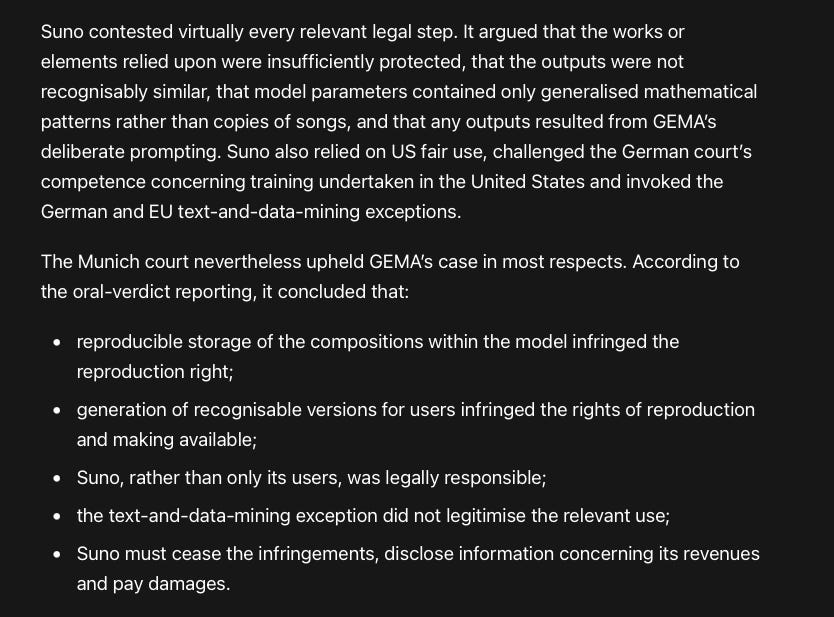
Suno contested virtually every relevant legal step. It argued that the works or elements relied upon were insufficiently protected, that the outputs were not recognisably similar, that model parameters contained only generalised mathematical patterns rather than copies of songs, and that any outputs resulted from GEMA’s deliberate prompting. Suno also relied on US fair use, challenged the German court’s competence concerning training undertaken in the United States and invoked the German and EU text-and-data-mining exceptions.
The Munich court nevertheless upheld GEMA’s case in most respects. According to the oral-verdict reporting, it concluded that:
reproducible storage of the compositions within the model infringed the reproduction right;
generation of recognisable versions for users infringed the rights of reproduction and making available;
Suno, rather than only its users, was legally responsible;
the text-and-data-mining exception did not legitimise the relevant use;
Suno must cease the infringements, disclose information concerning its revenues and pay damages.
The apparent reasoning of the court
1. Extractable works can amount to copies within a model
The central finding appears to be that the six compositions were reproducibly embodied in Suno’s model. The court treated memorisation as more than the acquisition of general facts, styles or musical correlations. If a work can be elicited in recognisable form without the user supplying its protected musical content, the model may contain a technologically encoded reproduction of that work.
This follows the same chamber’s November 2025 decision in GEMA v OpenAI. There, the court held that song lyrics were reproduced within model parameters because they remained capable of being generated substantially intact. It considered it irrelevant that the work was encoded through probability values rather than stored as a conventional text file: copyright’s reproduction right covers fixation “in any manner or form,” including material that becomes perceptible through technical means.
Applied to Suno, the reasoning is that recognisable musical reproduction is evidence of memorisation, memorisation constitutes fixation, and fixation constitutes reproduction.
2. The outputs were attributable to Suno
Suno argued that GEMA’s prompts broke the causal chain because users had intentionally tried to generate similar songs. The court evidently rejected this. The decisive point was that the prompts did not encode the melodies, harmonies, rhythms or arrangements that emerged. Suno selected or controlled the training process, designed and operated the model and supplied the mechanism that generated the protected musical content.
This again mirrors the OpenAI judgment. That court held that a provider could not shift responsibility entirely to users where straightforward prompts merely caused the provider’s model to reveal content already memorised during training.
3. Text and data mining did not protect memorisation
Section 44b of the German Copyright Act permits copies of lawfully accessible works for text and data mining, subject to a rights holder’s effective reservation of rights. Article 4 of the EU DSM Directive similarly protects certain reproductions and extractions made for automated analysis.
The Munich chamber’s established position is that this exception may cover the preparatory copying required to assemble and analyse a training corpus, but not a persistent reproduction of the work inside the resulting model. In its OpenAI judgment, it reasoned that text and data mining concerns the extraction of information; when the work itself remains reproducibly embodied in the model, the system has moved beyond analysis into continued exploitation of the work.
Suno’s apparent circumvention of YouTube’s download controls may also have weakened its reliance on the exception. Section 44b requires lawful access. Deliberately bypassing a technical barrier is difficult to reconcile with an argument that the relevant training copies were obtained through an ordinary lawful-access process. The complete judgment is needed to establish whether this point independently determined the issue.
Are the court’s arguments robust?
The output-infringement finding is the strongest part
Where an AI service generates recognisable protected melodies and the prompt does not itself contain those melodies, there is a powerful factual case that protected expression has been reproduced. Copyright does not protect a broad style or genre, but it does protect sufficiently original melodic expression.
The case is particularly strong where the output reproduces not merely a mood or instrumentation but an identifiable sequence of musical choices. Suno’s characterisation of its system as merely learning patterns cannot answer an infringement claim if the system actually produces protected portions of particular works.
Nevertheless, GEMA’s testing methodology deserves scrutiny. Requiring 176 attempts for one work and 124 for another could indicate deliberate extraction, cherry-picking or unusual prompting rather than ordinary model behaviour. It could also weaken the claim that the output followed from a genuinely simple request. Conversely, the fact that some compositions appeared after far fewer attempts, and that no musical notes or melodic instructions were supplied, supports GEMA’s position.
A robust appellate judgment should therefore distinguish between:
outputs routinely produced by ordinary prompts;
outputs obtained only through repeated extraction attempts;
similarity caused by the supplied lyrics, title or style;
similarity caused by memorised musical expression.
The conclusion that model weights are themselves copies is plausible but contestable
The court’s reasoning is strongest where the work can be reliably reconstructed from the model. Copyright has always recognised encoded and indirectly perceptible copies: an MP3, encrypted file or compressed representation does not cease to be a copy merely because a machine is required to make it perceptible.
The harder question is whether extractability proves that a composition is actually “fixed” in the parameters. A model may encode distributed relationships that make reproduction statistically possible without containing a separately identifiable representation comparable to a stored audio file. Much depends on the degree, consistency and specificity of reproduction.
The English High Court reached a contrasting conclusion in Getty Images v Stability AI. On the evidence in that case, it found that the final Stable Diffusion model weights did not store or contain copies of Getty’s images; they embodied learned patterns and features, even though copies had been used during training.
The decisions are not necessarily irreconcilable. Getty involved different models, evidence, statutory provisions and images. A system that cannot reconstruct training images presents a different question from a music model that can reproduce specific melodies. But the contrast illustrates why courts should avoid a universal rule that all model weights are copies—or that model weights can never be copies. The legally relevant question should be whether protected expression is reproducibly embodied in the particular model.
The narrow reading of the TDM exception is defensible, but not inevitable
The court is persuasive in distinguishing the analysis of a work from continued storage and exploitation of that work. An exception allowing automated analysis should not automatically authorise an AI product to operate as an alternative delivery mechanism for the original.
However, the statutory scheme does contemplate commercial text and data mining, subject to lawful access and rights reservation. An interpretation under which any incidental memorisation retrospectively removes the entire training process from the exception could create uncertainty: developers may not always know in advance which works a large model will memorise.
A more proportionate approach would distinguish:
lawful intermediate copies used for analysis;
the final model as a separate alleged copy;
infringing outputs generated from the model.
Under that approach, the training copies might remain protected by the exception while the provider incurs liability for failing to detect, mitigate or prevent memorisation and infringing outputs. The Munich court appears to adopt a more rights-protective position: once the work is reproduced in the model, that reproduction is outside the purpose and scope of text and data mining.
Provider responsibility is substantially robust
Suno’s attempt to place responsibility exclusively on users is unconvincing where the user did not supply the protected melody. The provider chose the data-acquisition process, created the architecture, trained the model and commercially supplied the generation service.
There should nevertheless be room to treat users as responsible where they upload protected content, provide detailed musical notation or deliberately manipulate an otherwise compliant service to create an infringement. Liability need not be exclusively assigned to either provider or user. In some circumstances both may contribute.
Territoriality may be the most vulnerable legal issue
German jurisdiction over infringing outputs offered to users in Germany is comparatively straightforward: EU jurisdictional rules permit claims where the harmful event occurs, while Rome II generally applies the law of the country for which IP protection is claimed.
The treatment of model training undertaken entirely in the United States is more difficult. German copyright law does not automatically regulate every reproduction occurring abroad. The official hearing record indicates that GEMA asserted claims under both German and US law, while Suno invoked US fair use and disputed the German court’s competence to determine the issue. Without the written judgment, it is impossible to determine whether the court:
applied US copyright law to the US training acts;
treated the model’s subsequent deployment in Germany as a new German reproduction;
relied primarily on German outputs rather than the original training;
or adopted another territorial theory.
This is likely to become a central appellate issue.
Consequences for AI developers
The judgment does not yet establish that all AI training on copyrighted material is unlawful in Europe. Its more defensible proposition is narrower: training is particularly dangerous when protected works are unlawfully obtained, remain memorised in the model and can be reproduced through prompts.
Developers operating in Europe should consequently treat copyright compliance as a model-lifecycle obligation rather than merely a data-collection exercise. That means documented data provenance, identification of rights reservations, licensing where appropriate, avoidance of technical-measure circumvention, deduplication, memorisation testing, similarity evaluations and effective output controls.
The judgment also makes “the user did it” a weak default defence. Terms of service transferring responsibility to users will not protect a provider where the provider’s own model supplies the protected expression.
Model-level injunctions are another serious possibility. If a court treats memorised works as copies within the weights, removing individual outputs may be insufficient. Developers could face requirements to retrain, unlearn particular works, withdraw a model version or prevent its operation in a territory.
The decision also reinforces the EU AI Act’s copyright-related requirements. Article 53 requires providers of general-purpose AI models to maintain a copyright-compliance policy, respect machine-readable rights reservations and publish a sufficiently detailed training-content summary. Those obligations apply to providers placing models on the EU market even where relevant training activities occurred elsewhere, although the AI Act does not itself decide whether a particular training act infringed copyright.
A likely commercial result is further movement towards licensed datasets and collective licensing. Large developers may be able to absorb those costs more readily than small companies, potentially strengthening market concentration. Courts and policymakers should therefore encourage scalable licensing, transparent rates and realistic access for start-ups rather than allowing copyright compliance to become available only to the largest firms.
Consequences for rights owners
Rights owners gain a potentially powerful evidential method: carefully documented output testing may help establish that particular works entered a training process and remain memorised, even where the developer refuses to disclose its corpus.
But the testing must be credible. Rights owners should retain prompts, timestamps, model versions, account information, unsuccessful attempts and complete outputs—not merely select the closest result. Independent technical and musicological analysis will be important to separate protected melodic copying from similarities in genre, instrumentation, rhythm or style.
Rights owners should also issue machine-readable rights reservations. The Hamburg Higher Regional Court’s LAION decision illustrates the risk of relying on ordinary contractual or human-readable restrictions: the court held that a reservation that was not machine-readable failed to prevent reliance on section 44b.
The Suno judgment strengthens the negotiating position of collective management organisations because it links memorisation to reproduction, provider operation to output liability and unauthorised use to both disclosure and damages. Under section 97 of the German Copyright Act, damages may be assessed by reference to actual loss, infringer profits or the reasonable licence fee that should have been paid.
Rights owners should not, however, read the decision as protection against AI-generated competition generally. Copyright does not confer ownership of a musical style, genre, atmosphere or creative method. A claim will still require identifiable protected expression, evidence of rights ownership and a legally relevant act occurring within the applicable territory.
Conclusion
The Munich judgment is significant because it rejects the proposition that AI training and model operation are necessarily abstract, non-expressive processes occurring beyond copyright’s reach. Where an AI model can regenerate recognisable protected melodies, the court is prepared to regard the model as containing reproductions and the provider as responsible for the resulting outputs.
The ruling is strongest concerning recognisable outputs, unlawful acquisition practices and provider responsibility. Its most contestable elements are the inference that extractability necessarily means legal fixation in model weights, the precise boundaries of the text-and-data-mining exception and the treatment of training carried out in the United States.
Until the written judgment and any appeal are available, this should be understood as an important first-instance decision—not yet a definitive European rule. Its lasting significance will depend on whether the Munich Higher Regional Court, and potentially the Court of Justice of the European Union, endorses the distinction between legitimate computational analysis and models that reproducibly retain the works they were trained upon.
Sources and associated URLs
Munich Regional Court I—official hearing record, case 42 O 763/25
https://www.justiz.bayern.de/gerichte-und-behoerden/landgericht/muenchen-1/presse/2026/6.phpMunich Regional Court I—official judgment-date notice
https://www.justiz.bayern.de/gerichte-und-behoerden/landgericht/muenchen-1/presse/2026/11.phpReuters—German court rules AI music firm Suno broke copyright rules
https://www.reuters.com/world/german-court-rules-ai-music-firm-suno-broke-copyright-rules-2026-07-31/MusikWoche—GEMA gewinnt Prozess gegen Suno
https://musikwoche.de/recorded-publishing/gema-gewinnt-prozess-gegen-suno/Munich Regional Court I—GEMA v OpenAI judgment summary
https://www.justiz.bayern.de/gerichte-und-behoerden/landgericht/muenchen-1/presse/2025/11.phpGerman Copyright Act, section 44b—Text and data mining
https://www.gesetze-im-internet.de/urhg/__44b.htmlGerman Copyright Act, section 97—Injunctions and damages
https://www.gesetze-im-internet.de/urhg/__97.htmlEU DSM Copyright Directive, Article 4
https://eur-lex.europa.eu/eli/dir/2019/790/ojHamburg Higher Regional Court—LAION/TDM decision
https://justiz.hamburg.de/gerichte/oberlandesgericht/gerichtspressestelle/ki-und-urheberrecht-hanseatisches-oberlandesgericht-weist-berufung-zurueck-1126528Getty Images v Stability AI, [2025] EWHC 2863 (Ch)
https://www.judiciary.uk/judgments/getty-images-v-stability-ai/EU AI Act, including Article 53
https://eur-lex.europa.eu/legal-content/EN/TXT/?uri=CELEX:32024R1689Rome II Regulation—law applicable to IP infringements
https://eur-lex.europa.eu/legal-content/EN/TXT/?uri=CELEX:32007R0864
GEMA v. OpenAI: The allegation was that these lyrics had been used to train ChatGPT without a license and that ChatGPT subsequently reproduced them nearly verbatim for users.

GEMA’s Opening Victory Against OpenAI—What Happened, Why It Matters, and How AI Makers Should Respond