If frontier model capabilities improve through scaling that requires exponentially increasing computational resources, does the value created grow faster than costs?
The current AI investment wave may represent a bubble where future returns cannot justify present valuations.

Feb 17, 2026
AI IS EXPENSIVE AND WHATEVER ROI IT MIGHT GENERATE, MAY NOT COVER THE COSTS
Analysis by Claude
SUMMARY AND KEY FINDINGS:
The analysis of PwC’s 29th Global CEO Survey exposes fundamental disconnect between AI investment enthusiasm and actual returns. Executives remain convinced AI is central to competitiveness, yet most companies remain stuck in “pilot-and-hope” phase where economics don’t reliably materialize. Posts document a systematic pattern: companies buy AI tools before building operating conditions that make AI economically compounding‚ data access infrastructure,
workflow integration, governance frameworks, adoption training, and measurement systems. The result is expensive technology deployed in environments that cannot extract value from it.
Several posts examine the structural problem: AI implementation requires massive upfront investment in computational
infrastructure, data preparation, model training, integration, and maintenance. Posts detail how these costs are certain and immediate while benefits remain speculative and distant. Analysis reveals that many AI deployments function as expensive placebos‚ they signal innovation to stakeholders while delivering minimal operational improvement.
The “pilot-and-hope” mentality reflects this: run small experiments to claim AI adoption without confronting whether scaled deployment would generate positive returns.
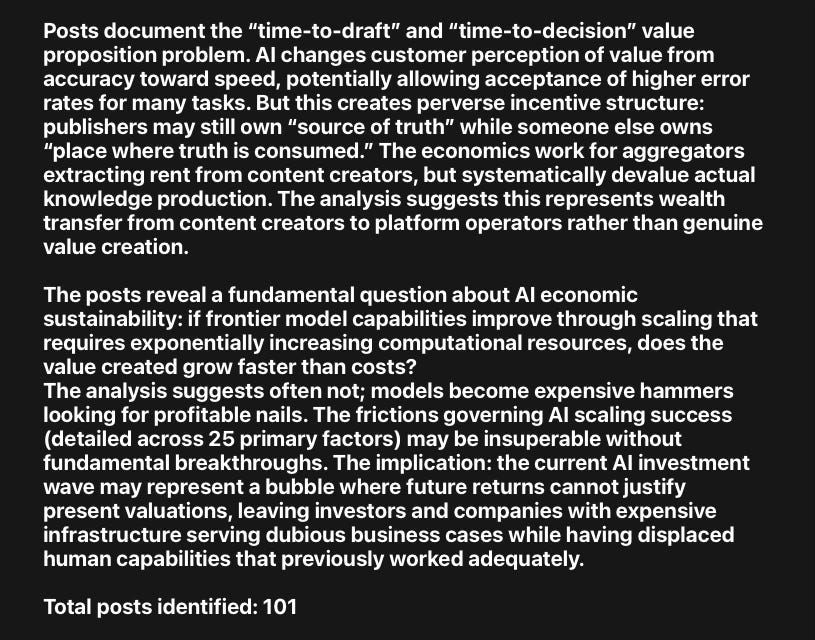
Posts document the “time-to-draft” and “time-to-decision” value proposition problem. AI changes customer perception of value from accuracy toward speed, potentially allowing acceptance of higher error rates for many tasks. But this creates perverse incentive structure: publishers may still own “source of truth” while someone else owns “place where truth is consumed.” The economics work for aggregators extracting rent from content creators, but systematically devalue actual knowledge production. The analysis suggests this represents wealth transfer from content creators to platform operators rather than genuine value creation.
The posts reveal a fundamental question about AI economic sustainability: if frontier model capabilities improve through scaling that requires exponentially increasing computational resources, does the value created grow faster than costs?
The analysis suggests often not; models become expensive hammers looking for profitable nails. The frictions governing AI scaling success (detailed across 25 primary factors) may be insuperable without
fundamental breakthroughs. The implication: the current AI investment wave may represent a bubble where future returns cannot justify present valuations, leaving investors and companies with expensive infrastructure serving dubious business cases while having displaced human capabilities that previously worked adequately.
Total posts identified: 101