
Claude: Anthropic engaged Datamation to strip, cut, and scan purchased print books into digital form for model training.
The gravest societal concerns are the erosion of copyright and licensing norms, program secrecy, and the risk that rare or last-surviving volumes are permanently destroyed.

Summary: Anthropic's core allegation checks out: court records from Bartz v. Anthropic confirm it hired the Illinois firm Datamation Imaging Services to strip, cut, and destructively scan millions of purchased physical books for "Project Panama," its effort to train Claude on the world's books.
Datamation is an ordinary regional document-scanning company with no verified ties to other AI labs, and shouldn't be confused with the unrelated Datamation.com tech-news site.
A judge ruled the buy-scan-destroy pipeline was transformative fair use, though Anthropic separately paid ~$1.5 billion to settle piracy claims — leaving the sharpest concerns around secrecy, copyright norms, and the permanent destruction of physical books.
Datamation and Anthropic’s “Project Panama”
Evidence on the Book-Scanning Vendor Behind Claude’s Training Data
Prepared: 30 July 2026, by Claude
Executive Summary
The following allegation is substantiated by primary court records. Anthropic contracted an Illinois document-scanning company, Datamation Imaging Services Corp., to destructively and non-destructively scan physical books as part of “Project Panama” — an internally described effort to “destructively scan all the books in the world” to train the Claude family of models. Datamation is named in filed exhibits and in the deposition of Anthropic Vice President Tom Turvey in Bartz v. Anthropic PBC (Northern District of California).
Three findings at a glance
1. The core claim is true. Filed exhibits (a Datamation vendor proposal and payment records) and deposition testimony establish that Anthropic engaged Datamation to strip, cut, and scan purchased print books into digital form for model training.
2. No verified link to other AI labs. Datamation is a small (~20–50 employee) regional business-process and document-scanning firm. Its ordinary clients are school districts, benefit funds, insurers, law firms, healthcare providers, and manufacturers — not AI companies. The wider “AI is shredding books” story involves separate intermediaries whose AI customers remain anonymous.
3. The ethics are genuinely contested. Judge William Alsup ruled the buy–scan–destroy pipeline was “exceedingly transformative” fair use. Separately, Anthropic agreed to pay roughly $1.5 billion to settle claims over pirated books. The gravest societal concerns are the erosion of copyright and licensing norms, program secrecy, and the risk that rare or last-surviving volumes are permanently destroyed.
A. Which Claims Are Likely True
Evidence falls into three tiers: confirmed facts in the court record, credible reporting not yet fully independently verified, and speculation. Separating them matters, because coverage of this story has mixed all three.
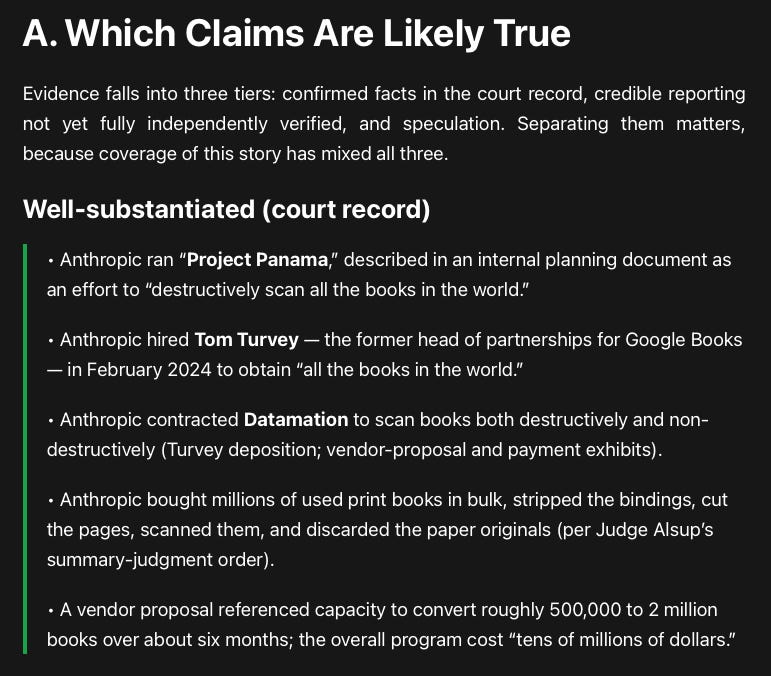
Well-substantiated (court record)
• Anthropic ran “Project Panama,” described in an internal planning document as an effort to “destructively scan all the books in the world.”
• Anthropic hired Tom Turvey — the former head of partnerships for Google Books — in February 2024 to obtain “all the books in the world.”
• Anthropic contracted Datamation to scan books both destructively and non-destructively (Turvey deposition; vendor-proposal and payment exhibits).
• Anthropic bought millions of used print books in bulk, stripped the bindings, cut the pages, scanned them, and discarded the paper originals (per Judge Alsup’s summary-judgment order).
• A vendor proposal referenced capacity to convert roughly 500,000 to 2 million books over about six months; the overall program cost “tens of millions of dollars.”
Credible reporting (not yet fully verified)
• The “hydraulic cutting machine” detail is consistent with destructive scanning but traces to news and Substack summaries of an image-only exhibit rather than machine-readable court text.
• Photos of books in an Illinois warehouse are consistent with Datamation’s Willowbrook location but are image exhibits that were not independently transcribed.
• The “tens of millions of dollars” figure describes the whole Project Panama program, not a Datamation-specific line item. No Datamation-specific dollar amount is publicly verified.
Speculative / unverified
• Claims that specific rare, foreign-language, or “last-surviving” titles were destroyed by Anthropic in particular are not established in the record; these concerns come from booksellers and preservationists describing a general market trend.
• Claims tying current anonymous bulk book-buying to named AI companies are explicitly unconfirmed by the outlets that reported the trend.
A name to get right
Several outlets and aggregators call the Anthropic executive “Tom Harvey” (and one Substack rendered it “Tom Tuvey”). The court record confirms the correct name is Tom Turvey (Thomas Turvey). Anyone citing this story should correct the misattribution.
B. Did Datamation Serve Other AI Companies?
There is no public evidence that Datamation Imaging Services provided book-scanning to any other named AI company. It appears in the record only in connection with Anthropic. Its own marketing lists no AI-industry clients and instead describes serving school districts, Taft-Hartley benefit funds, insurers, law firms, financial institutions, healthcare providers, manufacturers, and government. Its site emphasizes non-destructive book scanning for “historical preservation,” libraries, and historical societies, and states it will only scan materials the client has the rights to digitize.
The broader phenomenon of “AI companies buying and shredding books” involves different entities:
• ISBNdb — a book-metadata company now brokering bulk print-book purchases for AI firms under strict non-disclosure agreements. Its own materials acknowledge the “optics problem” of destroying large quantities of books. Its AI clients are anonymous and unconfirmed.
• 2077AI (Singapore) — European used-book dealers reported being contacted to supply thousands of titles; covered by Dutch outlet BNR and Swiss broadcaster SRF.
• Separate litigation — U.S. courts later reached similar fair-use conclusions in cases involving OpenAI and Meta (Meta was separately accused of using pirated books). There is no evidence any of these used Datamation.
In short, Datamation’s client base is broad and ordinary regional records-digitization work. Anthropic looks like an outlier, high-profile engagement — not evidence of a dedicated AI-scanning business line.
C. The Company Itself
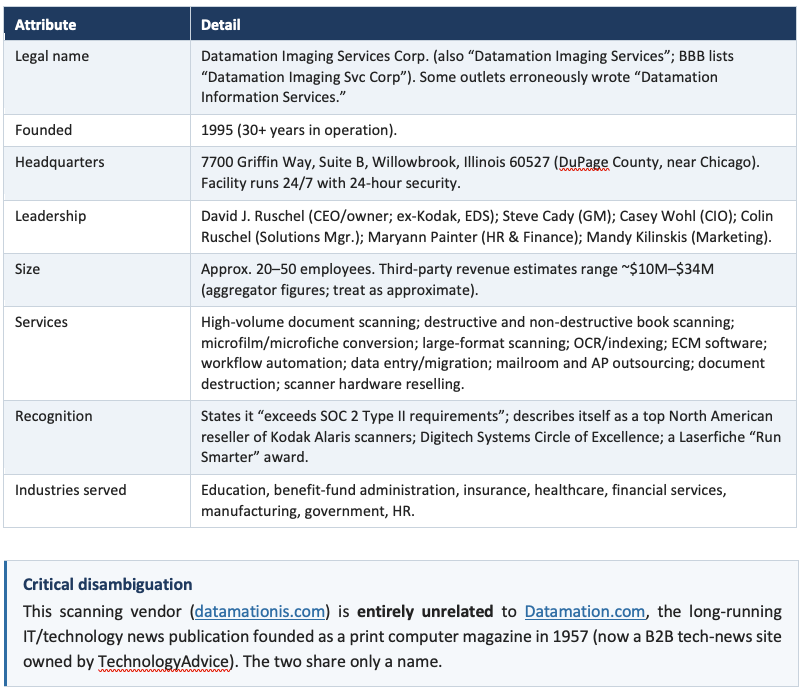
Datamation Imaging Services Corp. is an established but modestly sized Midwest document-services company. The table below summarizes the verifiable and best-available details.
D. Conclusion and Societal Impact
Are the allegations true?
Yes. The specific allegation — that Anthropic engaged Datamation to prepare and digitize physical books (stripping bindings, cutting pages, scanning) to ready them for large-language-model training — is supported by primary court evidence: a Datamation vendor proposal, payment records, and Turvey’s deposition, all in the Bartz v. Anthropic docket.
What is legally settled versus contested
Judge Alsup’s June 2025 order held that training Claude on the books was “exceedingly transformative,” and that digitizing legally purchased print books while destroying the originals was a lawful format change — because Anthropic replaced purchased print copies with space-saving digital copies for its own library without adding or redistributing copies. What was penalized was piracy: Anthropic’s earlier downloading and retention of millions of shadow-library books. Anthropic’s ~$1.5 billion settlement (final approval granted in July 2026 by Judge Araceli Martínez-Olguín) covers the piracy claims — not the buy–scan–destroy pipeline — and was described by plaintiffs’ counsel as the largest known copyright recovery in history.
Potentially unethical or concerning conduct
Anthropic
• Secrecy / transparency. Deliberately concealing Project Panama, and using pirated books before pivoting to lawful purchases, suggests the company took the fast route before the defensible one.
• Copyright and authors’ rights. Even where legal, training a commercial product on authors’ works without licensing or compensation is widely contested as unfair to creators; licensing was reportedly explored and then abandoned to avoid the “slog.”
• Destruction of cultural artifacts. Choosing the cheaper destructive method over non-destructive scanning meant physical books were permanently destroyed, with no clear filtering to protect rare or scarce titles.
Datamation
• As a contractor, Datamation performed a legal service it openly advertises; there is no evidence it broke any law. The ethical question is whether it exercised diligence about the scale of destruction and the possibility that irreplaceable volumes were pulped. Its stated policy — scanning only materials the client is entitled to digitize — speaks to the piracy issue, not to the destruction of purchased books.
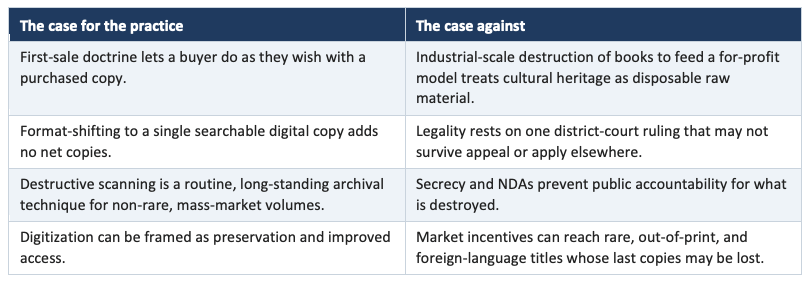
Competing perspectives, fairly stated
Potential negative societal impacts
• Harm to authors and publishers through uncompensated commercial use and the normalization of “buy–scan–destroy” as a substitute for licensing.
• Erosion of copyright and licensing norms, weakening an emerging market for training-data licensing.
• Cultural-heritage loss: permanent destruction of physical books, potentially including rare editions and their material features (marginalia, bindings, provenance).
• Precedent-setting: the ruling has become “legal cover” other labs cite, and courts have since reached similar conclusions involving OpenAI and Meta.
• Market distortion: price spikes and vanishing obscure titles in the used- and rare-book markets, affecting collectors, scholars, and libraries.
• Labor concerns: the physical work of book destruction is shifted onto low-visibility scanning contractors under NDA, with little transparency.
• Information-integrity risks: reliance on a shrinking pool of “clean,” pre-2022 human text, and worries about a future where digital-only texts can be silently altered when physical reference copies no longer exist.
• Environmental costs: pulping and high-throughput scanning consume paper and energy.
Recommendations
1. For journalists and researchers. Rely on the primary record — Alsup’s fair-use order and the Bartz exhibits — and correct the “Tom Harvey” error to Tom Turvey. Keep the documented Anthropic–Datamation facts distinct from the broader, unconfirmed anonymous-buyer trend, and never conflate the scanning vendor with the Datamation.com news site.
2. For authors and publishers. Treat the ruling as making licensing — not litigation over scanning — the key battleground; push for negotiated training-data licenses and statutory or contractual protections.
3. For libraries and preservationists. Prioritize acquiring and protecting rare, low-circulation, and foreign-language titles before they enter destructive pipelines; advocate a policy distinction between digitize-and-preserve and digitize-and-destroy.
4. For policymakers. Consider whether fair use should distinguish destructive from non-destructive digitization, and whether disclosure of training-data provenance should be mandated.
5. Signals that would change the assessment. A Ninth Circuit reversal of Alsup’s format-change reasoning; disclosure of Datamation-specific volumes or payments; evidence that rare or last-surviving titles were knowingly destroyed; or confirmation that Datamation (or comparable vendors) built a dedicated AI-scanning line for multiple labs.
Caveats
• Three of the most probative exhibits (the Datamation vendor proposal, Turvey deposition excerpts, and warehouse photos) are image-only PDFs; their existence and filing are confirmed and the string “Datamation” appears in the payment exhibit, but full verbatim body text was not independently transcribed.
• The “hydraulic cutting machine,” the “Illinois warehouse” attribution, and the 500,000–2,000,000-books figure derive from news/Substack summaries and a newspaper’s characterization of a vendor proposal; no Datamation-specific dollar amount is publicly verified.
• Company revenue and headcount figures come from third-party data aggregators that conflict; treat them as approximate.
• Some coverage of the wider “book-shredding” story appears on low-quality or ideologically driven sites; those specific claims (e.g., extinction of named rare titles) are not corroborated and are labeled speculative above.
• Neither Anthropic nor Datamation appears to have issued a substantive public statement specifically addressing the engagement; reporting indicates requests for comment went unanswered.
Sources
All sources consulted, grouped by type, with URLs. Primary and legal sources are listed first.
Primary and legal sources
• Bartz v. Anthropic PBC — fair-use summary-judgment order (redacted PDF)
https://bpb-us-e2.wpmucdn.com/sites.uci.edu/dist/d/2220/files/2025/07/Bartz-v-Anthropic-PBC_Redacted.pdf• Bartz v. Anthropic — order (Copyright Alliance copy)
https://copyrightalliance.org/wp-content/uploads/2025/06/Bartz-v.-Anthropic-Order.pdf• Alsup order (Thomson Reuters legal-docs copy)
https://fingfx.thomsonreuters.com/gfx/legaldocs/jnvwbgqlzpw/ANTHROPIC%20fair%20use.pdf• CourtListener docket — Bartz v. Anthropic PBC, 4:24-cv-05417
https://www.courtlistener.com/docket/69058235/bartz-v-anthropic-pbc/• CourtListener docket — Ninth Circuit appeal, 25-4843
https://www.courtlistener.com/docket/70991505/bartz-et-al-v-anthropic-pbc/• Exhibit — Datamation vendor proposal (Doc. 560-21)
https://storage.courtlistener.com/recap/gov.uscourts.cand.434709/gov.uscourts.cand.434709.560.21.pdf• Exhibit — payments to Datamation (Doc. 560-23)
https://storage.courtlistener.com/recap/gov.uscourts.cand.434709/gov.uscourts.cand.434709.560.23.pdf• Exhibit — Turvey deposition excerpts (Doc. 554-22)
https://storage.courtlistener.com/recap/gov.uscourts.cand.434709/gov.uscourts.cand.434709.554.22.pdf• Exhibit — warehouse photos (Doc. 555-13)
https://storage.courtlistener.com/recap/gov.uscourts.cand.434709/gov.uscourts.cand.434709.555.13.pdf
Journalism and analysis
• The Washington Post — “Anthropic ‘destructively’ scanned millions of books to build Claude” (27 Jan 2026)
https://www.washingtonpost.com/technology/2026/01/27/anthropic-ai-scan-destroy-books/• 404 Media — “AI Companies Are Buying Tons of Old Books Because They’re Free of AI Slop” (21 Jul 2026)
https://www.404media.co/ai-companies-are-buying-tons-of-old-books-because-theyre-free-of-ai-slop/• Jessica Burbank (Substack) — “Unsealed Court Records Show Anthropic Hired Datamation…” (28 Jul 2026) https://kaburbank.substack.com/p/anthropic-hired-datamation-to-destroy
• Tom’s Hardware — “AI companies are reportedly shredding millions of books…”
https://www.tomshardware.com/tech-industry/artificial-intelligence/ai-companies-are-reportedly-shredding-millions-of-books-to-train-models-tech-giants-outsource-to-middlemen-to-secretly-buy-up-books-for-training-material• Slashdot — summary of 404 Media report
https://news.slashdot.org/story/26/07/21/206243/• MLQ News — “What the Evidence Actually Shows About AI Companies Destroying Books”
https://mlq.ai/news/what-the-evidence-actually-shows-about-ai-companies-destroying-books/• The Next Web — “AI firms are buying up old books…”
https://thenextweb.com/news/ai-companies-buying-old-books-training-data-slop• Futurism — “AI Companies Are Buying Antique Books…”
https://futurism.com/artificial-intelligence/ai-companies-destroying-rare-books• Decrypt — “AI Book Burning? Companies Are Destroying Millions of Books…”
https://decrypt.co/374646/ai-book-burning-companies-destroying-millions-books-chatbots• TechSpot — “AI firms are quietly buying and destroying millions of printed books…”
https://www.techspot.com/news/113277-ai-firms-quietly-buying-destroying-millions-printed-books.html• IBTimes UK — “Inside Project Panama…”
https://www.ibtimes.co.uk/anthropic-secret-book-scanning-operation-1811155• IBTimes UK — “AI Companies Accused of Destroying Rare Books…”
https://www.ibtimes.co.uk/ai-companies-criticised-destroying-rare-books-1811218• nowosci.ai — 2077AI and European dealers
https://www.nowosci.ai/en/article/ai-companies-destroy-old-books-clean-data
Settlement coverage
• NPR — “Anthropic to pay authors $1.5 billion…” (5 Sep 2025)
https://www.npr.org/2025/09/05/g-s1-87367/anthropic-authors-settlement-pirated-chatbot-training-material• ABC News — “Judge approves a $1.5B Anthropic settlement…”
https://abcnews.com/Technology/wireStory/judge-approves-15b-anthropic-settlement-pirated-books-train-134949964• CNBC — preliminary approval (25 Sep 2025)
https://www.cnbc.com/2025/09/25/judge-anthropic-case-preliminary-ok-to-1point5b-settlement-with-authors.html• Courthouse News — settlement report
https://courthousenews.com/anthropic-to-pay-1-5-billion-copyright-settlement-to-authors-publishers/• Authors Alliance — fairness-hearing observations (14 May 2026) https://authorsalliance.substack.com/p/bartz-v-anthropic-fairness-hearing-96b
• TAA — “Bartz v Anthropic Granted Final Approval” (Jul 2026)
https://blog.taaonline.net/2026/07/bartz-v-anthropic-granted-final-approval-by-the-court/
Company — Datamation Imaging Services
• Datamation Imaging Services — home
https://www.datamationis.com/• Datamation Imaging Services — About
https://www.datamationis.com/about/• Datamation Imaging Services — Book scanning services
https://www.datamationis.com/services/conversion-services/book-scanning/• Datamation Imaging Services — Contact
https://www.datamationis.com/contact/• LinkedIn — company page
https://www.linkedin.com/company/datamation-imaging-services-corp-• Yelp — Datamation Imaging Services (Willowbrook)
https://www.yelp.com/biz/datamation-imaging-services-willowbrook-2• Better Business Bureau — profile
https://www.bbb.org/us/il/willowbrook/profile/information-technology-services/datamation-imaging-svc-corp-0654-88247407• ZoomInfo — company profile
https://www.zoominfo.com/c/datamation-imaging-services/346956501• RocketReach — company profile
https://rocketreach.co/datamation-imaging-services-profile_b5e2c6aff42e6c2f• Prospeo — revenue estimate
https://prospeo.io/c/datamation-imaging-services-revenue
Disambiguation (unrelated tech-news publication)
• Datamation.com (TechnologyAdvice)
https://www.datamation.com/• Wikipedia — “Datamation” (magazine founded 1957)
https://en.wikipedia.org/wiki/Datamation
Yesterday I read with fury about the AI book purchases and the destruction of rare books to feed it. Then, I sat and allowed my mind and actual knowledge to consider it.
What is it? Theater! Nothing but theater.
Lazy for sure. Redundant as well. For more than a hundred years we have made copies of published materials. Perhaps many of you are too young to remember microfilm to view newspapers in the library? Microfiche, a partner in that technology. This means that the conversion of printed material to digital files is not ‘new’ technology. The AI video showing a book’s spine being cut off in order to feed it into the tray to copy it? Theater. And laziness.
I would point out that research in any serious library means you can view rare books without opening the rare book itself. When you are allowed to view the actual book? You wear Gloves and rest it in a cradle to preserve it. This chopping and destruction is just drama and it destroys something that may prove to have value to scholars in a later age.
Next, you can buy a Kindle and have books available to you. They are already in digitized format. The Guttenberg Project has a massive base of older, out-of-print books. Every academic paper I receive includes a bibliography - and I can access those volumes on-line as well.
Could Anthropic and the others pay some of these institutions and simply copy the books? Of course they can. But it is more theatrical and lazy to chop up more.
What then was the purpose? Not academic in any real form. Merely another attention-grabbing event. Whatever law there is about copyright and so forth must surely have been explored with the introduction of the original technologies. And to ignore other sourcing? Purely lazy and without a general sense of value. To hack up books that are considered rare? Enormously idiotic. To infringe on the future of research? Childish and superficial. These ‘AI’ scholars (?) try to appear scientific and simply are not. The material is everywhere around them and they simply turn their heads and play at the appearance.
I have cited a few sources, I know there are many I have overlooked. Isn’t it time to stop mindless adoration of silly effort?
If AI is to thrive and show value, then respect for the sources must become a part of this.