AI’s intellectual-property reckoning will not end with training data. As AI products evolve from passive models into persistent agents that remember, schedule, coordinate, decide and act...
...they increasingly enter territory occupied by decades of patents covering computing architecture, automation, control systems and machine intelligence.

Summary: The University of Tennessee Research Foundation alleges that Claude Code and Anthropic’s agentic architecture infringe two neuroscience-inspired neural-network patents, seeking damages and a possible injunction.
The complaint is technically detailed but legally uncertain because it often treats software features—such as agents, prompts, schedulers and memory systems—as equivalent to patented neurons, synapses and neuromorphic circuitry.
The case could encourage claims against other AI developers, underscoring the need for patent freedom-to-operate reviews, careful technical documentation, design-arounds and early licensing discussions.
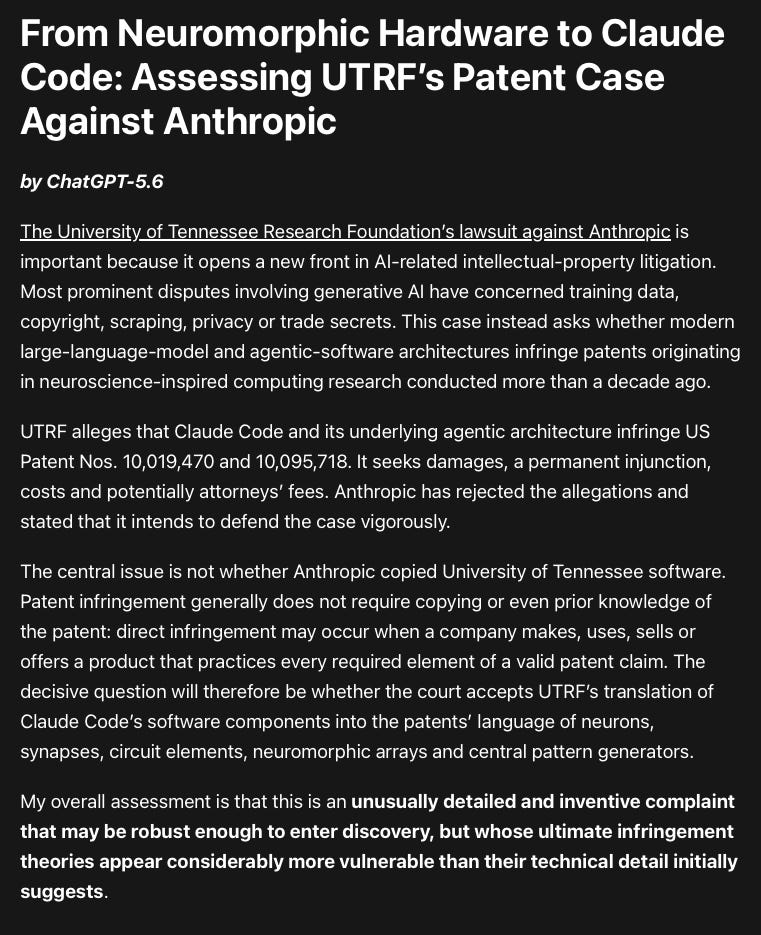
From Neuromorphic Hardware to Claude Code: Assessing UTRF’s Patent Case Against Anthropic
by ChatGPT-5.6
The University of Tennessee Research Foundation’s lawsuit against Anthropic is important because it opens a new front in AI-related intellectual-property litigation. Most prominent disputes involving generative AI have concerned training data, copyright, scraping, privacy or trade secrets. This case instead asks whether modern large-language-model and agentic-software architectures infringe patents originating in neuroscience-inspired computing research conducted more than a decade ago.
UTRF alleges that Claude Code and its underlying agentic architecture infringe US Patent Nos. 10,019,470 and 10,095,718. It seeks damages, a permanent injunction, costs and potentially attorneys’ fees. Anthropic has rejected the allegations and stated that it intends to defend the case vigorously.
The central issue is not whether Anthropic copied University of Tennessee software. Patent infringement generally does not require copying or even prior knowledge of the patent: direct infringement may occur when a company makes, uses, sells or offers a product that practices every required element of a valid patent claim. The decisive question will therefore be whether the court accepts UTRF’s translation of Claude Code’s software components into the patents’ language of neurons, synapses, circuit elements, neuromorphic arrays and central pattern generators.
My overall assessment is that this is an unusually detailed and inventive complaint that may be robust enough to enter discovery, but whose ultimate infringement theories appear considerably more vulnerable than their technical detail initially suggests.
A. The principal grievances
The alleged infringement of the ’470 patent
UTRF’s first claim focuses on claim 10 of the ’470 patent. That claim concerns a “central pattern generator” within a neuromorphic network used to control an external automated process or device. It contains a demanding collection of limitations, including:
prediction of component failure;
input and output neuron circuit elements positioned on the edge of a two-dimensional array;
configurable synapse and neuron circuit elements;
a reconfigured, different two-dimensional array;
cyclic or regenerative behaviour;
programmable thresholds and refractory periods;
programmable delay or distance values; and
a control signal applied to an actuator in response to predicted failure.
The claim is therefore much more specific than a general patent on artificial neural networks.
UTRF nevertheless argues that Claude Code satisfies these requirements through a combination of its background scheduler, memory-consolidation system, permission controls, shell-execution tools, terminal interface and graphical-layout components.
In particular, the complaint characterises cronScheduler.ts and autoDream.ts as a central pattern generator because they allegedly run recurring processes that compress and reorganise agent memories. It treats context-window overflow, memory saturation, command errors and runtime crashes as predicted “component failures”. It also characterises pre-execution parsing of shell commands as a process that anticipates and prevents such failures.
The complaint goes further. It says:
operating-system adapters and Model Context Protocol servers function as configurable input and output circuit elements;
terminal-rendering nodes located along the edges of a Flexbox grid function as input and output neurons;
parent-child references and JSON-RPC connections are synapses;
retry intervals and tool timeouts are programmable synaptic delays;
memory-consolidation trigger conditions are neuronal thresholds;
lock-out periods are refractory periods; and
virtual key presses, mouse clicks and shell commands are process-control signals applied to external actuators.
In essence, UTRF assembles several layers of Claude Code—the LLM, user interface, scheduler, memory subsystem, command parser, permission system and external tools—and presents them collectively as the claimed neuromorphic network.
The alleged infringement of the ’718 patent
Count II concerns claim 35 of the ’718 patent. That claim describes a method of constructing a neuromorphic network consisting of an “addressably reconfigurable multi-dimensional array of interconnected circuit elements”. Each circuit element must have similar electronic components, and the elements must be configurable as neurons or synapses under the control of a special-purpose processor. The system must also have an input neuron, an output neuron and configurable pathways between them.
UTRF alleges that:
Claude’s model weights are interconnected circuit elements;
the LLM is a multidimensional neuromorphic array;
coordinator prompts configure individual agent workers as neurons;
communication between workers operates as synapses;
user prompts and message arrays are input neurons;
generated tokens, text and tool-use instructions are output neurons; and
retry, routing, planning and verification loops create dynamically configurable pathways.
The complaint relies significantly on Anthropic’s own interpretability research and public explanations. It quotes Anthropic personnel describing model features as neurons, weights as connections and groups of features and weights as circuits. It also cites Anthropic’s explanation that concepts are distributed across multiple neurons and that internal model states can be represented through combinations of features.
The complaint then maps Claude Code’s coordinator, worker agents, error messages and tool-execution loops onto the patented input-neuron, synapse, pathway and output-neuron structure. It even alleges that XML task notifications are synapses and that errors returned to the model reconfigure its attention pathway.
Direct and induced infringement
UTRF alleges both direct infringement by Anthropic and induced infringement by Claude Code users. It argues that Anthropic’s documentation, marketing, support and training materials instruct customers to use the product in its ordinary infringing configuration.
One weakness is immediately apparent: the complaint says Anthropic had knowledge of the patents “since at least service of this Complaint or shortly thereafter”. In other words, it does not clearly plead that Anthropic knew about the patents before the lawsuit. That may permit a post-filing inducement theory if Anthropic continues the same conduct, but it makes pre-suit inducement and any suggestion of deliberate pre-suit infringement considerably harder to establish.
The requested remedies
UTRF asks for:
a finding of literal infringement or infringement under the doctrine of equivalents;
a permanent injunction;
damages, interest and costs;
a declaration that the litigation is an exceptional case; and
attorneys’ fees.
Patent damages must be adequate to compensate for infringement and cannot be less than a reasonable royalty. Courts can increase damages, potentially up to three times the assessed amount, but enhanced damages are generally reserved for egregious misconduct rather than ordinary infringement.
B. Are the arguments and evidence robust?
What makes the complaint relatively strong
First, these are issued patents. Each patent claim is presumed valid, with Anthropic bearing the burden of establishing invalidity. That does not mean the claims will survive, but UTRF begins with an important procedural advantage.
Second, UTRF does not merely accuse “Claude” or “artificial intelligence” in general terms. It identifies particular claims, product functions, source-code filenames, execution loops, memory processes, permission mechanisms and interface components. This level of detail is likely to make the complaint harder to dismiss as conclusory.
Third, much of the cited material comes from Anthropic itself: engineering posts, talks by employees, interpretability research and explanations of agent architecture. These sources may help UTRF demonstrate how Claude Code works before it has access to confidential source code.
Fourth, the patents predate Claude Code and the current agentic-AI boom. The ’470 and ’718 patents claim priority from 2013 and were filed in 2014. That chronology eliminates any suggestion that UTRF drafted the patents after observing Anthropic’s products.
Finally, the complaint says the patent families have been cited as prior art by patents associated with Apple, Google, Microsoft, Amazon, IBM, Meta and numerous universities. This shows that the patent family is not wholly obscure. It does not, however, establish that any of those organisations practised the claims, accepted their validity or considered their own systems infringing.
The core weakness: metaphor is doing too much legal work
The greatest vulnerability is that UTRF repeatedly treats a resemblance in terminology or function as proof that a patent limitation is satisfied.
Calling a software feature a “neuron”, “circuit”, “dream”, “memory” or “synapse” does not necessarily make it the particular circuit element, neuron or synapse defined by the patent. Technical metaphors are useful when communicating how AI works, but patent infringement turns on claim construction and architecture—not analogical language.
For claim 10 of the ’470 patent, UTRF must connect Claude Code to a highly particular combination of elements. Its complaint effectively argues that:
a cron process is a central pattern generator;
a cooldown period is a refractory period;
a timeout is a synaptic delay;
a rendering grid is a two-dimensional neuromorphic array;
an application node is a neuron;
a parent-child software reference is a synapse;
context-window pressure is component failure; and
a shell command is an actuator-control signal.
Each analogy is conceivable in isolation. The difficulty is proving that all of these components collectively form the single claimed system and interact in the way required by the patent.
The complaint also appears to combine distinct technological layers opportunistically. When it needs an artificial neural network, it relies on Claude’s model. When it needs a two-dimensional array, it shifts to the terminal’s visual-layout system. When it needs cyclic behaviour, it moves to the background scheduler. When it needs an actuator, it invokes the shell or computer-use function. A court may ask whether this is genuinely one integrated neuromorphic network or merely a mosaic assembled from otherwise unrelated product features.
Claim 35 of the ’718 patent may be somewhat more adaptable to software, but it has its own difficulties. It requires an array of circuit elements, each having similar electronic components and being configurable as either a neuron or a synapse under special-purpose program control. The complaint says agents, weights, prompts, messages and tool outputs are circuit elements, but those objects are not obviously interchangeable components that can each be configured as neurons or synapses.
Similarly, changing prompt context, compacting conversation history or adjusting token budgets is not necessarily equivalent to addressably reconfiguring the underlying array of circuit elements. The complaint sometimes appears to move between:
trained model parameters;
temporary model activations;
interpretability “features”;
independent agent instances;
user-interface nodes; and
inter-process messages.
Those are materially different objects. Discovery and expert evidence will have to establish whether the patent language can legitimately encompass them.
The evidential record is detailed but not yet decisive
The complaint’s evidence is strongest when it demonstrates an actual product function: for example, that Claude Code runs background tasks, delegates work to agents, invokes tools or consolidates memory. It is weaker when a public presentation uses biological language to explain an abstract concept.
The materials supplied do not include authenticated Anthropic source code, depositions, internal architecture documents or an independent expert declaration. The named files and functions may ultimately prove accurate, but a complaint is still an advocacy document. Public videos and engineering posts cannot conclusively establish how every relevant production component operates.
The citation of Anthropic’s earlier copyright dispute is particularly weak from a patent perspective. UTRF describes Anthropic as having been “no friend” to intellectual-property owners and alleges that its “cavalier approach” extends from copyright to patents. This may create a narrative of corporate disregard, but copyright conduct does not prove that Claude Code satisfies a patent limitation. It risks appearing prejudicial rather than technically probative.
Overall robustness assessment:
Quality of pleading: relatively strong.
Evidence sufficient to justify discovery: probably.
Literal infringement case as presently explained: uncertain and vulnerable.
’470 claim 10 theory: particularly strained.
’718 claim 35 theory: comparatively more plausible, but still dependent on expansive claim construction.
Induced infringement before the lawsuit: weak.
Validity: impossible to assess reliably without the prosecution histories, prior art and expert analysis.
C. The most surprising, controversial and valuable statements and findings
A background cron process is characterised as a biological central pattern generator. This is perhaps the complaint’s boldest conceptual leap.
The terminal’s Flexbox layout is treated as a two-dimensional array of neurons and synapses. A visual-rendering structure is thereby transformed into part of a neuromorphic network.
Context-window saturation is described as a predicted component failure. That interpretation could greatly broaden process-control patents if accepted.
Software cooldown periods become neuronal refractory periods, while timeouts and retries become synaptic distance or delay values.
Agents are treated as neurons and XML task notifications or JSON-RPC channels as synapses. This theory could expose a large proportion of multi-agent systems if the claim language is construed broadly.
Prompts are characterised as input neurons and generated text or tool-use JSON as output neurons. That would permit ordinary information structures to satisfy physical-sounding claim limitations.
Claude’s memory-consolidation feature is analogised to long-term potentiation. The complaint explicitly uses “dreaming” and biological-memory concepts to connect software optimisation to neuroscience-inspired claims.
Anthropic’s “dangerously-skip-permissions” option is cited as patent evidence. A security and autonomy feature is used to support the proposition that Claude Code controls external systems.
The complaint turns Anthropic’s interpretability research against the company. Scientific efforts to explain model behaviour are repurposed as a claimant’s infringement evidence.
The copyright settlement is introduced as evidence of an institutional attitude towards IP. This is rhetorically forceful but legally peripheral to claim construction.
UTRF alleges inducement while saying Anthropic learned of the patents through the lawsuit itself. That makes the inducement claim more naturally prospective than retrospective.
The most valuable broader lesson is evidential rather than doctrinal: model cards, GitHub materials, conference talks, research papers, developer documentation and even informal engineering metaphors can later become the building blocks of a patent claim chart.
D. Could other AI makers also be in trouble?
Potentially, but these patents do not amount to ownership of artificial intelligence, neural networks or AI agents generally.
Literal infringement requires the accused product to satisfy every limitation of the relevant claim. A product does not infringe merely because it contains an LLM, uses the word “neuron”, coordinates several agents or performs memory management.
The greatest exposure would likely arise for:
neuromorphic-chip manufacturers;
systems using reconfigurable neuron-and-synapse hardware;
autonomous coding agents capable of manipulating operating systems;
robotics and industrial-control systems combining failure prediction with physical actuators;
multi-agent platforms with persistent memory, scheduled autonomous actions and self-correcting feedback loops; and
AI products whose documentation explicitly describes components in terms closely tracking the patents.
Ordinary chatbot systems with no persistent background execution, external process control, reconfigurable circuit architecture or actuator function would appear less exposed—at least under the claims presently asserted.
Nevertheless, the lawsuit may encourage other patent holders to investigate leading AI companies. Modern AI providers publish unusually extensive technical material. Their model reports, safety papers, mechanistic-interpretability studies, open-source repositories and developer documentation allow patent owners to prepare plausible infringement theories without initially seeing internal source code.
Google, Microsoft, Amazon, Meta, Apple and other organisations should not infer from their appearance in UTRF’s citation list that they infringe these patents. Patent citations can be added by applicants or examiners and ordinarily establish little more than technological relevance. But organisations operating similar agentic, memory and tool-control architectures should now conduct product-specific claim reviews rather than assuming that “old neuromorphic patents” concern only specialised chips.
E. How Anthropic might have prevented or reduced this risk
Anthropic could not necessarily have prevented someone from filing a broad or aggressive lawsuit. It could, however, have reduced both the substantive risk and the claimant’s leverage.
Conduct a genuine freedom-to-operate review
Before launching Claude Code’s autonomous, multi-agent and memory features, Anthropic should have commissioned a search focused on:
neuromorphic computing;
dynamic neural-network arrays;
agent orchestration;
central pattern generators;
adaptive process control;
persistent AI memory;
failure-responsive reconfiguration; and
configurable neuron-and-synapse structures.
The review should have involved engineers and patent counsel jointly mapping every limitation—not merely searching patent abstracts for keywords.
Design around difficult claims
Where a claim presented a realistic risk, Anthropic could have documented architectural distinctions or redesigned particular combinations. Patent design-arounds often depend on ensuring that at least one required limitation is demonstrably absent.
For example, it could have maintained clearer separations between:
the LLM and the user-interface rendering system;
model inference and background scheduling;
agent communication and neural-network weights;
memory consolidation and external-device control; and
failure detection and autonomous actuation.
This would make it harder to portray disparate components as a single patented system.
Explore licensing before launch
If internal analysis concluded that UTRF’s claims were reasonably applicable, Anthropic could have approached the foundation for a licence, covenant not to sue or technical evaluation. A university foundation is ordinarily structured to commercialise research through licensing rather than to exclude all market participation.
Improve technical-communications governance
Anthropic should not suppress scientific research or replace accurate terminology merely to avoid litigation. Nor can marketing language determine infringement. But public explanations should distinguish carefully between:
biological neurons and mathematical features;
model parameters and temporary activations;
metaphors and implemented architecture;
agent-level workflows and neural-network circuitry.
A phrase such as “the agents are neurons and their messages are synapses” may be harmless educational shorthand but can later be presented as an admission.
Preserve independent-development evidence
Detailed design records, source-control histories, architecture decisions, prior-art materials and internal reviews would help show how and why Anthropic developed the accused functionality. Independent development is not a defence to direct patent infringement, but it can matter to willfulness, credibility, damages and settlement negotiations.
Possible outcomes
1. The complaint survives initially but narrows during claim construction
This is probably the most plausible procedural path. The complaint contains enough technical detail to avoid being dismissed as a bare accusation. The case may turn later, when the court defines terms such as “circuit element”, “addressably configurable”, “neuron”, “synapse”, “central pattern generator” and “external automated process”.
A hardware- and architecture-oriented construction could substantially weaken UTRF’s software analogies.
2. Anthropic wins on non-infringement
Anthropic may show that one or more mandatory elements are missing. The most obvious areas include the two-dimensional neuromorphic array, interchangeable circuit elements, programmable neuronal refractory period, synaptic distance parameter, special-purpose processor and unified failure-responsive actuator system.
Because every required limitation matters, failure on one properly construed element may dispose of the relevant claim.
3. Anthropic challenges patent validity
Anthropic is likely to investigate prior art, obviousness, enablement, written description and patent eligibility. It may also pursue review before the Patent Trial and Appeal Board and seek to stay the court litigation. The patents are presumed valid, but the presumption does not prevent a successful validity challenge.
4. A negotiated licence or settlement
A commercial resolution may be attractive to both sides. UTRF could receive recognition and revenue while Anthropic avoids expensive discovery, source-code exposure and operational uncertainty. A licence could also establish a benchmark for approaches to other AI providers.
5. Damages following trial or summary judgment
If infringement is established, the most natural remedy would be a reasonable royalty. UTRF’s status as a technology-transfer and licensing organisation may make a lost-profits theory more difficult unless it can identify displaced licensing income or commercial opportunities.
6. An injunction
An injunction is possible but not automatic. Courts must apply equitable principles and the traditional four-factor test. Importantly, the Supreme Court has said that university researchers or other licensors are not categorically unable to obtain injunctions merely because they prefer licensing to manufacturing.
Even so, an order effectively disabling Claude Code would raise proportionality and public-interest questions. A tailored injunction, design-around period or continuing royalty may be more realistic than an immediate product shutdown.
7. Attorneys’ fees or enhanced damages
Either side could pursue exceptional-case fees, but such awards are discretionary. Enhanced damages would require evidence of misconduct beyond ordinary infringement. Because the complaint identifies Anthropic’s knowledge as beginning with service of the lawsuit, a strong pre-suit willfulness case is not presently apparent.
Conclusion and recommendations
The lawsuit should be taken seriously, but its length and technical vocabulary must not be mistaken for proof. UTRF has created an impressively detailed narrative, yet many of its most important mappings depend upon treating functional analogies as architectural equivalence. Its case becomes weaker wherever it moves fluidly among LLM weights, software agents, UI nodes, memory files, schedulers and operating-system tools to satisfy different portions of a single patent claim.
For AI makers, the principal recommendations are:
Add patent freedom-to-operate reviews to the AI product lifecycle alongside copyright, privacy, safety and data-governance reviews.
Conduct claim-by-claim architecture analysis for agentic products, not merely keyword searches for “AI” or “neural network”.
Preserve design-around decisions and technical-development records.
Review public engineering materials for technical precision without suppressing legitimate scientific communication.
Monitor university and corporate patent portfolios relating to agents, memory, orchestration, neuromorphic computing and autonomous process control.
Establish a licensing and dispute-resolution strategy before receiving a complaint.
For patent holders, the recommendations are equally important:
Base infringement claims on coherent product architecture rather than a collection of metaphors.
Demonstrate how every limitation is practised by the same accused system.
Use qualified technical experts before filing.
Provide meaningful pre-suit notice and a credible licensing proposal where commercial resolution is the objective.
Develop a defensible royalty methodology rather than relying on the size or publicity of the AI defendant.
Avoid stretching claims so far that enforcement invites invalidity challenges, exceptional-case exposure or reputational damage.
Offer transparent and proportionate licensing structures where patents may affect an entire emerging technology sector.
The broader warning is clear: AI’s intellectual-property reckoning will not end with training data. As AI products evolve from passive models into persistent agents that remember, schedule, coordinate, decide and act, they increasingly enter territory occupied by decades of patents covering computing architecture, automation, control systems and machine intelligence.