
AI is moving beyond backend analysis and decision support towards direct involvement in operational tasks, including autonomous navigation, targeting, and even combat maneuvers.
AI plays an increasingly integral role in sensing, deciding, and acting on the battlefield, potentially at speeds exceeding human capacity. This raises critical questions.

The Algorithmic Battlefield: How Technology Companies are Shaping Modern Warfare
by Gemini Advanced, Deep Research with 2.5 Pro. Warning, LLMs may hallucinate!
1. Executive Summary
The landscape of modern warfare is undergoing a profound transformation, driven significantly by the accelerating integration of advanced technologies traditionally developed in the commercial sector. This report analyzes the deepening relationship between well-known technology companies—ranging from established giants like Google (Alphabet), Microsoft, and Amazon (AWS) to rapidly scaling defense-focused startups such as Palantir Technologies, Anduril Industries, Shield AI, and Applied Intuition—and the military-industrial complex, particularly the U.S. Department of Defense (DoD). Findings indicate a paradigm shift where software, artificial intelligence (AI), autonomous systems, and cloud computing are becoming central to military capabilities. Major defense contracts, exemplified by the multi-billion dollar Joint Warfighting Cloud Capability (JWCC) and the AI-focused Project Maven, underscore the DoD's reliance on commercial innovation. Concurrently, the rise of specialized defense tech firms, often backed by significant venture capital, challenges traditional procurement models and introduces new dynamics. This convergence, however, is fraught with ethical debates surrounding AI in warfare, surveillance, and data privacy, often sparking internal dissent within tech companies and public controversy. The development and deployment of these technologies, particularly evident in conflicts like the war in Ukraine, are reshaping military doctrine, force structures, and the very nature of global security competition. This report details the specific contributions of key companies, analyzes critical technology domains, examines the procurement environment, and considers the future trajectory of technology in warfare.
2. The Convergence of Silicon Valley and the Military-Industrial Complex
Setting the Stage: A New Era of Defense Technology
For decades, defense innovation was largely the domain of established prime contractors—companies like Boeing, Lockheed Martin, Northrop Grumman, Raytheon (now RTX), and General Dynamics, whose names became synonymous with military hardware.1 However, the 21st century has witnessed a significant strategic shift. The U.S. Department of Defense (DoD) and its associated intelligence agencies are increasingly turning to the commercial technology sector, including Silicon Valley giants and agile startups, to harness cutting-edge advancements, particularly in software, artificial intelligence (AI), cloud computing, and data analytics.3 This trend represents a departure from the traditional model, driven by the recognition that critical innovations relevant to national security are often emerging from commercial enterprises.3
While this convergence appears novel, it echoes, in part, the early history of Silicon Valley, which was significantly fueled by military research and development funding, a connection sometimes overlooked in the contemporary tech narrative.5 The current dynamic, however, is distinct due to the nature of the technologies involved. The emphasis is less on bespoke military hardware and more on adapting powerful software, AI algorithms, and vast data processing capabilities—often dual-use in nature—for defense applications.4 This marks a qualitative shift, moving towards what some describe as "war by algorithms".4
Drivers of Convergence
Several powerful forces are driving this intensified collaboration between the technology sector and the defense establishment:
Technological Advancements: The unprecedented pace of innovation in areas like AI, machine learning (ML), autonomous systems, cloud computing, big data analytics, and sensor fusion offers capabilities that promise to revolutionize military operations.3 AI, in particular, is seen as enabling faster decision-making, automating complex tasks like target recognition, and making sense of the deluge of data from modern sensors.4
Geopolitical Imperatives: Heightened strategic competition with nations like China and Russia, which are actively developing and integrating similar advanced technologies into their military forces, creates a powerful impetus for the U.S. and its allies to maintain a technological advantage.4 Ongoing conflicts, such as the war in Ukraine, serve as real-world proving grounds, demonstrating the battlefield impact of commercially derived technologies like drones, AI-powered targeting systems, and sophisticated ISR (Intelligence, Surveillance, and Reconnaissance) capabilities.3 This creates a feedback loop, further accelerating demand for these technologies.
DoD Modernization Efforts: The Pentagon has launched ambitious initiatives specifically designed to leverage commercial technology. Joint All-Domain Command and Control (JADC2) aims to connect sensors, platforms, and personnel across all warfighting domains, heavily relying on advanced networking, data fusion, and AI.13 Project Maven focuses explicitly on operationalizing AI for ISR data analysis.5 The transition from the canceled JEDI contract to the multi-cloud JWCC program highlights the strategic importance of commercial cloud infrastructure.27 Furthermore, the DoD established organizations like the Defense Innovation Unit (DIU, formerly DIUx) specifically to streamline engagement with non-traditional tech companies and accelerate the adoption of commercial solutions.1
Economic Incentives: The defense market offers significant financial opportunities for technology companies. Unlike often volatile consumer markets, defense contracts can provide stable, long-term revenue streams, often with high margins.1 For startups, securing DoD contracts can be transformative, validating their technology and providing substantial funding for growth, attracting significant venture capital investment.3
These drivers are deeply interconnected. The pressure of geopolitical competition fuels DoD modernization efforts, which in turn creates demand for specific advanced technologies readily available in the commercial sector. This demand generates lucrative economic opportunities, pulling tech firms—both established players and new entrants—deeper into the defense ecosystem, creating a cycle of increasing interdependence.
The New Ecosystem: Startups and Giants
The contemporary defense technology landscape is characterized by a diverse ecosystem involving both established technology corporations and a new breed of defense-focused startups:
Established Tech Giants: Companies like Google (Alphabet), Microsoft, and Amazon (AWS) leverage their vast resources, global cloud infrastructure, extensive AI research capabilities, and existing enterprise relationships to compete for and win large-scale defense contracts, particularly those focused on foundational capabilities like cloud computing (JWCC) or large-scale AI initiatives.8
Defense Tech Startups: A significant cohort of venture capital-backed startups has emerged, explicitly targeting the defense market. Companies like Palantir Technologies, Anduril Industries, Shield AI, and Applied Intuition often adopt a "software-first" approach, emphasizing AI, autonomy, and data analytics.2 They frequently position themselves as more agile, innovative, and responsive to warfighter needs than the traditional, larger defense primes, aiming to disrupt the established industrial base.3
Partnerships and Collaboration: The ecosystem is not solely defined by competition. Strategic partnerships are common, including collaborations between startups and traditional prime contractors to access larger programs of record 1, and alliances between tech companies themselves to combine complementary capabilities (e.g., Anduril and Microsoft partnering on the IVAS program 37, Anduril and OpenAI collaborating on AI solutions 11, Palantir forming partnerships with other AI firms 24).
This evolving landscape suggests a bifurcation in the market. Large tech companies are solidifying their roles as providers of essential, scalable infrastructure (like cloud services), while specialized firms (startups and specific divisions within larger companies) focus on developing and integrating cutting-edge applications, particularly in AI and autonomy. This dynamic fosters both intense competition for contracts and necessary collaboration to deliver complex, integrated systems.
3. Profiles in Defense Technology: Leading Tech Companies and Their Warfare Contributions
This section provides detailed profiles of prominent technology companies significantly involved in developing technologies for military and warfare applications. It outlines their leadership, the specific technologies created, key features, primary customers, and the relevant geopolitical or controversial contexts surrounding their involvement.
Summary Table: Tech Companies and Warfare Technologies
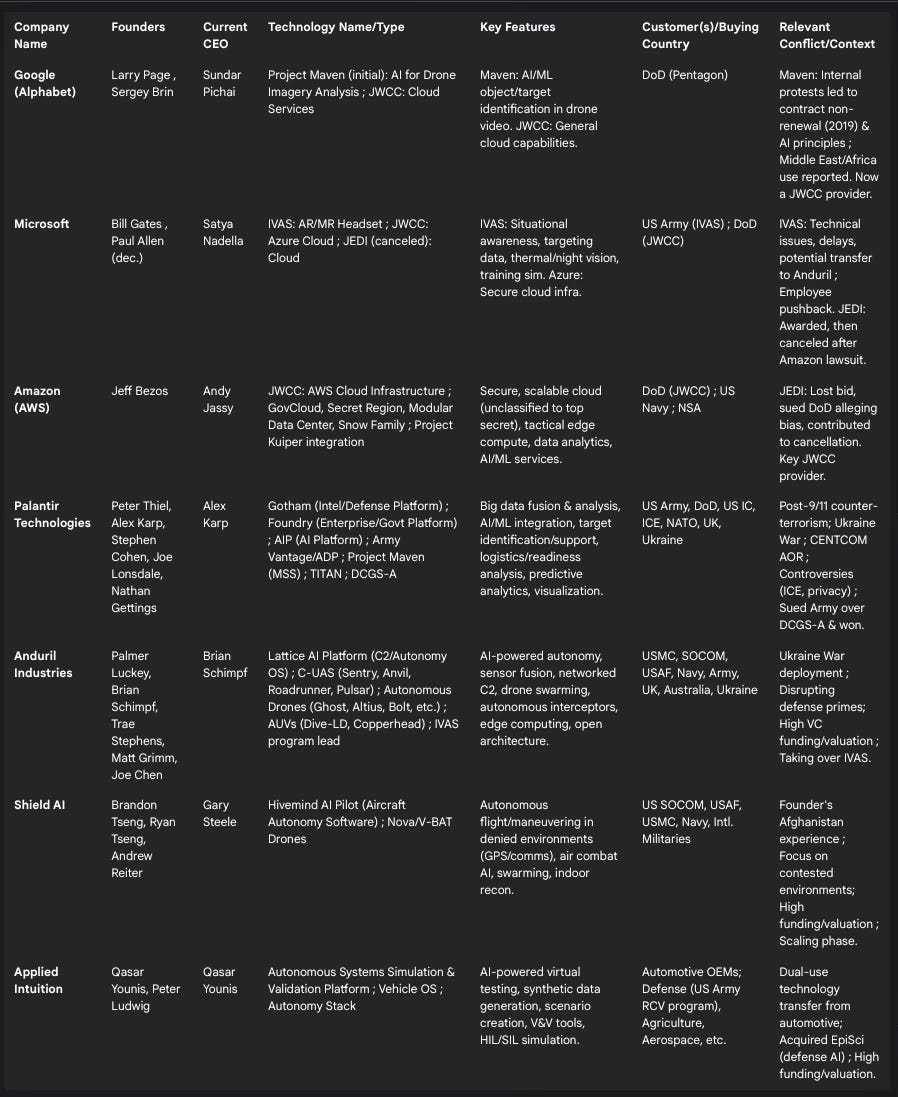
Google (Alphabet)
Leadership: Founded in 1998 by Stanford PhD students Larry Page and Sergey Brin, Google, now under the parent company Alphabet Inc., is led by CEO Sundar Pichai, who holds the CEO position for both Google and Alphabet.49 Page and Brin remain influential shareholders but stepped back from daily operations in 2019.49
Technology and Features: Google's most prominent and controversial involvement in military technology was its participation in the DoD's Project Maven.8 This project aimed to use AI and machine learning to accelerate the analysis of vast amounts of full-motion video footage captured by military drones, automatically identifying objects, vehicles, and potentially targets.9 The goal was to improve the efficiency of intelligence analysis and potentially enhance the precision of drone operations.8 Google executives described their specific contribution as relatively limited, primarily involving the application of existing, open-source AI algorithms.21 Beyond Maven, Google Cloud is now positioned to provide general cloud computing services to the DoD as one of the awardees of the multi-billion dollar JWCC contract.31
Customer and Context: The direct customer for Google's Maven work was the US Pentagon.8 While Maven technology was reportedly used in operations in the Middle East and Africa 21, Google's involvement sparked significant internal backlash. In 2018, over 4,000 employees signed a petition demanding Google cease its involvement and adopt a policy against building "warfare technology," with dozens resigning in protest.8 This employee activism, rooted in ethical concerns about contributing to potentially lethal military applications, successfully pressured Google leadership.5 Consequently, Google announced it would not renew its Maven contract upon its expiration in 2019 and subsequently published a set of AI Principles, pledging not to develop AI for weapons or technologies whose primary purpose is injury, while also avoiding surveillance violating international norms.20 The Maven controversy became a landmark event, igniting broader public and industry debate about the role of AI in warfare and the responsibilities of tech companies.5 Despite this history, Google's participation in the JWCC contract indicates a continued, albeit perhaps more infrastructural and less directly application-focused, engagement with the DoD.31 This path allows Google to engage with the lucrative defense market while potentially avoiding the direct ethical conflicts associated with weapons systems development, reflecting a strategic navigation of complex ethical and business considerations.
Microsoft
Leadership: Founded in 1975 by Bill Gates and Paul Allen (deceased), Microsoft is currently led by CEO Satya Nadella, who took over from Steve Ballmer in 2014.52
Technology and Features: Microsoft's most significant recent defense project is the Integrated Visual Augmentation System (IVAS) for the U.S. Army, based on its commercial HoloLens 2 mixed-reality headset.36 IVAS aims to provide soldiers with a heads-up display integrating real-world views with digital information, including holographic maps, targeting data, friendly/enemy positions, thermal and night vision feeds, and the ability to view feeds from weapon sights or external sensors.36 The system is intended as a multi-purpose platform for combat operations ("fight"), mission rehearsal, and virtual training ("rehearse and train").36 Microsoft is also a major cloud provider to the DoD through the JWCC contract via its Azure platform 27 and was the original sole awardee of the canceled $10 billion JEDI contract.28
Customer and Context: The primary customer for IVAS is the U.S. Army.36 The program, initiated under the first Trump administration with a potential value of up to $22 billion over 10 years 36, has encountered substantial difficulties. Field testing revealed significant problems, including soldier complaints of physical discomfort (nausea, dizziness, eyestrain), poor low-light sensor performance, and system reliability issues.37 These challenges led to program delays, restructuring into multiple iterations (IVAS 1.0, 1.1, 1.2 with redesigned hardware), and prompted the Army to consider a full recompete under the "IVAS Next" initiative.37 Reflecting these struggles, in February 2025, Microsoft announced a plan to transfer leadership of the IVAS program—including hardware/software development and production oversight—to defense tech startup Anduril Industries, pending government approval.37 Microsoft would remain involved, primarily as the preferred cloud provider via Azure.37 Similar to Google's Maven experience, Microsoft also faced internal dissent from employees objecting to the development of HoloLens technology for battlefield applications designed to increase lethality.55 The IVAS program's trajectory underscores the significant challenges in adapting sophisticated commercial technology for the rigors and specific requirements of military deployment, particularly for close combat. The potential handover to Anduril may signal a strategic realignment for Microsoft, focusing on its strengths in cloud and software while acknowledging the specialized expertise required for military hardware integration, simultaneously highlighting the growing capability and ambition of newer defense tech firms to tackle complex, high-stakes programs.
Amazon (AWS)
Leadership: Founded by Jeff Bezos in 1994, Amazon is now led by CEO Andy Jassy, who previously founded and led Amazon Web Services (AWS).57 Matt Garman currently serves as CEO of AWS.57 Jeff Bezos remains Executive Chair.57
Technology and Features: Amazon's primary role in the defense sector is through its cloud computing division, AWS. AWS is one of the four prime contractors awarded the $9 billion Joint Warfighting Cloud Capability (JWCC) contract, providing foundational cloud infrastructure to the DoD.27 AWS offers specialized government-focused cloud regions like AWS GovCloud (US) and AWS Secret Region, designed to meet stringent security and compliance requirements.27 Key features include secure and scalable compute, storage, networking, advanced data analytics, and AI/ML services deployable across unclassified, secret, and top-secret classification levels.27 AWS also provides solutions for the tactical edge, such as the AWS Modular Data Center and the AWS Snow Family of ruggedized devices, enabling cloud capabilities in remote or disconnected environments.32 Additionally, AWS is integrating with Amazon's Project Kuiper satellite constellation to offer global satellite communications capabilities relevant to defense needs.32 AWS also reportedly holds a major $10 billion cloud contract with the National Security Agency (NSA), codenamed "Wild and Stormy".27
Customer and Context: AWS's main defense customer is the U.S. Department of Defense via the JWCC contract.27 It also holds specific contracts with branches like the U.S. Navy (including support for Project Overmatch) and potentially the NSA.27 AWS was a central figure in the controversy surrounding the canceled JEDI contract. After losing the $10 billion single-award contract to Microsoft in 2019, Amazon filed a high-profile lawsuit against the DoD, alleging that the award process was tainted by "unmistakable bias" and improper political influence from the Trump administration due to President Trump's public feud with Jeff Bezos.31 While a DoD Inspector General report did not find conclusive evidence of White House interference impacting the award decision, it noted obstruction from White House officials during the investigation.29 The protracted legal battle and associated delays were significant factors contributing to the Pentagon's eventual decision to cancel JEDI in July 2021 and pivot to the multi-cloud JWCC approach.31 Amazon's vigorous legal pursuit underscores the immense strategic and financial stakes involved in foundational defense cloud contracts. Its prominent role in JWCC now solidifies the critical reliance of modern military operations on commercial cloud infrastructure for everything from enterprise IT to tactical data processing and AI enablement at the edge. The shift to JWCC, influenced by the JEDI fallout, reflects a DoD strategy favoring flexibility, resilience, and leveraging the specific strengths of multiple major cloud providers.
Palantir Technologies
Leadership: Founded in 2003 by a group including PayPal co-founder Peter Thiel, Alex Karp, Stephen Cohen, Joe Lonsdale, and Nathan Gettings.48 Alex Karp serves as the current CEO.48
Technology and Features: Palantir specializes in big data analytics software platforms. Its core offerings include Palantir Gotham, designed primarily for defense and intelligence community users 48, and Palantir Foundry, initially aimed at commercial enterprises but also used extensively by government clients.48 The company also offers Palantir Apollo for software deployment and management 61 and Palantir AIP, an Artificial Intelligence Platform designed to integrate large language models and AI into operational workflows.61 Key military programs utilizing Palantir software include the U.S. Army's Vantage / Army Data Platform (ADP), a service-wide system for data integration and analysis 24; the DoD's Project Maven, specifically through the Maven Smart System (MSS) for AI-powered ISR analysis and targeting 17; the Army's Tactical Intelligence Targeting Access Node (TITAN) ground station program 24; and the Army's Distributed Common Ground System-Army (DCGS-A) intelligence analysis platform.62 Features across these platforms center on integrating vast, disparate datasets (structured and unstructured, including ISR feeds, sensor data, personnel records, logistics information, etc.), applying AI/ML for analysis and pattern recognition, providing advanced visualization tools, supporting predictive analysis, enabling secure collaboration, and facilitating data-driven decision-making for missions ranging from counter-terrorism and intelligence analysis to readiness tracking, logistics optimization, and targeting support.11
Customer and Context: Palantir's origins lie in serving the U.S. Intelligence Community (CIA funding via In-Q-Tel was crucial early on 59) and the DoD, particularly in the post-9/11 counter-terrorism context.48 Its customer base has expanded significantly to include the U.S. Army (major client), various DoD components, international allies (NATO, UK), Ukraine (Gotham used in the current conflict 26), and controversial domestic agencies like U.S. Immigration and Customs Enforcement (ICE).17 The company's work, particularly its contracts with ICE allegedly facilitating deportations 48 and the general nature of its surveillance-enabling technology 11, has generated significant controversy and criticism from human rights groups and privacy advocates.11 Palantir also famously challenged the U.S. Army's procurement process for the DCGS-A program in court in 2016 and won, forcing the Army to consider commercial solutions and ultimately winning a major contract for the system.62 This legal victory presaged the more disruptive approach taken by newer defense tech entrants. Palantir's trajectory from a secretive startup heavily reliant on intelligence contracts to a publicly traded company 48 with major contracts across the DoD (like the $619M ceiling Army Vantage deal 94 and the $480M Maven contract 17) demonstrates the significant military demand for its sophisticated data integration and AI capabilities, despite ongoing ethical scrutiny. It exemplifies a company deeply embedded in the defense and intelligence ecosystem, blurring traditional lines between tech firm and defense contractor.
Anduril Industries
Leadership: Founded in 2017 by a team including Palmer Luckey (founder of Oculus VR), Brian Schimpf (former Palantir engineer), Trae Stephens (venture capitalist at Founders Fund), Matt Grimm, and Joseph Chen.6 Brian Schimpf serves as CEO, with Trae Stephens as Executive Chairman.6
Technology and Features: Anduril develops a range of advanced military technologies centered around its Lattice AI software platform, which acts as an open operating system for command and control, sensor fusion, and mission autonomy.6 Key hardware includes Counter-Unmanned Aerial Systems (C-UAS) featuring Sentry Towers (persistent surveillance), Anvil (kinetic interceptor drone), Roadrunner/Roadrunner-M (reusable, high-explosive interceptor), and Pulsar (electronic warfare system).13 They produce various autonomous drones (UAS) like Ghost/Ghost-X (ISR), Altius (long-range ISR/loitering munition), Fury (multi-mission AAV), Barracuda (cruise missile AAV), and Bolt/Bolt-M (man-portable ISR/loitering munition).3 Anduril also develops Autonomous Underwater Vehicles (AUVs) like Dive-LD and Copperhead 2, counter-intrusion systems 41, and is involved in hypersonic technology development.41 Notably, Anduril is poised to take over the U.S. Army's IVAS program from Microsoft 16 and participates in the Air Force's Advanced Battle Management System (ABMS) / JADC2 efforts.16 Core features emphasize AI-driven autonomy, real-time sensor fusion via Lattice for a unified operational picture, autonomous threat detection/tracking/identification/neutralization (especially for drones), networked operations enabling drone swarms, edge computing for operations in denied environments, and an open architecture facilitating integration and rapid upgrades.6
Customer and Context: Anduril has rapidly secured contracts across multiple branches of the U.S. military and allied nations. Key customers include the U.S. Marine Corps (a $642 million, 10-year I-CsUAS contract for base defense 38, and a $200M MADIS C-UAS contract 38), U.S. Special Operations Command (SOCOM) 42, U.S. Department of Homeland Security 42, U.S. Air Force (ABMS) 16, U.S. Navy 41, and the U.S. Army (via the IVAS transfer).16 International customers include the UK Royal Navy 42, the Australian DoD 42, and Ukraine, where systems like Ghost-X and Altius have been deployed in the ongoing conflict.12 Anduril explicitly positions itself as a disruptor to the traditional defense industrial base, emphasizing speed and software-centric solutions.13 The company has attracted substantial venture capital funding (over $3.7 billion total) and achieved a high valuation (estimated $14 billion in late 2024).19 It is investing heavily in scaling production, including building a large manufacturing facility, Arsenal-1.38 Anduril's rapid rise, significant contract wins, and potential takeover of the troubled IVAS program signify its emergence as a major player in the defense technology sector, embodying the potential of VC-backed, software-focused startups to challenge incumbents and shape the future of warfare with integrated autonomous systems.
Shield AI
Leadership: Founded in 2015 by former Navy SEAL Brandon Tseng, his brother Ryan Tseng, and Andrew Reiter.19 In May 2024, experienced tech executive Gary Steele (former CEO of Splunk) was appointed CEO to lead the company's scaling efforts, with Ryan Tseng transitioning to President.67
Technology and Features: Shield AI's core technology is Hivemind, an AI software stack designed to serve as an autonomous pilot for various aircraft, including drones and potentially fighter jets.7 Hivemind enables aircraft to navigate and execute complex missions autonomously, critically, even in environments where GPS signals are denied or communications are jammed.7 Its capabilities range from indoor reconnaissance and room clearing (demonstrated with their Nova quadcopter 66) to highly dynamic aerial maneuvers, including penetrating sophisticated air defenses and engaging in air-to-air combat (dogfighting), which has been tested in simulation against F-16 models.7 The AI uses advanced algorithms for real-time planning, mapping, state estimation, and employs reinforcement learning to develop and execute tactical maneuvers and strategies.7 Hivemind is also designed to enable intelligent teaming or swarming of multiple autonomous aircraft.68 The platform includes components like EdgeOS (onboard software), Pilot (decision engine), Commander (mission planning/C2), and Forge (simulation/development environment).7 The technology aims to enhance mission effectiveness, reduce risk to human pilots, and potentially address military pilot shortages.68 Shield AI also produces hardware, such as the Nova drone and the V-BAT VTOL UAS.66
Customer and Context: Shield AI's customers include various branches of the U.S. military, such as U.S. Special Operations Command (SOCOM), the U.S. Air Force (where it's involved in JADC2 efforts 43), the U.S. Marine Corps, and the U.S. Navy, as well as international military clients.66 The company also offers Hivemind Enterprise for integration by other defense contractors and government entities.19 The company's founding was inspired by co-founder Brandon Tseng's combat experiences as a Navy SEAL in Afghanistan, highlighting the need for better reconnaissance in dangerous close-quarters situations.66 Shield AI has achieved significant financial backing, reaching a valuation of $5.3 billion after a $240 million funding round in early 2025, with total funding exceeding $1.3 billion.19 The recent appointment of Gary Steele as CEO signals a strategic focus on scaling operations and maturing the business.67 Shield AI's focus on AI pilots places it at the forefront of military autonomy, tackling some of the most challenging aspects of autonomous flight in contested environments and complex combat scenarios, potentially paving the way for future concepts like autonomous loyal wingmen and drone swarms.
Applied Intuition
Leadership: Founded in 2017 by Qasar Younis and Peter Ludwig, both with backgrounds in the automotive industry and at Google.19 Qasar Younis serves as CEO, and Peter Ludwig is the CTO.40
Technology and Features: Applied Intuition specializes in developing software tools for the simulation, testing, and validation of autonomous systems.19 While its initial and primary focus has been on the automotive industry (supporting Advanced Driver-Assistance Systems (ADAS) and Automated Driving (AD) development), the company is actively extending its platform to the defense sector, as well as other industries like agriculture, construction, mining, and aerospace.19 Their product suite includes tools for creating realistic virtual scenarios (Object Sim, Sensor Sim), re-simulating real-world driving data (Log Sim), running simulations at scale in the cloud or on-premise (Cloud Engine), modeling vehicle dynamics (VehicleSim), and conducting hardware-in-the-loop (HIL) and software-in-the-loop (SIL) testing.71 Key features include AI-powered tools for generating synthetic data, automatically creating complex test scenarios, deterministic simulation for reproducibility, and comprehensive validation workflows designed to ensure safety and reliability and shorten development cycles by reducing reliance on costly physical testing.19 They also offer a Vehicle OS platform and an autonomy stack.72
Customer and Context: Applied Intuition counts 18 of the top 20 global automotive manufacturers among its customers.73 In the defense realm, it is working with the U.S. Army on the Robotic Combat Vehicle (RCV) program, providing tools to accelerate autonomy development 40, and targets defense contractors as customers.112 The company's move into defense was significantly bolstered by its acquisition of EpiSci, a company specializing in AI and autonomy software for national security applications.19 This acquisition clearly signals Applied Intuition's strategic intent to leverage its simulation expertise, honed in the demanding automotive sector, for military applications. The company is well-funded, achieving a $6 billion valuation after its Series E round, having raised over $600 million.40 Applied Intuition represents a key example of the dual-use technology phenomenon, where sophisticated tools developed for the commercial market find direct applicability in meeting critical defense needs, particularly the essential requirement to rigorously test and validate the increasingly complex AI driving autonomous military systems before deployment.
4. Critical Technology Domains Shaping Modern Warfare
The convergence of commercial technology and military requirements is most pronounced in several key domains that are fundamentally altering the character of warfare.
Artificial Intelligence and Machine Learning
AI and ML are arguably the most transformative technologies being integrated into military systems. Their applications span the entire spectrum of military operations. Target recognition, pioneered in programs like Project Maven, uses AI to automatically sift through vast amounts of ISR data (like drone video feeds) to identify objects or activities of interest, significantly speeding up analysis that previously required extensive human effort.8 Companies like Anduril leverage AI within their Lattice platform for similar automated detection, tracking, and classification functions.6 Beyond recognition, AI is employed for predictive analysis, helping anticipate enemy actions or logistical needs, a core capability offered by platforms like Palantir's Gotham and Foundry.61
Crucially, AI is moving towards enabling autonomous decision-making and action. Shield AI's Hivemind acts as an AI pilot capable of complex aerial maneuvers and combat tactics 7, while Anduril's Lattice facilitates autonomous mission execution for its integrated systems.6 AI also optimizes backend processes, from logistics and personnel management (as seen in Palantir's Army Vantage platform 62) to enhancing the realism and effectiveness of training simulations provided by companies like Applied Intuition.71 Key players in this space include not only the large platform providers like Palantir, Anduril, and Shield AI, but also specialized firms like Clarifai and Rebellion Defense, alongside the AI research arms of giants like Microsoft and potentially Google (despite its Maven withdrawal).3
The significance of AI lies in its potential to drastically shorten decision cycles (the OODA loop – Observe, Orient, Decide, Act), automate labor-intensive tasks, make sense of overwhelming data streams, and empower autonomous systems, all seen as vital for maintaining a competitive military edge in the modern era.4 However, this increasing capability, particularly the move from AI as an analysis tool to an enabler or even executor of kinetic actions (autonomous targeting, AI pilots), inevitably raises profound ethical questions about human control, accountability, and the potential for unintended escalation. This ethical dimension drives the need for extremely robust testing, validation, and verification (V&V) processes, creating a market for specialized simulation and testing providers like Applied Intuition.
Autonomous Systems and Robotics
Closely linked to AI, the field of autonomous systems is rapidly expanding military capabilities across all domains. Unmanned Aerial Vehicles (UAVs or drones) are perhaps the most visible manifestation, employed extensively for ISR, targeting, and direct strikes. Companies like Anduril offer a portfolio ranging from man-portable ISR/strike drones (Ghost, Bolt) to longer-range systems (Altius, Fury) and even air-launched cruise missiles (Barracuda).14 Shield AI produces the Nova quadcopter for indoor operations and the V-BAT VTOL platform 66, while other players like Skydio also contribute.3
The proliferation of offensive drone capabilities has simultaneously fueled demand for Counter-UAS (C-UAS) systems. Anduril is a major player here, offering layered defenses integrating sensors (Sentry Towers) with kinetic effectors (Anvil drone, Roadrunner missile) and non-kinetic options (Pulsar EW), all orchestrated by their Lattice software.38
Autonomy is also extending to ground and maritime domains. Startups like Overland AI focus on Unmanned Ground Vehicles (UGVs) 19, while companies like Saildrone develop Unmanned Surface Vehicles (USVs) 3, and Anduril produces Autonomous Underwater Vehicles (AUVs) like Dive-LD and Copperhead.2 Traditional defense contractors like HII are also investing in UUVs.2
A key development is the move towards collaborative autonomy or swarming, where multiple autonomous systems operate as a networked team.12 This concept, enabled by sophisticated software like Anduril's Lattice or Shield AI's Hivemind, holds the potential to overwhelm defenses or perform complex tasks beyond the capability of single platforms. The extensive use of drones in the Ukraine conflict has starkly illustrated their impact on modern battlefields, driving further investment and development.3
The significance of autonomy lies in its ability to reduce risk to human personnel, provide persistent surveillance and presence, enable operations in heavily contested or denied environments, and potentially alter traditional force structures by substituting numerous, cheaper autonomous systems for fewer, more expensive manned platforms. However, the true value and effectiveness of these autonomous systems increasingly depend not just on the hardware, but on the sophisticated AI and software (like Lattice and Hivemind) that enables intelligent behavior, collaboration, and cross-domain integration. This software layer is becoming the critical enabler, and consequently, developing effective counter-autonomy measures (C-UAS, EW) is rapidly becoming just as vital.
Cloud Computing and Data Infrastructure
Modern military operations generate and depend on staggering amounts of data. Commercial cloud computing offers the scalable, resilient, and accessible infrastructure needed to store, process, and analyze this data effectively. The DoD's JWCC contract, valued at up to $9 billion, represents a major commitment to leveraging commercial cloud capabilities from providers like AWS, Microsoft Azure, Google Cloud, and Oracle.27
Cloud infrastructure serves as the backbone for numerous advanced capabilities. It hosts the platforms for large-scale AI/ML model training and deployment required for programs like Maven.17 It underpins data-intensive initiatives like JADC2, which requires seamless data sharing and processing across domains.17 Cloud platforms also provide the environment for massive data fusion and analytics performed by systems like Palantir's Vantage/Gotham.62 Critically, cloud providers are developing solutions to extend these capabilities to the "tactical edge"—forward-deployed units operating in potentially disconnected or low-bandwidth environments. Technologies like AWS's Modular Data Center and Snow Family are designed to bring significant compute and storage power closer to the warfighter.32 Furthermore, secure cloud environments capable of handling data across multiple classification levels (unclassified, secret, top secret) are essential for military operations.31
The strategic importance of cloud is undeniable. The transition from the troubled single-award JEDI contract to the multi-award JWCC framework suggests a deliberate DoD strategy. This shift likely aims to avoid vendor lock-in, enhance resilience by utilizing multiple providers, foster competition, and allow different military components to leverage the specific strengths or specialized offerings of each major cloud service provider (CSP). This multi-cloud approach reflects a maturing understanding within the DoD of how best to integrate commercial cloud capabilities to meet diverse and evolving mission requirements.
Advanced Surveillance, Reconnaissance, and Data Fusion
The effectiveness of modern military forces hinges on achieving and maintaining situational awareness. This requires sophisticated surveillance and reconnaissance capabilities coupled with the ability to rapidly fuse data from a multitude of sensors—drones, satellites, ground-based sensors, cyber intelligence, human intelligence, and more—into a coherent and actionable common operating picture (COP).
Platforms like Anduril's Lattice 6 and Palantir's Gotham 61 are explicitly designed for this data fusion task, integrating diverse data streams in real-time. AI plays a critical role here, particularly in analyzing the massive volume of data generated by modern ISR assets, as exemplified by Project Maven's focus on drone video analysis.8 Persistent surveillance is another key aspect, enabled by systems like Anduril's Sentry Towers which provide continuous monitoring of perimeters or borders.13 The goal is to overcome traditional data silos, where information collected by one system or unit is not easily accessible or usable by others, and provide commanders and operators with timely, relevant intelligence to support faster and better decision-making.6
The development of advanced effectors, whether precision munitions or autonomous systems, is intrinsically linked to the quality of the intelligence picture. Accurate targeting and effective autonomous operations rely heavily on the fused data provided by these advanced surveillance and C2 platforms. This creates a critical interdependence within the modern military technology ecosystem: sensors collect data, AI analyzes and fuses it, C2 platforms present it, and effectors act upon it. The speed and accuracy of this entire cycle are paramount.
Augmented and Mixed Reality (AR/MR)
AR/MR technology holds the potential to significantly enhance the capabilities of individual warfighters by overlaying digital information onto their perception of the physical world. The U.S. Army's IVAS program, based on Microsoft's HoloLens, is the most prominent example.36 IVAS aims to provide soldiers with a heads-up display showing navigation cues, targeting information, friendly force locations, integrated thermal/night vision, and potentially data feeds from external sensors like drone cameras or weapon sights.36 AR/MR also offers powerful tools for immersive training, allowing soldiers to practice scenarios in realistic virtual environments using systems like the Squad Immersive Virtual Trainer (SiVT), which leverages IVAS hardware.81 Companies like Red6 are applying similar AR concepts to advanced pilot training simulations.19
Despite the high potential, the path to deploying effective AR/MR on the battlefield has proven challenging. The IVAS program, despite significant investment and based on mature commercial technology (HoloLens 2), has faced major setbacks related to hardware ruggedization, ergonomics (weight, comfort, causing nausea), display limitations (field-of-view, low-light performance), and overall system reliability.37 These difficulties suggest that while AR/MR holds promise, the technology for widespread deployment in demanding ground combat environments may still be less mature compared to advancements in cloud computing or AI-driven data analysis for defense. Significant hurdles remain in creating devices that are simultaneously powerful, reliable, rugged, and comfortable enough for extended battlefield use.
5. Navigating the Defense Procurement Landscape
The integration of commercial technology into the military sphere is shaped not only by technological possibilities but also by the complex processes of defense procurement, landmark government contracts, and the evolving relationships between the DoD, established contractors, and new tech entrants.
Landmark Contracts and Programs
Several major contracts and programs serve as bellwethers for the trends in tech-defense collaboration:
Project Maven: Initiated around 2017, Maven was the DoD's flagship effort to rapidly adopt AI/ML for analyzing ISR data, primarily drone video feeds, to improve intelligence processing and targeting.8 Google's initial involvement and subsequent withdrawal due to employee protests 5 brought significant attention to the ethical dimensions of military AI. Palantir has since become a key contractor for the program, now often referred to as the Maven Smart System (MSS), securing a $480 million Army contract and a separate deal with NATO.17 Other AI companies like Clarifai have also participated.19 Maven exemplifies the military's push for AI adoption and the controversies that can arise.
JEDI and JWCC: The Joint Enterprise Defense Infrastructure (JEDI) program aimed to provide a single, enterprise-wide cloud solution for the DoD, a contract potentially worth $10 billion.28 Awarded to Microsoft in 2019, it was immediately challenged in court by losing bidder Amazon (AWS), alleging political interference by the Trump administration.31 The ensuing legal battle and delays, coupled with evolving DoD requirements, led to JEDI's cancellation in 2021.31 It was replaced by the Joint Warfighting Cloud Capability (JWCC), a $9 billion multi-award, multi-cloud contract vehicle awarded to AWS, Microsoft, Google Cloud, and Oracle.27 This shift signifies a major change in DoD cloud strategy towards flexibility and leveraging multiple commercial providers.
IVAS: The Integrated Visual Augmentation System program represents a potential $22 billion investment by the U.S. Army in soldier-worn AR/MR technology based on Microsoft's HoloLens.36 However, technical failures and soldier feedback issues have plagued the program, leading to delays and redesigns.37 The proposed transfer of program leadership from Microsoft to Anduril Industries underscores the difficulties and the evolving role of defense tech startups.37
Army Vantage / ADP: This program highlights Palantir's deep integration with the U.S. Army, providing a central data platform for analytics across numerous domains like readiness, logistics, and personnel management, under contracts with ceilings exceeding $600 million.24
Anduril I-CsUAS: Anduril's $642 million, 10-year contract with the U.S. Marine Corps for counter-drone base defense showcases the significant investment in C-UAS capabilities and the ability of newer companies to win large, long-term programs of record.38
These major programs demonstrate the scale of DoD spending on key technology areas and how contracts awarded to tech companies are shaping future military capabilities. The controversies and strategic shifts observed in programs like Maven, JEDI/JWCC, and IVAS also reveal the inherent complexities, potential for political influence, and ongoing evolution within defense acquisition as it adapts to the pace of commercial technology.
Procurement Mechanisms and Partnerships
Recognizing that traditional, slow-moving acquisition processes are often ill-suited for harnessing rapid commercial innovation, the DoD has employed various mechanisms to engage more effectively with the tech industry, especially startups:
Alternative Acquisition Pathways: Mechanisms like Other Transaction Authority (OTAs) are increasingly used by organizations like the Defense Innovation Unit (DIU) and Army Futures Command to fund rapid prototyping and experimentation, bypassing some traditional bureaucratic hurdles.1 Programs like the Small Business Innovation Research (SBIR) and Small Business Technology Transfer (STTR) provide non-dilutive funding for early-stage companies, acting as a "license to hunt" for larger contracts.1 Specific funding initiatives like STRATFI, TACFI, APFIT, and RDER also aim to accelerate technology transition.1
Partnerships: Collaboration is often essential for navigating the complex defense ecosystem. Startups may partner with established prime contractors (like Lockheed Martin, Northrop Grumman, etc.) to gain access to existing programs, leverage institutional knowledge, and meet complex requirements.1 Partnerships between technology companies themselves are also prevalent, allowing firms to combine complementary expertise, such as Anduril's collaborations with Microsoft (IVAS), OpenAI (AI), Aalyria (networking), and Epirus (EW) 11, or Palantir's partnerships with other AI firms.24
Persistent Challenges: Despite these efforts, significant barriers remain for tech companies, particularly startups. Defense sales cycles can take years, compliance requirements are stringent (e.g., DD Form 254 for classified work), and navigating the complex funding and requirement processes demands specialized knowledge.1 Intellectual property rights can be a concern in collaborative agreements like Cooperative Research & Development Agreements (CRADAs).1 Furthermore, successfully transitioning a technology from a prototype or SBIR phase into a large-scale, funded program of record (crossing the "Valley of Death") remains a persistent challenge.4
The DoD's procurement landscape is clearly evolving to better accommodate commercial technology and startups. However, systemic hurdles persist, meaning successful engagement often requires strategic navigation of specific contracting vehicles and leveraging partnerships. The very success of disruptive startups is forcing a continual re-evaluation of long-standing acquisition practices.
Ethical Considerations and Controversies
The increasing integration of advanced technology, particularly AI, into warfare brings significant ethical considerations and public controversies to the forefront:
AI in Warfare: The potential use of AI for lethal purposes, especially in drone targeting and autonomous weapons systems, remains highly contentious. The Google/Project Maven controversy serves as a stark example, where employee concerns about contributing to "warfare technology" led to the company's withdrawal.8 This sparked ongoing debates about the need for human control over lethal force, the risks of algorithmic bias, and the potential for unintended escalation driven by AI speed.11 Calls for clear ethical guidelines and even international treaties governing autonomous weapons persist.9
Surveillance and Privacy: Companies like Palantir, whose core business involves aggregating and analyzing vast amounts of data for government and intelligence agencies, face persistent criticism regarding mass surveillance, data privacy infringements, and potential human rights impacts, particularly concerning their work with agencies like ICE.11 The power of these data analysis tools raises fundamental questions about government oversight and civil liberties.
Employee Activism: A notable trend is the rise of activism among tech workers. Google employees demonstrated significant influence over the Maven contract 8, and Microsoft workers voiced objections to the IVAS contract's potential applications.55 The formation of groups like the Alphabet Worker's Union 20 suggests a growing willingness among employees to challenge corporate decisions on ethical grounds, potentially acting as an internal check on involvement in controversial defense projects.5
Dual-Use Dilemma: Many technologies being adopted by the military, from AI algorithms to cloud platforms and AR headsets, have origins or primary applications in the civilian sector.5 This dual-use nature creates inherent ethical tensions, as tools developed for benign purposes can be repurposed for potentially harmful military applications.
Transparency and Accountability: The often-secretive nature of defense contracts and the complexity of the technologies involved can hinder public understanding and accountability, fueling distrust.23 Companies like Palantir often defend their work by emphasizing national security needs, while critics demand greater transparency about how these powerful tools are being used.5
Ethical challenges are not peripheral but central to the convergence of technology and defense. They influence corporate strategy, employee relations, public perception, and policy debates. Navigating this complex terrain requires balancing national security imperatives with fundamental concerns about human rights, privacy, accountability, and the very morality of automating warfare.
6. Conclusion: The Future Trajectory of Tech in Warfare
The evidence presented in this report points towards an undeniable and accelerating fusion of advanced commercial technology with military operations. This convergence is not merely incremental; it is fundamentally reshaping the tools, tactics, and strategic considerations of modern warfare. Several key trends define this trajectory:
Software-Defined Warfare: Increasingly, military capabilities are being defined not just by the physical hardware of platforms (jets, ships, tanks) but by the software that controls them and integrates them into larger networks. Platforms like Anduril's Lattice and Shield AI's Hivemind exemplify this shift, offering adaptable, upgradeable, and interoperable systems where software updates can rapidly introduce new capabilities or tactics.6 This software-centric approach promises greater flexibility and responsiveness compared to traditional hardware development cycles.
The AI-Infused Battlefield: Artificial intelligence is moving beyond backend analysis and decision support towards direct involvement in operational tasks, including autonomous navigation, targeting, and even combat maneuvers.7 The pursuit of AI pilots, autonomous targeting systems, and sophisticated human-machine teaming indicates a future where AI plays an increasingly integral role in sensing, deciding, and acting on the battlefield, potentially at speeds exceeding human capacity. This raises critical questions about command and control, reliability, and the potential for rapid, unforeseen escalation.
Autonomy and Evolving Force Structures: The proliferation of relatively inexpensive, highly capable autonomous systems, particularly drones operating individually or in swarms, has the potential to significantly alter traditional military force structures.12 These systems can perform tasks previously requiring manned platforms, often with reduced risk and greater persistence, potentially leading to shifts in personnel requirements, training paradigms, and operational concepts. The effectiveness demonstrated by drones in recent conflicts provides a glimpse into this future.12
Persistent Challenges: Despite the rapid advancements, significant challenges remain. Reforming defense procurement to better accommodate the speed and culture of the tech industry is an ongoing effort.1 Bridging the gap between commercial-grade technology and the demanding requirements of military ruggedness, reliability, and security, as highlighted by the IVAS program, remains difficult.37 Ensuring the resilience and security of these software-dependent systems, especially in contested communication environments, is paramount.7 Finally, the ethical dilemmas surrounding AI, autonomy, and surveillance will continue to demand careful consideration, policy development, and public debate.5
In conclusion, the integration of technology companies and their innovations into the fabric of national defense is an irreversible trend with profound implications. It promises enhanced capabilities and potentially greater efficiency, but also introduces new complexities and ethical considerations. Military forces, technology developers, and policymakers must continually adapt to navigate this dynamic landscape, ensuring that technological advancements serve strategic goals responsibly and effectively in an increasingly complex global security environment.

Works cited
DoD Contracting for Startups 101 | Andreessen Horowitz, accessed May 2, 2025, https://a16z.com/dod-contracting-for-startups-101/
The Top 10 U.S. Aerospace and Defense Contractors - USFunds, accessed May 2, 2025, https://www.usfunds.com/resource/the-top-10-u-s-aerospace-and-defense-contractors/
Roadmap: Defense Tech - Bessemer Venture Partners, accessed May 2, 2025, https://www.bvp.com/atlas/roadmap-defense-tech
The rise of Silicon Valley's digital defence industry, accessed May 2, 2025, https://www.tni.org/files/2023-04/Militarising%20%20Big%20Tech.pdf
The 'silver lining' in the fallout between Google and Project Maven | FedScoop, accessed May 2, 2025, https://fedscoop.com/project-maven-silver-lining-peter-thiel/
Anduril Industries Business Breakdown & Founding Story - Contrary Research, accessed May 2, 2025, https://research.contrary.com/company/anduril
Shield AI Business Breakdown & Founding Story - Contrary Research, accessed May 2, 2025, https://research.contrary.com/company/shield-ai
Faculty AI's defence chief on the promise and perils of military tech: 'You think about it all the time' - Sifted, accessed May 2, 2025, https://sifted.eu/articles/faculty-ai-defence-mistral-interview
Why Project Maven is a 'moral hazard' for Google - C4ISRNet, accessed May 2, 2025, https://www.c4isrnet.com/it-networks/2018/06/26/why-googles-project-maven-pullout-is-a-moral-hazard/
Future of Warfare: MASSIVE Anduril Arsenal-1 to Produce 'Tens of Thousands' of AI-Powered Weapons - YouTube, accessed May 2, 2025, https://www.youtube.com/watch?v=5qJgeIrLZu4
Silicon Valley's Embrace of Israeli AI-Driven Warfare and Surveillance - ZNetwork, accessed May 2, 2025, https://znetwork.org/znetarticle/silicon-valleys-embrace-of-israeli-ai-driven-warfare-and-surveillance/
UK and Anduril's Attack Drones for Ukraine: A Game-Changer in Modern Warfare, accessed May 2, 2025, https://agincourt.io/uk-and-andurils-attack-drones-for-ukraine-a-game-changer-in-modern-warfare/
Anduril in 2023: A year in review, accessed May 2, 2025, https://www.anduril.com/article/anduril-in-2023-a-year-in-review/
Anduril debuts Bolt, loitering munition on contract with Marine Corps - Defense News, accessed May 2, 2025, https://www.defensenews.com/industry/2024/10/10/anduril-debuts-bolt-loitering-munition-on-contract-with-marine-corps/
The Future of Drones in Ukraine - CSET, accessed May 2, 2025, https://cset.georgetown.edu/article/the-future-of-drones-in-ukraine-ii-a-report-from-the-nato-ukraine-defense-innovators-forum/
Anduril Industries - Wikipedia, accessed May 2, 2025, https://en.wikipedia.org/wiki/Anduril_Industries
NATO inks deal with Palantir for Maven AI system | DefenseScoop, accessed May 2, 2025, https://defensescoop.com/2025/04/14/nato-palantir-maven-smart-system-contract/
Palantir Expands Maven Smart System AI/ML Capabilities to Military Services, accessed May 2, 2025, https://investors.palantir.com/news-details/2024/Palantir-Expands-Maven-Smart-System-AIML-Capabilities-to-Military-Services/
Here Are The Top AI Startups Shaping U.S. Defense - AIM Research, accessed May 2, 2025, https://aimresearch.co/ai-startups/here-are-the-top-ai-startups-shaping-u-s-defense
Case study: Google Workers & Project Maven — The Turing Way, accessed May 2, 2025, https://ttw-rtd.readthedocs.io/en/latest/ethical-research/activism/activism-case-study-google.html
DoD's Cheery 'Project Maven' Seal Features Smiling Warfare Robots - Inverse, accessed May 2, 2025, https://www.inverse.com/article/45423-project-maven-logo-department-of-defense-google
Google backtracks over controversial military drone project Maven, as thousands of employees protest its involvement - City AM, accessed May 2, 2025, https://www.cityam.com/286848-google-backtracks-over-controversial-military-drone-project/
Google Staff Quit Over Military Drone Project | Silicon UK Tech News, accessed May 2, 2025, https://www.silicon.co.uk/e-innovation/research/google-staff-quit-military-drone-project-232399
Army eyes data platform upgrade for 2025 - Defense One, accessed May 2, 2025, https://www.defenseone.com/defense-systems/2024/12/army-eyes-data-platform-upgrade-2025/401870/
Palantir lands $480M Army contract for Maven artificial intelligence ..., accessed May 2, 2025, https://defensescoop.com/2024/05/29/palantir-480-million-army-contract-maven-smart-system-artificial-intelligence/
NATO buys AI-powered military system from Palantir - Harici, accessed May 2, 2025, https://harici.com.tr/en/nato-buys-ai-powered-military-system-from-palantir/
Top Government Contracts Won by Amazon Web Services - ExecutiveGov, accessed May 2, 2025, https://executivegov.com/articles/top-government-contracts-won-by-amazon-web-services/
Pentagon splits giant cloud contract among Amazon, Microsoft, Google, and Oracle, accessed May 2, 2025, https://www.geekwire.com/2022/pentagon-splits-giant-cloud-contract-among-amazon-microsoft-google-and-oracle/
Pentagon IG pushes back on Republicans' criticisms of JEDI review | FedScoop, accessed May 2, 2025, https://fedscoop.com/pentagon-ig-pushes-back-on-republicans-criticisms-of-jedi-review/
Report on the Joint Enterprise Defense Infrastructure (JEDI) Cloud Procurement (DODIG-2020-079), accessed May 2, 2025, https://www.dodig.mil/Reports/All-DoD-OIG-Reports/Article/2150471/report-on-the-joint-enterprise-defense-infrastructure-jedi-cloud-procurement-do/
Pentagon greenlights $9B contract pool for military cloud spending ..., accessed May 2, 2025, https://www.ciodive.com/news/dod-cloud-contract-jwcc/638341/
AWS on JWCC for U.S. Defense | AWS, accessed May 2, 2025, https://aws.amazon.com/federal/defense/jwcc/
US DOD Ends Cloud Drama with $9 Billion Contract to Top Cloud Providers - HPCwire, accessed May 2, 2025, https://www.hpcwire.com/2022/12/08/us-dod-ends-cloud-drama-with-9-billion-contract-to-top-cloud-providers/
accessed January 1, 1970, https://fedscoop.com/jedi-contract-canceled-dod-cloud/
How Much Did Anduril Industries Raise? Funding & Key Investors - Clay, accessed May 2, 2025, https://www.clay.com/dossier/anduril-industries-funding
Army Solicits Info on IVAS Next - GovCon Wire, accessed May 2, 2025, https://www.govconwire.com/2025/01/army-ivas-next-rfi/
Microsoft announces plan to slide $22 billion IVAS contract over to ..., accessed May 2, 2025, https://breakingdefense.com/2025/02/microsoft-announces-plan-to-slide-22-billion-ivas-contract-over-to-anduril/
Anduril confirms $642M deal to defend Marine Corps bases from ..., accessed May 2, 2025, https://defence-blog.com/anduril-confirms-642m-deal-to-defend-marine-corps-bases-from-drones/
The Greatest Victory Requires No War as Shield AI Raises $240M for Military Autonomy, accessed May 2, 2025, https://aimresearch.co/ai-startups/the-greatest-victory-requires-no-war-as-shield-ai-raises-240m-for-military-autonomy
Applied Intuition Business Breakdown & Founding Story - Contrary Research, accessed May 2, 2025, https://research.contrary.com/company/applied-intuition
Anduril: Transforming US & allied military capabilities with advanced ..., accessed May 2, 2025, https://www.anduril.com/
Anduril — The Defense that Never Rests, accessed May 2, 2025, https://www2.dfjgrowth.com/story/anduril-the-defense-that-never-rests/
Microsoft hands over US Army's IVAS program to Anduril, remains preferred cloud provider, accessed May 2, 2025, https://www.datacenterdynamics.com/en/news/microsoft-hands-over-us-armys-ivas-program-to-anduril-remains-preferred-cloud-provider/
Anduril and Microsoft Partner to Advance Integrated Visual Augmentation System (IVAS) Program for the U.S. Army, accessed May 2, 2025, https://www.anduril.com/article/anduril-and-microsoft-partner-to-advance-integrated-visual-augmentation-system-ivas-program-for/
Anduril and Microsoft Partner to Advance Integrated Visual Augmentation System (IVAS) Program for the U.S. Army, accessed May 2, 2025, https://www.anduril.com/article/anduril-and-microsoft-partner-to-advance-integrated-visual-augmentation-system-ivas-program-for
Anduril Secures $642M U.S. Marine Corps Contract for Counter-Drone Systems, accessed May 2, 2025, https://www.defensemirror.com/news/39010/Aduril__642M_C_UAS_Contract
Anduril Awarded 10-Year $642M Program of Record to Deliver CUAS Systems for U.S. Marine Corps, accessed May 2, 2025, https://www.anduril.com/article/anduril-awarded-10-year-642m-program-of-record-to-deliver-cuas-systems-for-u-s-marine-corps/
The History and Evolution of the Palantir Technologies Logo, accessed May 2, 2025, https://companylogos.org/palantir-technologies-logo/
Google - Wikipedia, accessed May 2, 2025, https://en.wikipedia.org/wiki/Google
Are Larry Page and Sergey Brin Still Involved With Google? - SurgeGraph Vertex, accessed May 2, 2025, https://surgegraph.io/business/are-larry-page-and-sergey-brin-still-involved-with-google
Department of Defense Announces Joint Warfighting Cloud Capability Procurement, accessed May 2, 2025, https://www.defense.gov/News/Releases/Release/Article/3239378/department-of-defense-announces-joint-warfighting-cloud-capability-procurement/
From Gates to Nadella: Four leaders who defined Microsoft's 50-year legacy and path in tech history | Malay Mail, accessed May 2, 2025, https://www.malaymail.com/news/tech-gadgets/2025/04/01/from-gates-to-nadella-four-leaders-who-defined-microsofts-50-year-legacy-and-path-in-tech-history/171464
From Gates to Nadella: 50 Years of Microsoft Through 4 Visionary Leaders - Observer, accessed May 2, 2025, https://observer.com/2025/04/microsoft-50-anniversary-leaders/
The Tactical Considerations of Augmented and Mixed Reality Implementation, accessed May 2, 2025, https://www.armyupress.army.mil/Journals/Military-Review/English-Edition-Archives/May-June-2022/Kallberg/
Microsoft workers thumbs down on heads-up displays for war - C4ISRNet, accessed May 2, 2025, https://www.c4isrnet.com/intel-geoint/sensors/2019/02/26/microsoft-roiled-by-fight-over-who-is-responsible-for-making-weapons/
DOD cancels $10 billion JEDI contract at center of Microsoft and Amazon feud - Engadget, accessed May 2, 2025, https://www.engadget.com/department-of-defense-cancels-jedi-contract-172009337.html
Officers and directors - Amazon.com, Inc., accessed May 2, 2025, https://ir.aboutamazon.com/officers-and-directors/default.aspx
Andy Jassy - Wikipedia, accessed May 2, 2025, https://en.wikipedia.org/wiki/Andy_Jassy
Palantir Technologies Inc. (PLTR): history, ownership, mission, how it works & makes money, accessed May 2, 2025, https://dcfmodeling.com/blogs/history/pltr-history-mission-ownership
Palantir, Trump's 'big brother' dominating the stock market | Economy and Business, accessed May 2, 2025, https://english.elpais.com/economy-and-business/2025-03-08/palantir-trumps-big-brother-dominating-the-stock-market.html
Palantir Technologies - Wikipedia, accessed May 2, 2025, https://en.wikipedia.org/wiki/Palantir_Technologies
US Army extends Palantir's contract for its data-harnessing platform - Defense News, accessed May 2, 2025, https://www.defensenews.com/land/2024/12/18/us-army-extends-palantirs-contract-for-its-data-harnessing-platform/
Offerings | Intelligence - Palantir, accessed May 2, 2025, https://www.palantir.com/offerings/intelligence/
Anduril Leadership, accessed May 2, 2025, https://www.anduril.com/leadership/
Marines to lean on Anduril tech to protect bases from drones | DefenseScoop, accessed May 2, 2025, https://defensescoop.com/2025/03/13/marine-corps-anduril-contract-defend-installations-small-uas-drones/
Shield AI - Wikipedia, accessed May 2, 2025, https://en.wikipedia.org/wiki/Shield_AI
Shield AI hires former Splunk chief as CEO - Washington Technology, accessed May 2, 2025, https://www.washingtontechnology.com/companies/2025/03/shield-ai-hires-former-splunk-chief-ceo/403695/
US military letting artificial intelligence 'Hivemind' fly fighter jet - YouTube, accessed May 2, 2025, https://m.youtube.com/watch?v=Yl69PD1KqyA
Closing the Military Divide: How Shield AI Empowers Soldiers for the Future - EnvZone, accessed May 2, 2025, https://envzone.com/closing-the-military-divide-how-shield-ai-empowers-soldiers-for-the-future/
Qasar Younis - Wikipedia, accessed May 2, 2025, https://en.wikipedia.org/wiki/Qasar_Younis
ADAS and AD development platform - Applied Intuition, accessed May 2, 2025, https://www.appliedintuition.com/adas-ad-development-platform
Vehicle OS - Applied Intuition, accessed May 2, 2025, https://www.appliedintuition.com/vehicle-os
Applied Intuition: Vehicle software supplier, accessed May 2, 2025, https://www.appliedintuition.com/
Autonomous vehicle simulation | Applied Intuition, accessed May 2, 2025, https://www.appliedintuition.com/industries/automotive
Peter Ludwig Bio - Congress.gov, accessed May 2, 2025, https://www.congress.gov/118/meeting/house/117651/witnesses/HHRG-118-AS00-Bio-LudwigP-20240916.pdf
Sergey Brin and Larry Page - Lemelson-MIT Program, accessed May 2, 2025, https://lemelson.mit.edu/resources/sergey-brin-and-larry-page
Larry Page - Wikipedia, accessed May 2, 2025, https://en.wikipedia.org/wiki/Larry_Page
Interview: Microsoft CEO Satya Nadella on the tech giant's 50th anniversary — and what's next - GeekWire, accessed May 2, 2025, https://www.geekwire.com/2025/microsoft-ceo-satya-nadella-on-the-tech-giants-50th-anniversary-and-what-comes-next/
Microsoft celebrates 50 years, accessed May 2, 2025, https://news.microsoft.com/microsoft-50/
The Tactical Considerations of Augmented and Mixed Reality Implementation - Army University Press, accessed May 2, 2025, https://www.armyupress.army.mil/Portals/7/PDF-UA-docs/Kallberg-UA.pdf
The Synthetic Training Environment | AUSA, accessed May 2, 2025, https://www.ausa.org/publications/synthetic-training-environment
Army kickstarts possible recompete of Microsoft's $22 billion IVAS production deal, accessed May 2, 2025, https://breakingdefense.com/2025/01/army-kickstarts-possible-recompete-of-microsofts-22-billion-ivas-production-deal/
The 24 Programs the Army Promised to Expedite: Part Five — Training and Simulation, Night Vision - National Defense Magazine, accessed May 2, 2025, https://www.nationaldefensemagazine.org/articles/2023/10/6/the-24-programs-the-army-promised-to-expedite-part-five-training-and-simulation-night-vision
Microsoft HoloLens Loses $22 Billion Life Line to Oculus Founder! - IVAS Contract Ditched, accessed May 2, 2025, https://www.xrtoday.com/mixed-reality/microsoft-hololens-loses-22-billion-life-line-to-oculus-founder-ivas-contract-ditched/
Palmer Luckey Speaks on IVAS Partnership and HoloLens Shakeup - XR Today, accessed May 2, 2025, https://www.xrtoday.com/mixed-reality/palmer-luckey-speaks-on-ivas-partnership-and-hololens-shakeup/
en.wikipedia.org, accessed May 2, 2025, https://en.wikipedia.org/wiki/Andy_Jassy#:~:text=In%20January%202021%2C%20Bezos%20designated,and%20vests%20over%2010%20years.
Amazon CEO Andy Jassy Says Attitude Is the Key to Success | Entrepreneur, accessed May 2, 2025, https://www.entrepreneur.com/business-news/amazon-ceo-andy-jassy-says-attitude-is-the-key-to-success/488975
IG Report Shows Just How Problematic the JEDI Contract Process Has Been, accessed May 2, 2025, https://www.pogo.org/post/ig-report-shows-just-how-problematic-the-jedi-contract-process-has-been
Pentagon IG finds JEDI contract didn't violate law, but ethical questions remain, accessed May 2, 2025, https://www.federaltimes.com/civilian/dhs/2020/04/15/pentagon-ig-finds-jedi-contract-didnt-violate-law-but-ethical-questions-remain/
WATCH: Pentagon cancels disputed JEDI cloud contract with Microsoft | PBS News, accessed May 2, 2025, https://www.pbs.org/newshour/politics/pentagon-cancels-disputed-jedi-cloud-contract-with-microsoft
Joe Lonsdale - Wikipedia, accessed May 2, 2025, https://en.wikipedia.org/wiki/Joe_Lonsdale
Gotham | Palantir, accessed May 2, 2025, https://www.palantir.com/platforms/gotham/
Palantir AIP | Defense and Military - YouTube, accessed May 2, 2025, https://www.youtube.com/watch?v=XEM5qz__HOU&pp=0gcJCdgAo7VqN5tD
Palantir Expands Army Vantage Partnership with $618.9 M Contract, accessed May 2, 2025, https://investors.palantir.com/news-details/2024/Palantir-Expands-Army-Vantage-Partnership-with-618.9M-Contract/
Palantir's Stock Gains After Extending Army Contract Worth $619 Million - Investopedia, accessed May 2, 2025, https://www.investopedia.com/palantir-stock-surges-after-extending-army-contract-worth-usd619-million-8764288
Palantir Expands Army Vantage Partnership with $618.9M Contract – Company Announcement - FT.com - Markets data, accessed May 2, 2025, https://markets.ft.com/data/announce/full?dockey=600-202412181601BIZWIRE_USPRX____20241218_BW946739-1
Palantir Extends Work to Power U.S. Army Vantage Program - Business Wire, accessed May 2, 2025, https://www.businesswire.com/news/home/20231215388376/en/Palantir-Extends-Work-to-Power-U.S.-Army-Vantage-Program
Army Vantage | PEO Enterprise, accessed May 2, 2025, https://www.eis.army.mil/army-vantage
Palantir Lands $619M U.S. Army Contract Extension for AI-Powered Data Platform, accessed May 2, 2025, https://www.stocktitan.net/news/PLTR/palantir-expands-army-vantage-partnership-with-618-9m-kupijo3ee8uz.html
Palantir Defense Solutions | U.S. Army, accessed May 2, 2025, https://www.palantir.com/offerings/defense/army/
Palantir wins Army network modernization contract, expanding its military work - FedScoop, accessed May 2, 2025, https://fedscoop.com/palantir-military-army-network-modernization-gotham/
Anduril Industries Secures Contract to Develop Counter Drone System for US Marine Corps' MADIS - YouTube, accessed May 2, 2025, https://www.youtube.com/watch?v=EjOkSRi48mY
Anduril Lattice Software Enhances US CENTCOM Air Defense Exercise, accessed May 2, 2025, https://thedefensepost.com/2024/11/14/us-centcom-exercise-anduril-lattice/
CounterUAS | Anduril, accessed May 2, 2025, https://www.anduril.com/capability/counter-uas/
accessed January 1, 1970, https://defencescoop.com/2025/03/13/marine-corps-anduril-contract-defend-installations-small-uas-drones/
Ghost | Anduril, accessed May 2, 2025, https://www.anduril.com/hardware/ghost-autonomous-suas/
Anduril wins $640 million I-CsUAS contract - EDR Magazine, accessed May 2, 2025, https://www.edrmagazine.eu/anduril-wins-640-million-i-csuas-contract
Anduril Scores $642M Deal to Provide Counter-Drone Systems for US Marines, accessed May 2, 2025, https://thedefensepost.com/2025/03/12/anduril-counter-drone-marines/
Anduril Selected as Autonomy Systems Integrator for USSOCOM Uncrewed Platforms, accessed May 2, 2025, https://thedefensepost.com/2025/03/27/anduril-autonomy-systems-ussocom/
Shield AI Looks To Unleash Its Hivemind Autonomy Software On Multiple Platforms, accessed May 2, 2025, https://shield.ai/shield-ai-looks-to-unleash-its-hivemind-autonomy-software-on-multiple-platforms/
From Concept to Combat: How Hivemind SDK Powers Next-Gen Autonomy - Shield AI, accessed May 2, 2025, https://shield.ai/from-concept-to-combat-how-hivemind-sdk-powers-next-gen-autonomy/
AI-First Approach: Bringing Silicon Valley's Leading Edge to Global Automakers, accessed May 2, 2025, https://www.roadtoautonomy.com/ai-first-approach/
The Contours of War are Changing - We Must Prepare for Interoperability at the Edge, accessed May 2, 2025, https://www.anduril.com/article/the-contours-of-war-are-changing-we-must-prepare-for-interoperability-at-the-edge/
The Synthetic Training Environment - AUSA, accessed May 2, 2025, https://www.ausa.org/sites/default/files/publications/SL-20-6-The-Synthetic-Training-Environment.pdf